Waste warning over potentially dangerous items

 Bristol Waste Company
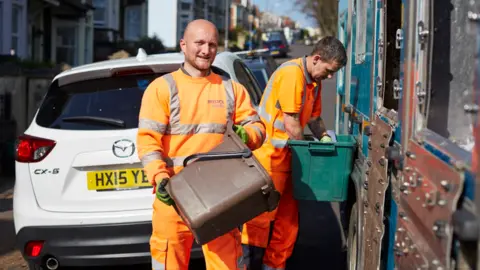
Waste and recycling companies have urged householders not to put crews at risk when disposing of hazardous items.
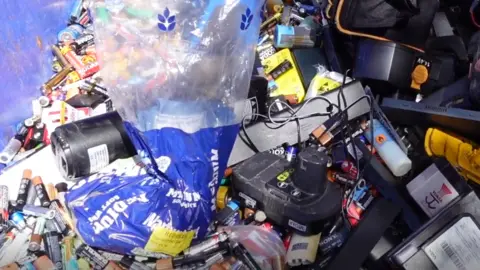
The warning comes after a fire in a refuse collection truck run by Bristol Waste Company (BWC) - believed to have been caused by a battery or gas cannister incorrectly placed in with non-recyclable waste.
The GMB union said the growing use of weight-loss injections had also created "a new and worrying risk" for workers after a member was injured by a needle stick.
Residents in Bristol and Gloucestershire are now being encouraged to check they are fully aware of guidance on the safe disposal of domestic hazardous material.
Waste collection teams in Bristol handle 23 million collections each year.
External communications manager Hannah Deas said contamination was always a potential risk.
"Contamination in a nutshell is a thing in the wrong bin. It might be a nappy in amongst your food recycling; it might be a tin in amongst the glass," she said.
"Some contamination is just a bit fiddly, but some of it can be really dangerous."
'Nasty chemicals' in vapes
"A couple of years ago, suddenly everyone was getting rid of disposable vapes, which we haven't had to deal with in the past.
"I think in the UK, there are now about six to eight million vapes disposed of every week and each one of those vapes has a battery in it.
"A battery is a little case of nasty chemicals that can cause explosions, that can cause fires, that can cause corrosion damage and can pollute the environment."
 Bristol Waste Company
Cotswold District Council said waste crews had encountered items such as nappies, dog waste and used tissues in food waste collections.
"We have also seen incidents such as needles placed in recycling sacks," said Andrea Pellegram, cabinet member for environment and regulatory services.
"Crews often find broken glass in recycling boxes, which has resulted in facial cuts to operatives when items ricochet out of waste vehicles during tipping."
The disposal of vapes and nitrous oxide cannisters has also "raised significant concerns within the industry" according to Cheltenham Borough Council.
"Vapes contain lithium-ion batteries that can ignite if crushed or damaged, while nox canisters can cause explosions if mixed with general waste" said a spokesperson.
Meanwhile, Stroud District Council said it had introduced a new col+lection method which avoided crushing batteries and helped reduce the risk.
The GMB union said the incorrect disposal of weight-loss injection needles was a "serious health and safety issue".
The union said it was calling for clearer public messaging and better disposal systems - such as sharps collections for medical instruments and other hazardous waste, which are colour-coded to indicated the type of waste they contain.
"Workers need to know that their wellbeing matters, and employers must take responsibility for reducing the risks faced on every shift," said the spokesperson.
 Bristol Waste Company
Deas said that BWC staff had received training on how to deal with sharps but the risk of injury was increased if items were incorrectly disposed of.
"They've got the PPE, they've got the kit to keep them safe, but all within the parameters of what they're expecting to be in each container.
"I hope that people looking into any sort of medical sharps will take it very seriously and will follow all the rules for safe disposal."
Follow BBC Bristol on Facebook, X and Instagram. Send your story ideas to us on email or via WhatsApp on 0800 313 4630.
