Island seabird numbers soar after rats eradicated

 Annabel Sharpe, RSPB
The number of puffins and other seabirds has soared on an island 20 years after it was declared "rat free".
Efforts to clear Lundy Island in the Bristol Channel of invasive rats, which prey on birds, eggs and chicks, were officially declared successful in March 2006.
Twenty years on, organisations have revealed it is now home to more than 40,000 seabirds including puffins, razorbills and guillemots – the highest number recorded since the 1930s.
Derek Green, Lundy's managing director, described the recovery as "one of the UK's great conservation success stories" but conservationists say their efforts must continue.
The number of Manx shearwaters on Lundy has increased from under 600 birds in 2001 to more than 25,000 today, making it home to 95% of the birds breeding in England.
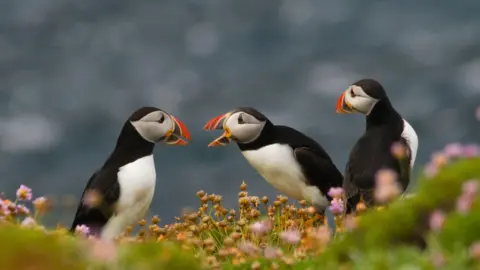
Puffins meanwhile have recovered from the brink of extinction, with numbers increasing from just 13 birds on the island in 2000 to 1,335 now.
Species that had seemed entirely lost to predation by rats on the island have also returned, the conservationists said.
The seabirds are counted by the Lundy Island team, looking at the number of nest sites, fledgling chicks and counts from land and sea.
Ben McCarthy, head of nature conservation at the National Trust, said eradicating rats from the island was "a remarkable achievement made possible through strong partnership working and bold, ambitious thinking".
"The island's ongoing commitment to biosecurity has helped keep the island rat-free, and the results for seabirds have been truly astonishing," he added.
 Getty Images
Lundy's seabird numbers plummeted from an estimated 80,000 in 1939 to 7,351 in a survey in 2000.
A partnership between the RSPB, Natural England, the National Trust and the Landmark Trust was formed in 2002 to deal with rats – identified as the primary threat to burrow‑nesting birds such as Manx shearwaters and puffins – which had been inadvertently introduced via ships and shipwrecks.
The island was declared rat-free four years later - with numbers counted by the project team at the time - and ongoing biosecurity and long-term monitoring have ensured it has stayed that way.
Such biosecurity includes preventing rats coming onto the island via boat through various cargo checks on board, as well as regular checks of monitoring stations across the island.
These check points have a chocolate wax block inside, checked for bite marks.
Visitors are also urged to report any signs of rats on the island or their boat, with an Island Response Team ready to control any new rat incursions if one is ever sighted.
Helen Booker, RSPB senior conservation officer, said if restoring more than 40,000 seabirds on a single island was achievable, "just imagine what could be done for nature across the UK if we scaled up this ambition".
She added: "These remarkable results reinforce the need for Lundy to be designated as a Special Protection Area to safeguard seabirds at sea as well as on land."
Follow BBC Devon on X, Facebook and Instagram. Send your story ideas to spotlight@bbc.co.uk.
