Why the battle for the green belt matters so much to communities across the country

 Save Our Fields/Facebook
Across the country, the signs have gone up in dozens of locations along the same theme: "Save Our Green Belt".
Yet ministers insist more homes must be built, councils warn they have little choice and developers argue that parts of the green belt are no longer the untouched countryside many imagine.
"We don't need these lovely fields and pastures covered in concrete."
Lee Fowkes lives in Hagley, a village in Worcestershire, near Birmingham but with a belt of countryside between the two.
He has lived in the area for 26 years and said one of the key reasons was being near local green belt areas.
"Losing the green belt here would be terrible," he said.
A flurry of planning activity that began last summer threatened otherwise, as proposals for about 180 homes were drawn up at the southern edge of the village.
The moment the consultation document appeared, Fowkes said he and other residents decided to act, forming the Save Hagley Action group to oppose them.
"It just felt wrong really. We've already proven the local infrastructure can't cope. Our hospitals are full," he said, adding people in the village just felt the size of the plan was unfair.
"There are plenty of disused brownfield sites that could be developed first," he added.
Developers Ashberry Strategic Land and Bloor Homes say their plans will still include a big area of green space along with open spaces and meet local needs for more homes.
 Hagley Action Group
It is that issue, the demand for more homes against the demand to protect the green belt, which campaigners say, once built on, is gone forever.
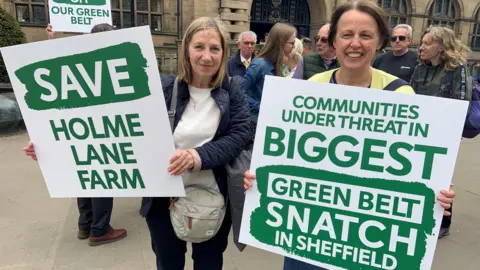
The Hagley campaign mirrors many across the country, including in Shropshire, Dudley, London and Sheffield, fighting for their voices to be heard.
For many campaigners, they say the green belt is more than open countryside, instead being a buffer between towns and cities, preserving the character of communities.
Their fears are not just that homes will be built, but once those boundaries begin to shift, changes cannot be reversed.
The idea of a green belt emerged in the early 20th Century and became embedded in the post-war planning system as a way of preventing urban sprawl and preserving open land around towns and cities.
After World War Two, the Town and Country Planning Act 1947 created the modern planning system, allowing councils to ring-fence land around towns and cities, leading to the later designation of green belts nationwide.
For decades, those protections remained largely unquestioned but the housing crisis and falling rates of housebuilding brought renewed scrutiny of whether some green belt land should be released for development.
Developers, housing campaigners and ministers argued that an undersupply of housing over decades meant many young people cannot get on the housing ladder.
Two years ago, the new Labour government, as part of a pledge to build 1.5 million homes, revealed plans to overhaul England's planning rules.
The then-Housing Secretary, Angela Rayner, laid out proposals to make it easier to build on low-quality green belt land, reclassified as "grey belt".
"We are in the middle of the most acute housing crisis in living memory," she added.
But the countryside charity CPRE, the Campaign to Protect Rural England, argued "targeting the green belt is a choice, not a necessity".
 Save Our Fields/Facebook
In Warwickshire, a small WhatsApp group of residents started to light up last year, as news emerged of plans for 700 homes on green belt land.
Malcolm Lines and others set up their own campaign group, Save Our Fields, raising money to fight against the proposed development near Kenilworth Castle.
"It's the loss of historic land," he voiced for the group's feelings. "It's just the wrong place - it's unsound, unviable land. It's just not sustainable."
Their main concern is that it would be "harmful" to the surrounding heritage and the castle itself.
"Once you start to release green belt land, you start to coalesce with other settlements," Lines sighed.
"Once you release the hard line, you make future developments much less sustainable."
One developer involved in the plans previously said it was "appropriate to explore" whether the sites met local housing needs.
