'We have to find a cure for Huntington's disease'

 BBC
BBCRomy Kerschbaumer was 48 when her life changed forever after she started getting symptoms of Huntington's disease.
She was forced to medically retire from the job she "absolutely loved" setting IT strategy for a government department in Jersey.
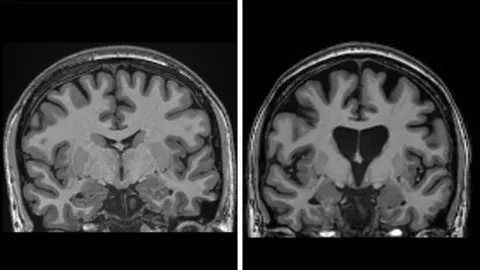
Huntington's disease relentlessly kills brain cells and resembles a combination of dementia, Parkinson's and motor neurone disease.
"It was terrifying because there was no cure," said Romy. We really need a cure desperately."
About 1 in 10,000 people in the UK have Huntington's disease which is caused by an error in part of the DNA called the huntingtin gene.
The first symptoms of the disease tend to appear when sufferers reach their 30s or 40s.
Symptoms of the disease affect a person's mind, mood and mobility and it is normally fatal within two decades.
If a parents has the disease, there is a 50% chance their children will inherit the altered gene and eventually also develop Huntington's.
Romy said she had seen her parents and other family members "suffer so much" due to the illness.

When she was first diagnosed in 2016, Romy tried not to allow the disease to affect her family's daily life and continued to take her daughter Sofia to dancing and her son Joe to football.
"We carried on and were brave about it," she said. "Because what's the point of just ruining every day?"
But Romy said the disease had "massively" affected her life more recently.
Her two adult children, who live at home to care for her, said they had become "a bit more hands-on" as there were "things Mum can't do anymore".
"I just do the very minimum, because it's taken a lot," Romy said.
She said living with Huntington's had affected her emotionally and psychologically but it had not affected her "Austrian spirit", which "wouldn't be crushed".
Sofia, 21, said her Mum was her "hero" and "the bravest person in the world."
"We're best friends, two peas in a pod. She just means the world to me.
"Just seeing what she goes through every day is so motivating."
"When Mum has her bad days, that's when we have our bad days, because seeing her upset or in any pain or discomfort kind of puts us in the same way."
She added: "We obviously get really upset and emotional but I think we all try and not show that in front of Mum because we want to be as strong as her."
 UCLH
UCLHRomy said she had "a lot of support" from her best friends although, as a private person, she had been unwilling for a number of years to speak publicly about her diagnosis.
But she had recently made social media contact with other people living with Huntington's disease and created a WhatsApp group for them.
"Since I've started that journey, it's really benefited me emotionally," she said.
She said she had received "great support" from her GP but there was no Huntington's disease specialist doctor in Jersey.
Sofia added a new consultant neurologist had "only recently" started working for Jersey's health department, after the previous one retired.
"Other than kind of adjusting mum's medication we've not had a great deal of support," she said.We don't know what we're missing, really."
"I think this is why it's so important for us to talk about this, so that people learn more about it."
Jersey's health department has been approached for comment.
'The hope is incredible'
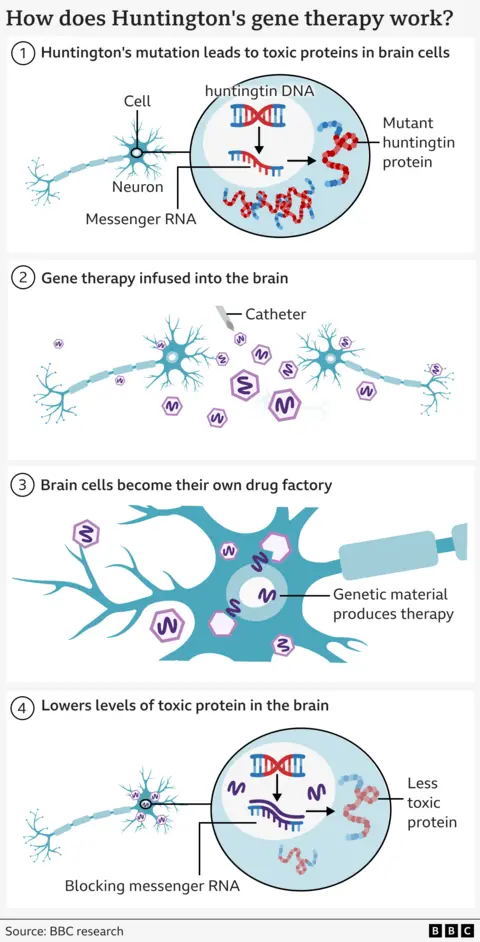
Last year, Huntington's was successfully treated for the first time, after doctors at University College London found a gene therapy which slows the progression of the disease by 75%.
Romy said news of the trial had left her feeling "elated".
"The hope is incredible and it really keeps me going on darkest days," she said.
"I want more people to be able to experience that and not have to have the fear and terror of this in their families."
Sofia added: "It does make us a bit lost for words, because it's a chance for people in the younger generations to not have to go through what we've been through."
Cath Stanley, chief executive of the Huntington's Disease Association (HDA), said the breakthrough had "created a lot of excitement, a lot of opportunity, however there is still an awful long way to go."
She said that she was hopeful "many other research opportunities will follow".

Inspired by her mum, Sofia plans to run the London Marathon for the Huntington's Disease Association next year.
"I want to raise as much money as I can for people in our situation, because you do just feel so alone in these things.
"It's a really positive thing for Mum to focus on every day. She's just excited about what can we do to raise more money."
Follow BBC Jersey on X,Facebook and Instagram. Send your story ideas to channel.islands@bbc.co.uk.
