Will English status prevent a whisky wild west?

 PA Media
English Whisky has been recognised as a distinctive spirit with stringent rules on its production, just like those made in Scotland, Wales and Ireland. But voices of dissent north of the border claim the regulations are unfairly relaxed compared with those in Scotland. What does the oldest English whisky producer, based in Norfolk, make of it all?
What has changed?
 John Fairhall/BBC
Put simply, only whisky made in England is allowed to call itself English Whisky.
It joins the Cornish pasty (only to be made in Cornwall) and the Melton Mowbray pork pie (you get the idea) and more than 1,700 food and drink products that have been afforded Geographical Indication (GI) status by the Department for Environment, Food & Rural Affairs (Defra).
The new status came after years of work by the English Whisky Guild. It called it a "landmark achievement" for a sector which has grown from one distillery in Roudham, Norfolk, 20 years ago, to 70 and counting across the country.
Why has it been controversial?
 Loch Lomond Group
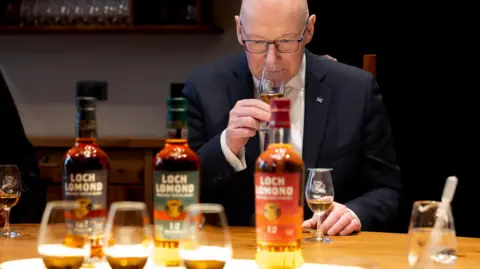
To attain the definition, English single malt whisky needs only to be distilled at one site, while mashing and fermentation can take place elsewhere - unlike for producers of Scotch.
The Scotch Whisky Association was firmly against this key point of difference.
They argued that allowing the English industry to use the term for its alcohol "would really damage the integrity of the single malt category and with it, the reputation of the Scotch whisky industry."
Politicians also had their say.
Mairi Gougeon, Scotland's cabinet secretary for rural affairs, said anything that undermined the reputation or definition of the term single malt could be "devastating" for the Scotch whisky industry, which exported £5.4bn of goods last year.
What do English makers say?
 Mousumi Bakshi/BBC
The English Distillery was the first in England in 100 years when it set up in 2005.
It is unusual in that its single malt whisky is mashed, fermented and distilled all on one floor at its purpose-built site at Roudham, between Attleborough and Thetford.
"There are plenty of others, not just in England, but everywhere else, including Wales, that have the brewing part of it, if you like, the mashing and fermenting, done off-site," said owner Andrew Nelstrop.
"The end result is all the same."
Nelstrop pointed out that other rules differed for English Whisky. The spirit could be matured in wood and not specifically oak, as in Scotland. Grain used by English distillers has to be grown in the UK, while Scotland is allowed to use imports.
Scotch whisky must be bottled in Scotland but English Whisky can be bottled elsewhere, which Nelstrop said had an environmental and cost benefit when exporting around the world.
"There has to be some difference between a Scotch and an English," he added.
"If we had exactly the same rules, there wouldn't be a lot of point to having the rules at all."
He said he believed the all-on-one site argument was the only element that had "caused a bit of angst".
Asked if the Scottish sector was being overly sensitive, he said: "I think so."
"There is nothing we are doing that is going to reduce the public perception of the quality of single malt and I think we've proved that by the amount of awards that we all get," he added.
"Undoing what we've done removes all the rules, all the safeguards, and allows the Wild West to appear."
What difference will it make?
 Mousumi Bakshi/BBC
The English Whisky Guild said the status gave legal protection and greater confidence and clarity for consumers, and supported UK agriculture.
Echoing this sentiment, Environment Secretary Angela Eagle said the "milestone" would bring "jobs, investment and pride to communities across the country".
But what about the whisky itself?
"I don't think there'll be any cataclysmic change in what we do," said Nelstrop.
"English whisky is, in the world of whisky, now recognised as a good product.
"This [status] ensures no one can cheat the system.
"Without it, there's nothing stopping someone importing cheap whisky and calling it English whisky."
Annabel Thomas, founder of Nc'nean Whisky, made at a small distillery on the Scottish west coast, said the status could actually be a boon for Scotch.
She told BBC Radio Scotland that makers should be proud and confident of their own "incredible product, long regarded as the best in the world".
"I think we should be focusing on getting that out to more consumers... rather than looking too much over our shoulders at our neighbours," she added.
Do you have a story suggestion for Norfolk? Contact us below.
Follow Norfolk news on BBC Sounds, Facebook, Instagram and X.
