Bat expert who lost part of her brain finds new species

 Nancy Irwin
"I had more fractures in my face than could be counted easily. I lost a section of my skull, I have plastic behind my eyes and metal plates in my head. I got gangrene of the brain, so I had to have a portion of my brain removed."
Dr Nancy Irwin, from Glossop in Derbyshire, was a bat expert four weeks away from completing her PhD when a life-threatening accident in Gabon in 2002, when she was 28, put her career on hold.
At the time working for an oil company, she and her husband took a boat trip with the World Wildlife Fund (WWF). They were struck by another vessel, which made direct contact with her head, throwing her into a lagoon.
The next 48 hours were critical for her survival.
A helicopter was sent from the Republic of Congo by the oil company, and this evacuation saved her life.
"I wouldn't have survived the morning to wait for lights at the airstrip, and so they took me to a French oil platform where there was a European medical team," she said.
 Nancy Irwin
They originally planned to fly her to Europe, but her deteriorating condition meant she was evacuated to South Africa instead, and ended up at a hospital in Johannesburg that specialised in complex trauma.
Following a long recovery in which she had to learn to read and walk again, Irwin eventually returned to academia in 2009 at the University of York.
"I spent eight years in rehab, learning to walk, talk, manage being a disabled person," she recalls.
"I've lost something called proprioception, so that means I don't know where I am in space and I can't see moving cars.
"I was so close to finishing my PhD, and then after eight years of not doing science, you get a bit out of date, so I needed an opportunity to relearn and finish my PhD."
Irwin's return was supported by a fellowship from the Daphne Jackson Trust, a charity that supports STEM (science, technology, engineering, and mathematics) professionals returning to research following a career break.
"It was an absolute lifeline," said Irwin. "It's full of a bunch of people who have had caring responsibilities for parents or children.
"There's a whole cohort of highly trained scientists who, for whatever reason, they step off the path, that doesn't stop them being highly trained to be able to come back and contribute to the economy."
 Deb Wright
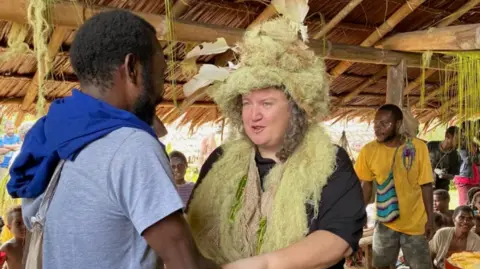
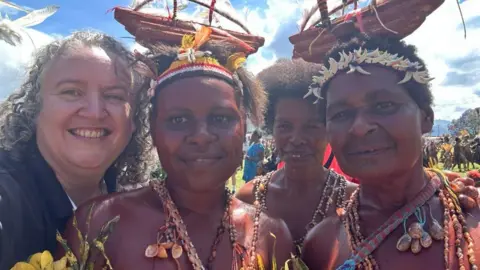
Following her recovery, Irwin spent much of her career working in Papua New Guinea, where she founded a vanilla and cocoa export company and also worked in protecting rainforests from deforestation.
"I academically got interested in saving rainforests and trying to put an economic value on rainforest that wasn't just the timber, but also was disease prevention," she said.
"I realised that there was a movement in emerging diseases to classify and sequence diseases like viruses, like Zika and Covid and it looked to me the outbreak was related to habitat destruction.
"So if you destroy an environment, animals move, they become in contact with a domestic animal, and then you get outbreak."
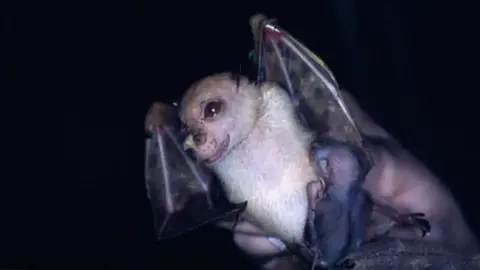
In 2017, Irwin registered a new species of fruit bat found in the country nicknamed as the "Yoda" bat due to its resemblance to the Star Wars character.
The bat, renamed "the happy tube-nosed fruit" bat due to its smiling appearance, was discovered by Irwin in a remote rainforest.
"When you describe something new, you have to make sure there's nothing else in the world that was described and forgotten about in a museum somewhere," she said.
"Eighty-five per cent of [Papua New Guinea's] population lives in rainforest, they don't have power, they don't have TV and I felt it was inappropriate to name a bat after a Star Wars movie that they have never seen."
 University of York
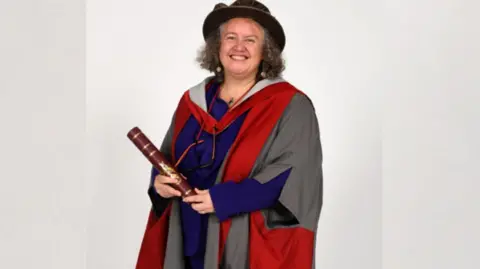
On 20 July, Irwin was awarded an honorary doctorate from the University of York for her work on sustainability, something which she sees as a great achievement.
"I'm the first [Daphne Jackson] fellow who's ever received an honorary doctorate.
"A trust and a university collaborated to fix one broken student and I combined those skills that I did not know I had and a rainforest is still standing because of it," she said as she closed her speech to students at their graduation ceremony.
"Every day is a gift, be brave and whenever it gets hard ask the question: 'Is it fatal?' And if it's not, get on with it."
Listen to BBC Radio Derby on Sounds and follow BBC Derby on Facebook, on X, or on Instagram. Send your story ideas to eastmidsnews@bbc.co.uk or via WhatsApp on 0808 100 2210.
