Firm eyes land speed record with digger engine

 JCB
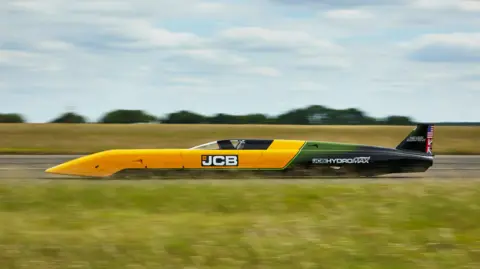
JCBA Sussex-based engineering firm says it wants to show off hydrogen power as part of efforts to break a land speed record - with a digger engine.
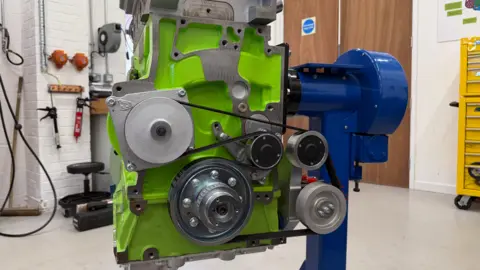
Ricardo, from Shoreham, West Sussex, has turned a 74 horsepower (hp) JCB hydrogen engine which powers construction vehicles into an 800hp engine capable of a record attempt.
Two of the engines, one to power the front wheels and one for the back wheels, will be put into the JCB Hydromax car being built by Banbury-based firm Prodrive to attempt the land speed record in August.
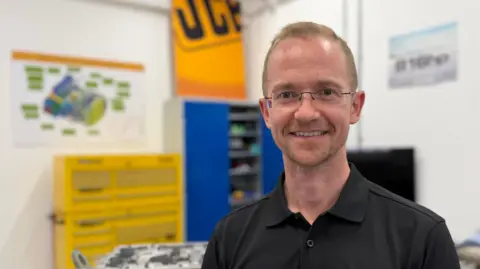
Ben Hassett, chief programme engineer at Ricardo, said: "It's a really good way to demonstrate hydrogen as a reliable, realistic and exciting clean alternative to diesel."
 Danny Pike / BBC
Hassett added: "Hydrogen power isn't ready for the consumer market just yet, but it has a real application on heavy duty machines.
"It may well filter down to consumers, but one way to drum up interest is to break a land speed record."
With the engines being flown out to Utah's Bonneville Salt Flats, the company hopes its car will hit 350 mph (563 km/h), beating the current diesel record - nearly twice the 187 mph (301 km/h) record for a hydrogen-powered vehicle.
JCB already holds the 350.092 mph (563.418 km/h) diesel land speed record, which was set in 2006.
 Danny Pike / BBC
Testing for the car was also carried out at RAF Wittering, where the car hit 208mph (334.744 km/h).
Records are measured with an average speed over the space of one mile, but the car could have as much as nine miles of space to get up to speed.
The new car will be driven by Andy Green, a pilot who was also behind the wheel of the rocket-powered outright land speed record-breaking car, which hit 763.035 mph (1,227.985 km/h) in 1997.
Follow BBC Sussex on Facebook, X, and on Instagram and listen to BBC Radio Sussex on Sounds. Send your story ideas to southeasttoday@bbc.co.uk or WhatsApp us on 08081 002250.
