Aberdeen's failed hydrogen bus fleet cost almost £14m

 BBC
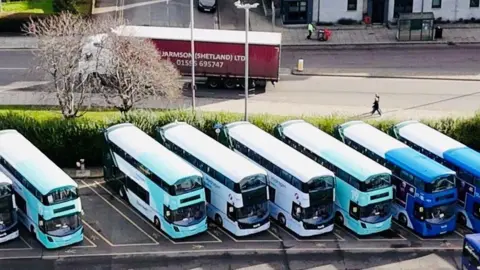
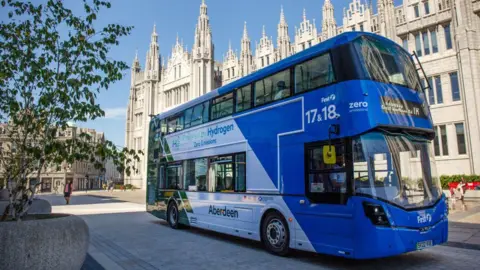
BBCThe world's first hydrogen double-decker bus fleet which was ditched in Aberdeen cost almost £14m, figures have revealed.
The project involving 25 buses was aimed at being the future of clean public transportation, with the city billed as the global hub for hydrogen-powered buses.
However in February the city council announced it was the end of the road for the initiative, electing for electric vehicles instead.
Following a freedom of information (FoI) request by STV, the council has now said that the bus fleet cost about £13.9m.
The city council and oil and gas giant BP became commercial partners in 2022 to take forward Aberdeen's hydrogen ambitions.
However the buses had been out action since September 2024, due to problems with fuelling stations at Kittybrewster and Cove.
The council then announced it was to drop the fleet in favour of electric vehicles following a meeting of its urgent business committee.
Asked how much Aberdeen City Council had spent buying the buses, the local authority said: "The 25 vehicles currently in the city were procured in two tranches.
"The total purchase cost was approximately £13.9m across the fleet."
 Getty Images
More and more cities have opted for the battery alternative for buses.
In 2021, First Bus in Glasgow confirmed that it was investing in a fleet of 120 single and double-decker buses which could be charged very quickly overnight before spending 18 hours on the road.
More recently, the electric inter-city bus operator Ember has seen its fleet in Scotland grow to about 100 vehicles.
Battery capacity and efficiency has improved, meaning electric buses can be charged quickly and cover long distances.
They cost more than the diesel equivalent, but running costs are low, meaning operators are saving money from the moment the vehicles take to the road.
Mixed fortunes for Scotland's hydrogen projects
Hydrogen has often been touted as an environmentally-friendly future fuel because when burned the main by-product is water vapour - and there are no CO2 emissions.
While not all hydrogen production methods are eco-friendly, it is possible to make "green hydrogen" through a process called electrolysis - where electricity from renewable sources is used to split water into hydrogen and oxygen.
Scotland currently hosts the UK's only large-scale trial of using hydrogen for domestic heating - the H100 project in Fife where 300 homes have been offered hydrogen boilers, supplied by a bespoke gas network.
The future of the scheme, however, looks uncertain as the UK Climate Change Committee stated last year there was "no role for hydrogen in domestic heating".
Two similar pilot schemes in villages in England have been cancelled.
Scotland had previously played a leading role in a project with European partners to investigate the use of hydrogen as a fuel for shipping.
The Hyseas project culminated in a design for a hydrogen-powered small ferry for Orkney - but it never got beyond the drawing board.
The Norwegians, who were also partners in the project, did take the work forward however, and Norway is now a world leader in hydrogen-powered ships.
There is more optimism in the aviation sector with a US start-up ZeroAvia planning to build a Hydrogen Centre of Excellence and manufacturing facility near Glasgow Airport.
Loganair, Scotland's largest regional airline, has signalled it wants to deploy hydrogen-powered aircraft once certified.
The big problem hydrogen faces is that making it from electricity currently uses far more energy that just storing that energy in a battery - and battery technology is advancing rapidly.
