Chance of wildfire ignition 'never been so high'

 Devon and Somerset Fire
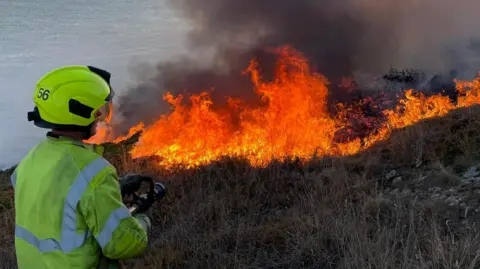
A wildfires expert says she has never seen the UK be so at risk of a fire breaking out as the area experiences a record-breaking heatwave.
Claire Belcher, who is an Exeter University professor, explained a fire prediction system built by a group of universities recorded the likelihood of a fire being ignited by a spark in Somerset at 100% on Wednesday.
"If you had an ember from a bonfire or a barbecue or a spark perhaps from agricultural machinery or something, there is a extremely high chance it could start an ignition," she said.
Earlier this week, Natural England asked people to dispose of cigarettes responsibly and not use disposable barbecues in wild areas amid an "exceptional" fire risk.
A hedgerow blaze which broke out in Somerset on Saturday was one of a number of fires seen in England and Wales in recent days.
"We [England] haven't been a typically fire-prone country, but northern temperate landscapes are becoming much more fire prone now," Belcher added.
Dry weather does not, on its own, cause wildfires - there needs to be a source of ignition too, such as a spark from a barbecue or a discarded cigarette.
But the continued hot and dry weather, coupled with strengthening winds and lower humidity, is accelerating the drying of vegetation, increasing the risk of fires.
Mark Humphrey, who is the chair of the National Farmers' Union in Somerset, said farmers were "very anxious" about the situation.
"We're very on edge about the risk of wildfires at the moment with the two weeks of really hot weather.
"All it takes is a spark off one of the combines in a field and that could be that. The crops are so dry at the moment so we're being very careful," he said.
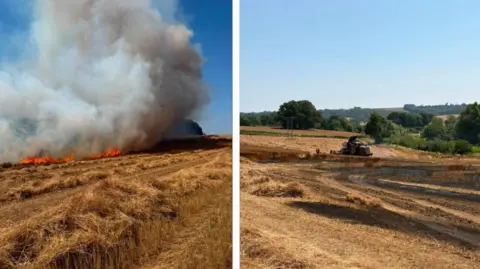
On Tuesday, fire crews responded to a combine harvester vehicle fire at Compton Pauncefoot, near Wincanton in Somerset.
Devon and Somerset Fire and Rescue said the cause was accidental and the field was damaged.
Humphrey, who farms near Ilminster, added those in the profession had noticed weather patterns changing.
 Devon and Somerset Fire
"Back in the spring it was about flooding and the impact and here we are only four months later talking dry weather.
"For our cattle we're also feeding some of our winter feeds already, to look after them and bring in extra food. I don't think there's any let up in the forecast at the moment," he added.
Tim Parish has been a ranger on Exmoor for 24 years and said the UK had to "adapt" to changing weather patterns.
"I think the biggest changes I've seen is the shift in when you see fires. Traditionally speaking on Exmoor, you tend to see fires in February and March being the classic time.
"We do tend to normally get huge amounts of rain, so things don't burn and that's been the biggest shift.
"We are suddenly getting these long, dry spells and that is when most people are out visiting, when most people are out enjoying the countryside," he added.
Follow BBC Somerset on Facebook and X. Send your story ideas to us on email or via WhatsApp on 0800 313 4630.
