After record heat, could the Atlantic make Britain's weather even more extreme?

 BBC
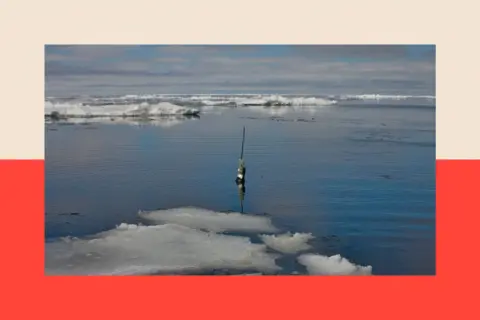
BBCSomewhere in the stormy waters off Greenland, a bright yellow robotic probe, known as an Argo float, is sinking silently beneath the waves.
It is roughly the size of a person, with a tough metal body and an array of sensors packed inside.
The float is part of a global effort to solve one of the great mysteries of the ocean: how its hidden movements help shape the climate above.
There is no crew, no one steering it. Instead, it drifts with the currents, measuring temperature, the amount of salt in the water and pressure as it moves through the waves.
When it rises, it briefly breaks the surface and sends its data home by satellite. Then it does it all again. Dive, drift, measure, surface, transmit. The question those floats are helping investigate is one of the most important - and most contested - in climate science: whether one of the world's great systems of ocean currents is beginning to change.
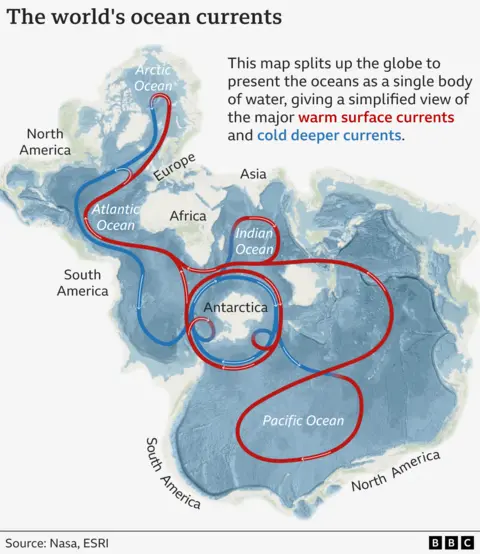
It is called the Atlantic Meridional Overturning Circulation, or AMOC - a vast, north-south system of currents that carries warm surface water towards the Arctic and returns colder water thousands of miles south through the deep ocean.
 Argo
ArgoBut scientists say the AMOC is under pressure. Most agree it is likely to weaken as the planet warms. The UK government has said that, as "a key component within the Earth's climate system" the AMOC contributes to the UK's long-term climate risks.
The disagreement is over how much and how fast the current could change, what that would mean for the weather and crucially, whether the seasons we know today could begin to change.
A current under pressure
The question matters because the AMOC is part of a vast heat-moving system that influences the climate far beyond the Atlantic. But for the UK and north-west Europe, its influence is much closer to home: it helps shape the climate we live in and the weather we get.
The tropics receive far more energy from the sun than the poles. That imbalance sets both the air and the ocean in motion. Winds, storms, rainfall and currents are all, in different ways, the planet trying to even out that difference.
The UK sits in the middle of that exchange. Heat released from the Atlantic feeds into the air above it, helping fuel storms, steer winds and influence the pressure systems that reach north-west Europe. So, if the ocean changes, the weather can change too.
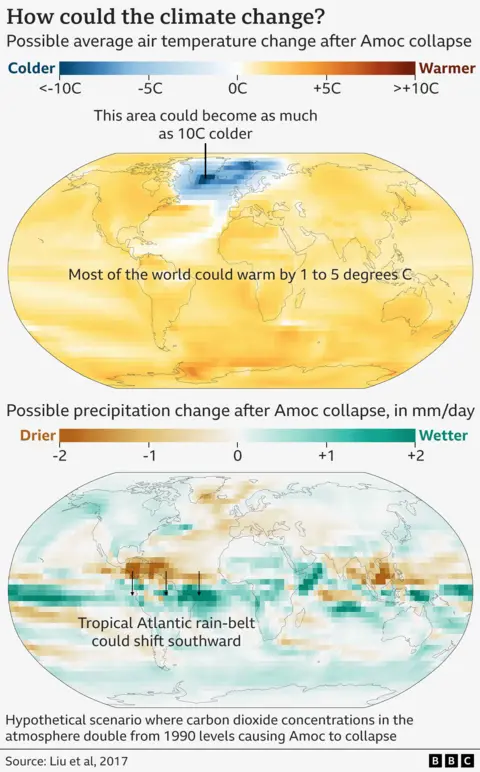
That includes a possibility that might seem bizarre in a warming world: changes in the Atlantic could bring more extreme swings in the UK's weather, including colder winters, even as average global temperatures continue to rise.
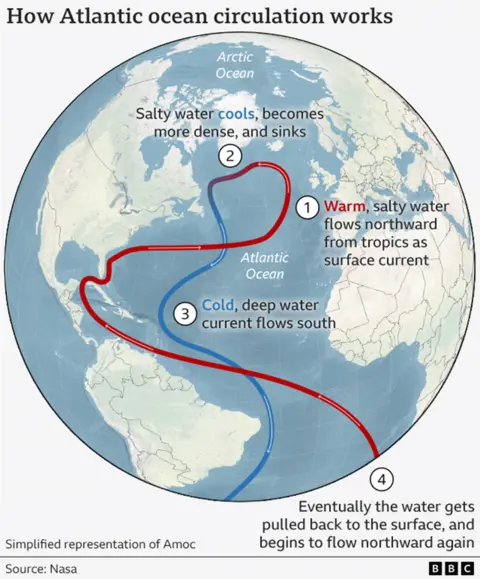
The AMOC includes the Gulf Stream and helps explain why Britain and north-west Europe are milder than their latitude would suggest. Its scale is hard to grasp. It carries about one petawatt of heat northwards - roughly 50 times the total energy humanity uses.
Some researchers say the warning signs are already visible: a strange patch of cooling in the North Atlantic and changes in how salty the water is.
They point to recent studies suggesting the circulation may be less stable than previously thought - raising the possibility that it could weaken sharply or even shift into a different state. In the most extreme scenario, some scientists warn it could "collapse".
Others urge caution. They say weakening is not the same as collapse, and that the evidence may point to a slower decline or reorganisation rather than a sudden shutdown.
But if the AMOC weakens significantly, it could shift storm tracks, alter rainfall and make winters more volatile.
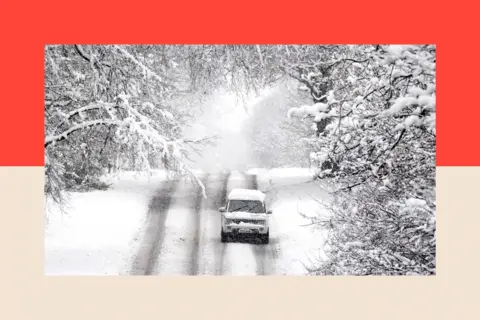
A severe weakening, or collapse, could go further, bringing colder, drier winters to the UK and north-west Europe even as the planet as a whole continues to heat up.
 PA
PAAnd the consequences would not stop at the Atlantic. The AMOC helps shape rainfall and temperature patterns far beyond Europe.
A major shift could tug at the West African monsoon, tropical rainfall belts and rainfall over the Amazon. These are not abstract changes on a map: they could affect harvests, water supplies and the livelihoods of hundreds of millions of people.
Which is why scientists are watching the ocean so closely.
A warning from history
The floats are only part of the effort. Satellites, moored arrays of sensors and research ships are gathering data from the modern ocean too.
Other clues are much older. They lie in mud, shells, ice and rock - fragments of evidence from a time when the Atlantic appears to have changed with startling speed.
New research led by University College London (UCL), for example, looked back nearly 13,000 years to the Younger Dryas, a sudden reversal in the warming that followed the last ice age.
The cooling appears to have taken hold over just a few decades. Britain and parts of northern Europe were pushed back towards colder, more hostile conditions for more than a thousand years. In Scotland, glaciers advanced again in parts of the uplands.
For the small groups of hunter-gatherers then living in Britain, it would have been a catastrophic upheaval - forcing them to adapt or retreat as the cold returned and the landscapes they depended on changed around them.
But for scientists studying the AMOC today, the real significance of the Younger Dryas is what it reveals about the Atlantic.
The new study suggests the circulation did not just weaken. It rearranged itself. The Gulf Stream shifted hundreds of miles north, sending much warmer water towards eastern Canada.
The lead author of the study, Fangjingcheng Zhu, says the study shows the Atlantic circulation can be "abruptly altered during climate change".
For Prof Stefan Rahmstorf, that is part of a much wider warning from the past.
Rahmstorf, of the Potsdam Institute for Climate Impact Research, is one of the world's leading experts on the AMOC. He has spent more than three decades studying the stability of the Atlantic circulation. From the start of his career, he says, he was interested in what ancient climate records revealed about abrupt changes in the North Atlantic currents.
The lesson, he says, was that "the paleoclimate evidence actually doesn't suggest that climate change would happen smoothly, but rather in some jumps and jolts and non-linear effects".
But for years, Rahmstorf treated an AMOC shutdown as a low-probability, high-impact risk. Serious, but unlikely.
That has changed.
 Zoomedia/PA
"In the last five years or so," he says. "I really unfortunately had to change my view about the probability of this happening."
His argument begins with seawater. The AMOC depends on dense water sinking in the high North Atlantic. Cold and salt help make seawater dense.
As warm, salty surface water travels north through the Atlantic, evaporation makes it saltier. Further north, it cools. Together, those processes can make the water heavy enough to sink into the deep ocean, helping to drive the AMOC's overturning flow.
Could the AMOC reach a tipping point?
Rahmstorf's concern is not just that global warming could weaken that process. It is that, beyond a certain point, the weakening could begin to feed on itself.
Warmer surface water is lighter. Extra rainfall and meltwater from ice make the ocean fresher. Fresher water is lighter too.
If the water in the high North Atlantic becomes too light, less of it sinks. If less water sinks, the AMOC weakens. And if the AMOC weakens, it brings less salty water north.
That is the feedback loop: the current helps keep the North Atlantic salty enough for the current to keep running. Less salt makes the water lighter, so it sinks less easily and the circulation weakens further.
Rahmstorf puts it more simply: "We have this AMOC because it's salty enough in the North Atlantic. And it's salty enough because we have the AMOC. So that's a self-sustaining system."
That helps explain why one patch of ocean has attracted so much attention.
In a warming world, the ocean surface is expected to warm. But south of Greenland, part of the North Atlantic has stubbornly refused to follow the global pattern. On climate maps, it appears as a strange blue smudge in a sea of red - the so-called cold blob.
For Rahmstorf, the cold blob is one of the clearest fingerprints of AMOC weakening. If the current is carrying less warm water north, that region would be expected to warm less than the rest of the ocean - or even cool.
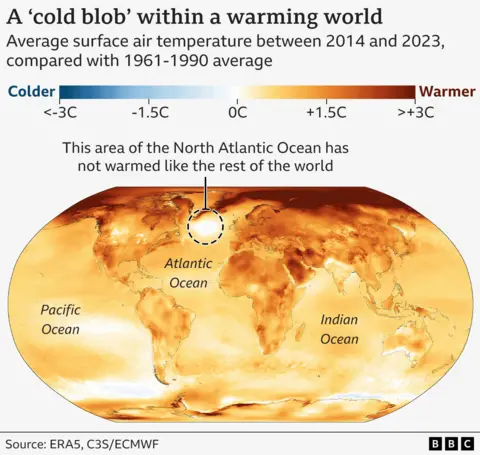
He says the temperature signal is only part of the story. The same region is also becoming less salty, and other studies point to changes in the Gulf Stream and signs that parts of the North Atlantic are being renewed more slowly.
"There are quite a few independent lines of evidence," he says, "that point to an AMOC slowing already well before the measurements in 2004 began."
But that is also where the caution begins. Because continuous direct measurements of the AMOC only began in 2004, the longer-term case still depends heavily on indirect evidence.
The next question is more frightening. Is the AMOC simply weakening, like a dimmer switch being turned down? Or can it flip into a different state?
Rahmstorf believes the tipping-point risk is real. He says the underlying physics was first shown in simple models decades ago and has appeared repeatedly since. "Every single climate and ocean model that has been tested for this tipping point has found it," he says.
That does not prove collapse is imminent. But for Rahmstorf, the difference between weakening and crossing a tipping point is crucial.
"Once we have crossed the tipping point," he says, "we can't do anything to stop the further shutdown."
The process would become self-amplifying, he argues. "And so basically we're losing control."
For Rahmstorf, the past shows the Atlantic can shift suddenly from one state to another, while the modern ocean is already showing warning signs of the system reinforcing its own decline.
But not all scientists read the evidence the same way.
The case for caution
Prof Andrew Watson, of the University of Exeter, is one of Britain's leading ocean scientists. A Royal Society Research professor, he has spent decades studying the ocean's role in climate.
Watson does not dismiss the risk. He agrees the AMOC has shifted before. "Clearly, its behaviour has changed in the past," he says. "So there's every chance that it can change again."
But he is wary of drawing too straight a line from the ice age to today - or of imagining the AMOC as a single conveyor belt that simply switches off.
The AMOC is part of the same planetary heat-moving system that drives weather itself. Heat still has to move away from the tropics. Water that rises in one part of the ocean has to be balanced by water sinking somewhere else.
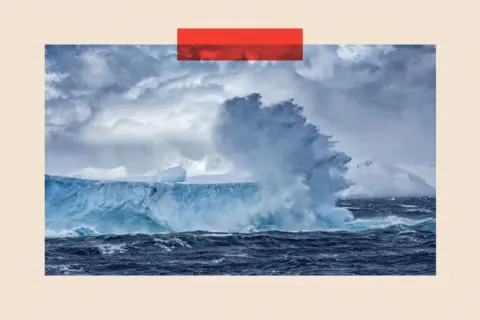
One of the great engines of that wider overturning lies far from the North Atlantic, in the Southern Ocean. There, fierce winds blow almost continuously around Antarctica, drawing deeper water up from below.
 Getty Images
So if deep water formation weakens in the North Atlantic, Watson argues, the system may not simply stop. The sinking may shift. The circulation may reorganise. Warm water may still flow north, even if less of it reaches the places where it now gives up heat and sinks.
The AMOC depends on deep water forming in a handful of places in the North Atlantic - including the Labrador Sea, the Greenland Sea and waters south of Iceland. But in the ocean, Watson says, that sinking is not a simple plughole. It happens through a combination of eddies, mixing, rotation and friction close to land.
Climate models, with grid boxes often tens or hundreds of kilometres wide, cannot resolve that detail directly. They have to approximate it. "The models are good in many other ways," Watson says, "but they're not good in this particular thing."
That does not mean the AMOC is safe. It means the evidence is complex, and the future of the system cannot yet be reduced to a simple story of imminent collapse.
More than colder winters
That caution is reflected in recent work led by the UK Met Office. In a study published last year, Dr Jonathan Baker and colleagues tested the AMOC across a range of climate models. Their conclusion was reassuring in one sense: a total collapse this century looked unlikely.
But it was not reassuring in every sense. The AMOC still weakened. And even a weaker AMOC, rather than a collapsed one, could reshape weather patterns across Europe and beyond.
Watson also points out that any AMOC weakening would unfold in a warming world. Some of the cooling influence of a weaker AMOC could be offset by the wider rise in global temperatures. Britain and north-west Europe would not be pushed back into an ice age, he says.
The effect could be more complicated: continued risk of extreme summer heat, greater exposure to cold winters, and more volatile weather generally.
 PA
PARahmstorf accepts that global warming could soften the cooling effect in average temperatures. But he argues that does not make the risk benign.
"Only the temperature impact," he says. "It enhances the drought impact for Europe, because both AMOC slowing and global warming increase drought in Europe."
And, he adds, averages can hide what matters most to people living through the changes. "This moderation may be in a climatological 30-year average temperature sense, but not for our weather."
A weaker AMOC, he argues, could sharpen the temperature contrast between northern and southern Europe - one of the gradients that helps drive storms and other extremes.
For now, the closest thing climate science has to an official judgement comes from the Intergovernmental Panel on Climate Change (IPCC), the UN-backed body that assesses climate research.
Its latest major assessment from 2021 concluded the AMOC is very likely to weaken this century, but that an abrupt collapse before 2100 was not expected.
But the IPCC does not update its verdict every time a new paper appears. Its assessment reflected the evidence available at the time.
Since then, the field has moved fast. New studies have sharpened concern. Others have challenged the methods behind some of the most dramatic warnings.
Watson says that uncertainty needs to be understood carefully.
"The basic science of climate change is very well established," he says. "But the AMOC is one of the few areas where models can disagree even when they start from the same assumptions. Normally, the big uncertainty is what people will do - how quickly we will cut emissions. Here, there is real uncertainty about how the ocean itself will behave."
The argument is over how close the system is to a threshold - and how much weight to give to each kind of evidence: ancient climate records, modern observations, statistical warnings and complex climate models.
The disagreement is also a glimpse of science doing its hardest work: weighing uncertain evidence when the stakes are high.
Living with uncertainty
Watson's instinct is to keep the uncertainty visible. For him, caution is not complacency. It is a demand for precision.
Rahmstorf draws a different lesson from the same uncertainty. He sees a risk that is low enough to remain debated, but severe enough to demand action.
"We will not have certainty before it's too late," Rahmstorf says. "So we will have to act on our uncertainty."
The science does not offer a neat ending. It offers probabilities, warnings, caveats and arguments between experts who weigh the same clues differently.
But they agree on what is driving the risk.
The AMOC is being stressed by the warming of the planet. The more greenhouse gases humanity releases, the greater that stress becomes.
Cutting emissions does not remove every uncertainty. It does not guarantee the Atlantic will behave as scientists hope.
But it reduces the pressure on a system no society can afford to push too far.
Somewhere in the North Atlantic, the floats will keep diving, drifting and surfacing - measuring a circulation that is still moving, still mysterious, and still capable of surprise.
Whether the AMOC is simply weakening, or being pushed towards something more abrupt, remains unresolved.
But the safest response is already clear.
Top image credit: Universal Images Group via Getty Images
Graphics by Erwan Rivault

BBC InDepth is the home on the website and app for the best analysis, with fresh perspectives that challenge assumptions and deep reporting on the biggest issues of the day. Emma Barnett and John Simpson bring their pick of the most thought-provoking deep reads and analysis, every Saturday.Sign up for the newsletter here
