Triple killer's consultant denies 'covering own back'

 Supplied
A consultant psychiatrist who was part of a team that cared for Valdo Calocane has denied trying to cover her back after he killed three people in Nottingham.
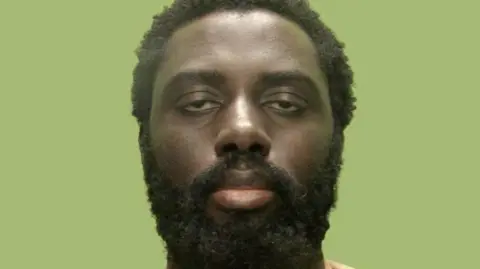
Calocane, who was diagnosed with paranoid schizophrenia in 2020, stabbed to death Barnaby Webber, Grace O'Malley-Kumar and Ian Coates, and tried to kill three others on 13 June 2023.
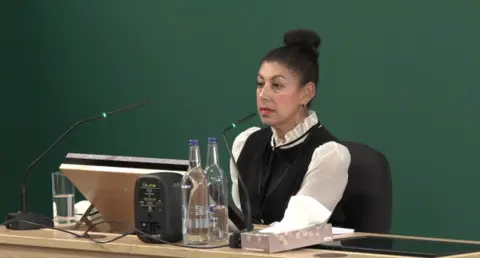
Dr Tuhina Lloyd, from Nottinghamshire Healthcare NHS Foundation Trust, said she met Calocane once in the two years he was under her care, before he was discharged in September 2022.
On Wednesday, Lloyd admitted to the Nottingham Inquiry that the team failed to engage with Calocane in the community, but said it did not have enough powers to treat him.
Calocane was referred to the Early Intervention in Psychosis team (EIP), under which Lloyd was the community consultant, in 2020, after his first detention under the Mental Health Act and subsequent discharge from a psychiatric ward at Highbury Hospital in Nottingham.
Addressing the inquiry - which is examining the killings and the aftermath, Adam Straw KC - representing Calocane's family - said: "You, quickly after the June 2023 attacks, realised you'd made a serious error by discharging VC [Calocane] into the community to his GP."
She replied: "No, it's not right."
Straw continued: "And since then your evidence has been aimed at covering your back rather than telling the truth, that's right isn't it?
Lloyd said: "That's not correct."
 Nottinghamshire Police
Previously, the inquiry heard from one of Calocane's care co-ordinators on the EIP team Gary Carter, who claimed Lloyd denied the killings could have been predicted nor prevented during a meeting.
However, Lloyd told the inquiry she did not recall discussing whether the attacks could have been prevented or not.
Lloyd had more than 20 years of experience with patients who had psychosis when Calocane came under her care, the inquiry heard.
She said following the attacks, a clinical lead at the NHS trust, Sharon Heath, asked for the Nottingham killings not to be discussed.
She said: "We were told very clearly after the incident that we should not be talking to any member of the team whatsoever, both within the service or out of the service. And I stopped that very much.
"We had to keep it all within ourselves, it was incredibly hard."
Asked during her evidence, if the attacks could have been prevented, Lloyd said: "It's a difficult question to answer.
"Predicting violence, particularly homicide, which is a rare event, is really hard at an individual level."
'We'd lost him'
In cross-examination, Tim Moloney KC, who is representing the bereaved families, questioned Lloyd over her contacting two members of her team to discuss questions she was due to answer at a tribunal into the handling of Calocane.
He said: "Isn't that what Gary Carter said, that you wanted everybody to be on the same page?"
Lloyd replied: "Many of the questions that had been put to me were things that I had not been directly involved with. For example, the discharge letter.
"We always work as a team and that's how EIP teams work - all about team working, team decision-making.
"Of course I will ask for their opinion on many of the answers, so that I make sure I give the best and most accurate answer."
 The Nottingham Inquiry
Lloyd, who at the time had almost 150 patients on her caseload, said she only met Calocane once while he was under her care.
She told the inquiry management of individuals was the responsibility of care co-ordinators.
"I had one and a half days allocated to the EIP team, that's 12 hours a week," Lloyd said. "As the consultant that often isn't time to do everything, as much as I'd like to.
"It's a continuous and repeated issue which we bring up, it's not just me, [consultants] are all in the same boat."
Speaking about the period when the decision to discharge Calocane was being discussed, Lloyd said: "We had no choice but to do so. We had run out of options.
"We'd lost him. We didn't know where he was. His family didn't know where he was.
"We felt that there was nothing else that our small team could do."
Calocane was discharged in September 2022, nine months before he carried out the attacks.
 PA Media
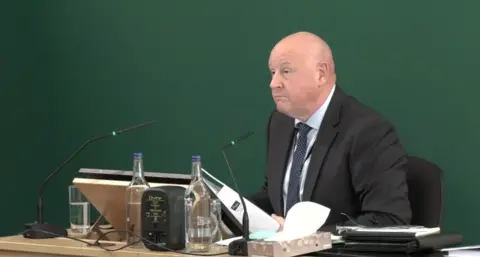
The inquiry also heard evidence from Anthony Rogers, chief inspector of His Majesty's Crown Prosecution Service Inspectorate, on Wednesday.
Calocane was sentenced to an indefinite hospital order in January 2024, after pleading guilty to three counts of manslaughter on the grounds of diminished responsibility, and to three counts of attempted murder.
The bereaved families have never been happy with that outcome, and following Calocane's sentencing, met the prime minister.
A "thorough and rapid" inspection was ordered of the case by the attorney general.
Rogers told the inquiry it was only the second inspection of its kind in the history of the organisation.
His team examined the decision not to proceed to trial for the charge of murder, and whether the families of the victims had been engaged correctly in the process.
 The Nottingham Inquiry
By late March, a 116-page report was produced, which found the Crown Prosecution Service (CPS) had applied the relevant law correctly in the charging decision over the "horrific" crimes of Calocane, and accepting his manslaughter plea due to the "clear and unambiguous" findings of psychiatric reports that he had been in psychosis.
But the report found that if the law was different, and had Parliament introduced tiers of homicide, the charge against Calocane would have differed.
Rogers said: "It would possibly have been more understandable [to the families] if it had been second degree murder, not manslaughter."
The report, Rogers said, found the CPS had "tried their best to speak to the families throughout" but recommended that in future, the CPS should change its use of the word "consult" when recording communication with families, in favour of terms such as "inform" and "explain".
The inspectorate found some communication failings in which offers of meetings between families and the CPS were not relayed by the police's family liaison officers.
The inquiry continues.
Listen to BBC Radio Nottingham on Sounds and follow BBC Nottingham on Facebook, on X, or on Instagram. Send your story ideas to eastmidsnews@bbc.co.uk or via WhatsApp on 0808 100 2210.
