Vet nurse sorry for feline felon's goggle spree

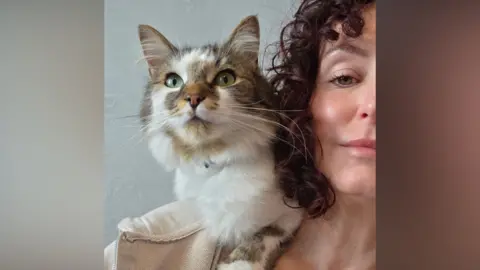 Gina Goldwater
A veterinary nurse has been asking for forgiveness after her pet started bringing home stolen swimming goggles.
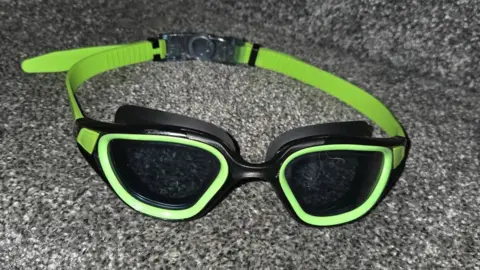
Gina Goldwater said four-year-old Sett had been pilfering the aquatic eyewear since he started going out last year.
So far he has brought four pairs of goggles back to his home in Whitehaven, Cumbria, with his owner only managing to return one.
Cumbria Police said it had received no reports of stolen goggles. Cat experts said there could be various reasons for Sett's goggle fixation.
"Last summer there were a couple of pairs of broken goggles brought in and we put the blame on his sister because she's a bit special," Goldwater said.
"But about three weeks ago the first pair came in [and] it was definitely Sett."
At the time she didn't think anything of it, but since then two sets of goggles have been deposited in the house.
 Gina Goldwater
Goldwater went knocking on neighbours' doors to try and return Sett's loot but has so far only had one success.
"They were a bit gobsmacked", she said. "I just said 'he's a special cat please forgive him', and they did."
Sett and his blameless five-year-old sister Vanellope were both adopted from West Cumbria Cats Rehab by Goldwater's son James Hurst.
"The rest of our animals hunt, but Sett isn't that clever," Goldwater said.
"He's good at hunting flies in the house, but otherwise it's inanimate objects."
'No limit to cats' interests'
Dr Jemma Forman, who has a PhD in cat cognition and behaviour from the University of Sussex, said it was not unusual for cats to steal and play with household items.
She said bottle caps, cat toys and things like crumpled paper could all be attractive, but Sett's infatuation was quite unusual.
"Goggles I was not expecting", she said.
"But if they have a certain affinity for it, they might just be more interested in that."
Feline habits are diverse according to Forman, who said there was "no limit" to what they might choose to focus on.
She suggested the smell of the goggles could be a novelty for Sett.
"If they're used in a swimming pool or the sea, [the smell] might be something the cat has never really experienced before," she said.
'Best to ignore'
Forman said breaking cat behaviour, no matter how problematic, could be difficult because felines were "very opportunistic and routine-based".
But her best advice for Goldwater was to avoid giving too strong a reaction when the thefts occur.
"Ignoring the behaviour would be ideal," Forman said.
"If the cat sees the reaction of the owner and perceives it in a rewarding way or a way they enjoy, then it might encourage the cat to do it more often.
"Repeat offences, if you will."
Dr Claudia Vinke, a behavioural biologist at Utrecht University in the Netherlands, said making sure Sett had enough playtime could also help reduce his misdeeds.
"You have to consider if you're giving your cat enough physical and mental exercise, so that the animal is not bored," she said.
"Maybe the cat is self-enriching."
Vinke said there were lots of resources available online for cat owners to create play which simulated the act of hunting prey, something which many felines enjoy.
But unsure how to reform Sett, Goldwater said if any more poolside contraband was brought into the house she would keep trying to return it to its owners.
"What else can you do?"
"Some kid somewhere might be upset because they can't go in the swimming pool."
