Warning over fading tradition of sending postcards

 English Heritage
English Heritage has warned the tradition of sending postcards "could become a distant nostalgic memory".
The charity's conservation, curatorial and learning director, Matt Thompson, said there was "something genuinely sad about the idea of this tradition disappearing".
More than half of Brits that OnePoll surveyed on behalf of English Heritage in June reported they never send postcards.
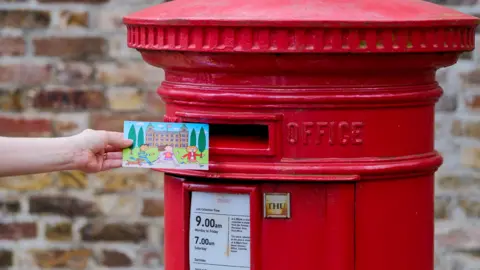
The preservation charity said it would give free limited edition postcards to children visiting 18 of its sites over the summer "in a bid to revive the once popular holiday tradition".
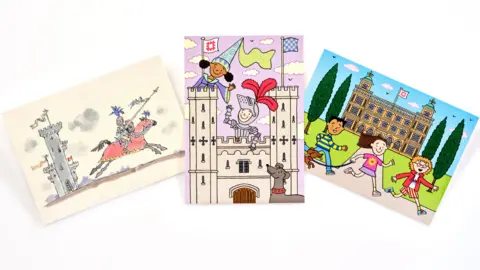
The postcards were designed by authors and illustrators Nick Sharratt and Sir Quentin Blake.
Sharratt said: "I wanted my designs to be the kind of thing a child would want to pick up and perhaps keep, but even more inspire that first trip to the postbox.
"If they do, maybe postcards have a future after all."
 English Heritage
Sir Quentin, whose works include illustrating stories by Roald Dahl, said: "In the days of knights in armour they didn't have postcards, so I do hope children enjoy mine and send him on to someone special."
The postcards were printed at Hastings-based Judges, which is the UK's last surviving postcard business.
The company's Graeme Wolford said the industry had declined from 12 million cards sold annually in the 1960s and 1970s to about 3 million sold annually in recent years.
But he added there had been a "striking evolution" where postcards had become "more of a collector's item, transforming into a mini art form".
"We still see a higher demand for postcards in summer and there's definitely been an increase in demand for those nostalgic seaside designs," Wolford said.
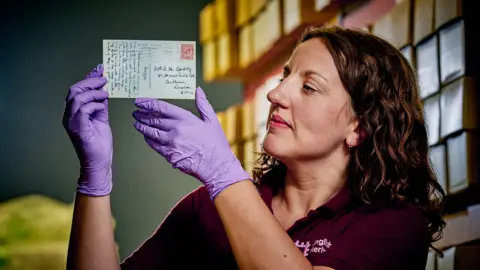
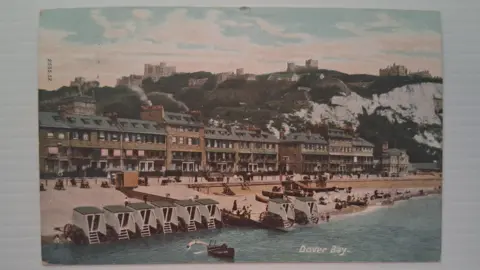
English Heritage has also acquired a collection of 800 historical postcards of Dover Castle, which were collated by the site's former head custodian.
Pat Cunningham, who worked at the castle between 1988 and 2010, bought the cards online or from local antique shops over decades, according to English Heritage.
Visitors to the Kent attraction can view a selection of the postcards on 18 July.
Grace Parsonage, English Heritage's assistant curator for the South East, said: "It's been a real treat to work through this remarkable collection, alongside our volunteers, to record and transcribe these messages from the past."
 English Heritage
The images of Dover Castle show how its structure has changed since the 19th Century, while the messages offer insights into the lives of their senders.
In addition to comments about holiday fun and pleasant weather, sentiments expressed included a 1906 sender's "hope the eggs will arrive quite safe" and another sender's request in 1914 for his mum to "please send my clean vest".
 English Heritage
In 1924 a father wrote to his daughter that he was "very disappointed that I did not see you before I left on Friday".
The following year one sender requested that "if anyone comes to Dover, ask them to bring some potatoes".
One postcard dated in 1967 included an apology that the author had "started to write in pencil but Tony pinched my pen".
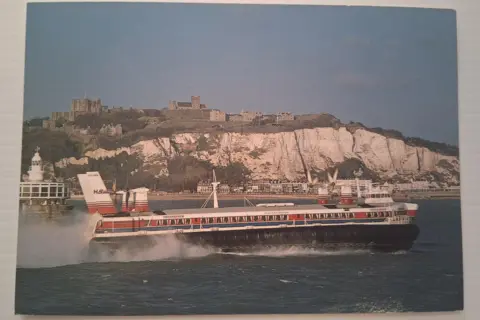 English Heritage
Postcards were introduced to Britain in 1870 and initially did not have illustrations as they were intended to be a quick and informal mode of communication, according to the Postal Museum.
By 1910, 800 million postcards were sent each year in Britain.
They later became popular with holidaymakers after designs changed and pictorial postcards were introduced.
In addition to Dover Castle, English Heritage's new postcards are available at:
- Audley End, House and Gardens - Essex
- 1066 Battle of Hastings, Abbey and Battlefield - East Sussex
- Beeston Castle - Cheshire
- Belsay Hall, Castle and Gardens - Northumberland
- Bolsover Castle - Derbyshire
- Brodsworth Hall and Gardens - South Yorkshire
- Carisbrooke Castle - Isle of Wight
- Eltham Palace and Gardens - London
- Framlingham Castle - Suffolk
- Kenilworth Castle and Elizabethan Garden - Warwickshire
- Osborne - Isle of Wight
- Pendennis Castle - Cornwall
- Scarborough Castle - North Yorkshire
- Stonehenge - Wiltshire
- Walmer Castle and Gardens - Kent
- Whitby Abbey - North Yorkshire
- Wrest Park - Bedfordshire
Follow BBC Kent on Facebook, on X, and on Instagram and listen to BBC Radio Kent on Sounds. Send your story ideas to southeasttoday@bbc.co.uk or WhatsApp us on 08081 002250.
