Expert calls for safety review at Scotland's troubled superhospital

 BBC
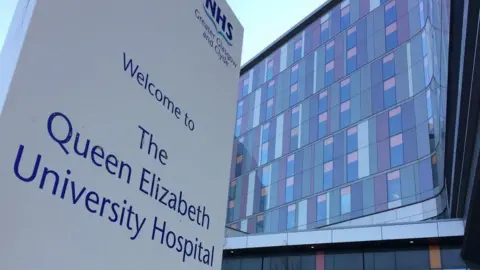
BBCA risk assessment should be carried out on Glasgow's entire Queen Elizabeth University Hospital campus, a leading safety expert has told BBC Scotland News.
Andrew Poplett, who conducted safety reviews for the Scottish Hospitals Inquiry, said it was "incredibly difficult" to say whether the hospital was safe or unsafe for all patients.
NHS Greater Glasgow and Clyde has admitted there were failings with the hospital when it opened and now accepts that some patient infections were probably linked to contaminated water.
The board has said the whole hospital is now safe but families and lawyers for the public inquiry say they want to see further evidence to back this up.
The Scottish Hospitals Inquiry was ordered in 2019 after a number of deaths and high levels of infection at the QEUH campus, which had opened just four years earlier.
The inquiry drew to a close in January and Lord Brodie's final report is expected later this year.
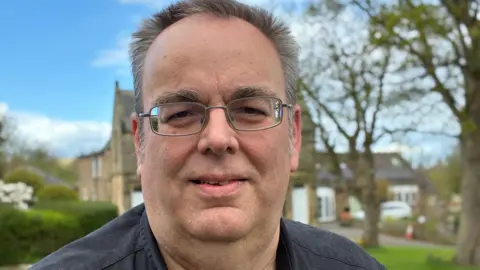
Engineer Andrew Poplett was the independent expert who wrote reports on water and ventilation for the inquiry.
First Minister John Swinney and the health board have said Poplett's evidence supported the claim that both the QEUH and the Royal Hospital for Children, on the same site, were now safe.
But in an exclusive interview with BBC Scotland News, Poplett said it was "incredibly difficult to give a black and white 'safe or unsafe' answer".
He said this was because of the complexity of assessing risk when caring for vulnerable patients.
Popplett said: "If you want to reassure the public that this building is safe, do a risk assessment.
"You don't need to wait for a final report from the public inquiry."
The expert, who has 35 years experience working in hospital safety engineering research, said risk assessments of all wards should be made and they should be ongoing to make sure there are measures in place to protect vulnerable people.
Timeline: The issues at Queen Elizabeth University Hospital
Poplett said the hospital was currently being maintained and run to a good standard but the building was "sub-optimal".
He said it had been "surprising" to find that when the hospital was built there had been a decision to accept ventilation rates that did not meet guidance on air changes per hour.
None of the wards in the QEUH are compliant with current national design standards on ventilation.
Poplett said he did not believe "the right people with the right level of competency" were involved at the right time throughout the design and build process.
He said staff working at the QEUH had been working the best they could with the building they had got, to make it as safe as it could be.
"If you've built a building that is suboptimal in design, putting it right is impossible," he said.
However, he found improvements had been made by the board "to the best of their ability with the facility that they have been left with".
Some specialist units at the hospital are already subject to regular risk assessment but not the general wards.
In his report, he warned that full assessments could lead to suspending or stopping clinical services.
What do families think?
Seven deaths of patients at the QEUH are being investigated by prosecutors for potential links to the hospital environment, which could lead to criminal charges.
Some of the families of those patients said the health board and Scottish government were not giving the full picture about the current safety of the hospital.
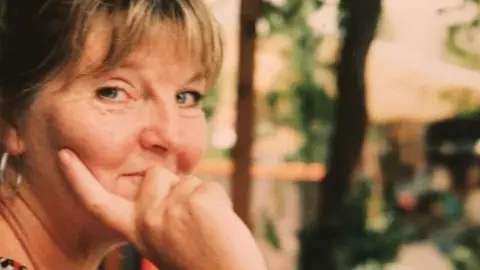
Gail Armstrong, 73, died with non-Hodgkin lymphoma in January 2019 after contracting a cryptococcus fungal infection caused by pigeon droppings.
The ward Gail was treated on does not have to be annually risk-assessed for ventilation, unlike another on the same floor where air quality has been improved.
 Armstrong family
Gail's daughters Sandie and Beth want "every single ward in the hospital" to be risk-assessed to protect vulnerable patients on general wards.
They said the health board was getting around safety standards because of the original agreement that the ventilation in general wards did not have to comply with national guidance.
"Our mother died in a general ward which houses leukaemia patients and transplant patients, it is classed by NHSGGC as a general ward," said Sandie.
"It has been risk-assessed on that basis. But these people are really vulnerable to infection.
"They need to be speaking in facts, and not in the type of spin that we've experienced for the last seven years from NHSGGC, since our mother died."
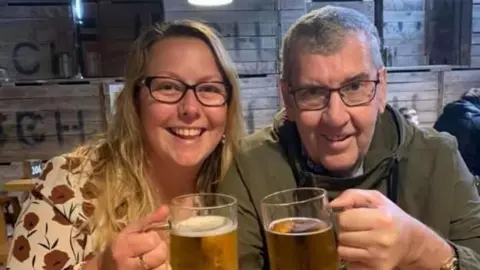
Tony Dynes, 63, died in May 2021 in the QEUH's national bone marrow unit while being treated for non-Hodgkin lymphoma.
His widow, Maureen, said it was only after he had died that she learned the significance of two infections he contracted - one bacterial and the other caused by mould.
In March, the health secretary confirmed that new mould growth had been found in one of a number of rooms sealed off in the same unit due to potential water ingress.
Just last month NHSGGC proposed to build a new adult bone marrow transplant unit after a small number of infections.
Maureen said she would welcome a new unit but worried about how long this might take. She wants to see action now.
"It needs to be fixed for other families so that they don't have to discover this," she said.
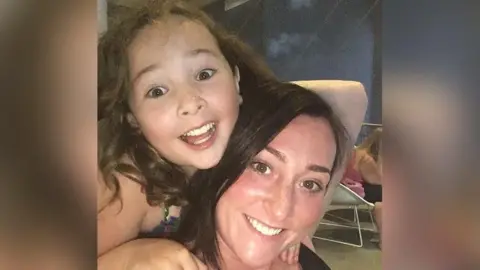 Kimberly Darroch
Milly Main, 10, died after a successful stem cell transplant at the Royal Hospital for Children in 2017.
An independent review which looked at 84 cases of unusual infections in child cancer patients concluded that Milly's infection was "probably related to the hospital environment".
A year after she died, cancer wards at the children's hospital were closed for an £8.9m upgrade to the water and ventilation systems.
NHSGGC said it was "confident of the water quality" across the campus.
But Milly's mother, Kimberly Darroch, has called for the hospital to close.
Some families of surviving children who have been treated at the campus said they had been left with debilitating conditions from taking preventative medication because of issues with the building.
What has the hospitals inquiry said?
The public inquiry into the design and construction of the QEUH campus has heard from 186 witnesses since it opened in 2020.
In a note published following its final hearings, lawyers for the inquiry criticised NHSGGC for not being clear about the level of compliance with NHS ventilation standards.
They accused the health board of "a fundamental misunderstanding of the guidance" after previous claims that ventilation was compliant.
They also said that although they had seen evidence of "clear progress" in the management of the water system, plans to remove point-of-use filters on taps in some areas, could pose "real issues for NHSGGC in terms of maintaining the confidence of patients, staff and the public".
Fred Mackintosh KC and Craig Connal KC, who are senior counsel for the inquiry, said a "rigorous" risk assessment of the whole campus should be carried out and until then there should be a limit of four people allowed in single patient bedrooms on general wards.
They also said there had been a "systematic failure" to not listen to whistleblowers over the last decade who had repeatedly raised safety concerns.
A top doctor who still works at the QEUH said she had "ongoing serious concerns"
No date has been set for Lord Brodie's final report but it is expected to take several months.
What has the health board said?
In January, NHSGGC admitted that some infections were probably linked to the hospital building, most likely the water system.
This came after years of denying any link.
The then medical director gave evidence that the building was "not built right" and the board has an ongoing legal action against the main contractors.
The new leadership of NHSGGC maintains that the hospital is "wholly safe", pointing out that chemical treatment of the water system and routine testing and monitoring of air and water are more "rigorous than any other hospital in the UK".
The health board said prophylactic drugs continued to be prescribed as part of some patients' treatment to reduce the risk of infections.
It has spent a total of £50m on improvements.
A spokeswoman for NHSGGC said: "The QEUH and RHC complex delivered in 2015 was not what we paid for.
"We acknowledge the impact this has had and are sorry to all those affected."
She said that comprehensive programmes of remediation continued to be taken forward and safety was actively managed every day.
The spokeswoman said the health board undertook thorough testing of the water and ventilation to provide additional assurance, particularly for the most vulnerable patients.
She added: "We are wholly committed to transparency, with comprehensive information and updates regularly published online, in addition to the creation of the independently co-chaired safety and public confidence oversight group, which includes independent experts and patient family representatives."
