Remains discovered during flood work to be reburied

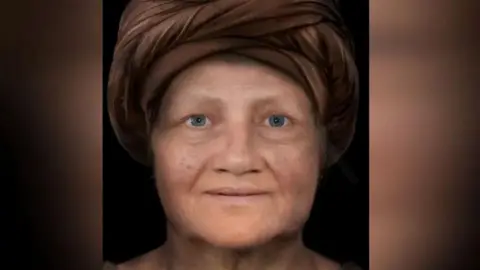 FACE LAB / LIVERPOOL JOHN MOORES UNIVERSITY
Dozens of skeletons unearthed during work to improve flood defences will be formally reburied this week.
Caskets containing the 900-year-old remains of 66 women and children will be on public view until 16:00 BST on Monday at Holy Trinity Kendal Parish Church in Cumbria, before being laid to rest in a private ceremony.
The remains include a woman whose face was digitally reconstructed by academics at Liverpool John Moores University after her skull was found buried at the church in 2022.
The Reverend Canon Shanthi Peiris said the burial ceremony will bring a sense of satisfaction and closure.
'Mortal remains'
"I will be happy when we've laid them to rest, and we put them back in the ground," she said.
"Part of the prayers I put together say their bones may rest now, undisturbed, as it were.
"As Christians we believe their souls were commended to God at their original burial, so it is just their mortal remains that they're putting down, but there will be a bigger sense of peace."
The medieval skeletons were found at the church in Kendal, Cumbria, when the Environment Agency (EA) started work on a flood management scheme four years ago.
On Friday, the remains were brought to the Bellingham Chapel, where residents could pay their respects ahead of the private reburial.
Peiris said groups of bones from the 66 skeletons have been deliberately grouped together, which reflected the customs of the time.
"They are very carefully presented in that all the remains of the children are in caskets with adult females, which is what they would have done at the time," she said.
"If a child died, they would bury them with an adult female, so that they weren't on their own, as it were."
Face-to-face
Peiris also described the moment she first saw the reconstructed face of the woman, who would likely have been a member of the church's congregation.
Scientists created the image in November 2025 and more than 300 people voted to name the woman Agnes, who was estimated to be in her 50s when she died in the mid-12th Century.
Peiris said it was emotional to come face-to-face with someone from so long ago.
"It was a sort of heart-fluttery moment when we knew we were going to see the image, and then the image appeared," she said.
"It's lovely to look at the face of someone who worshipped, was part of our church family 900 years ago, and she just looks like a normal lady.
"You feel like 'Oh, I think I'd have liked her.'"
