Female performers tell of sexual harassment at work

 Martin Giles/BBC
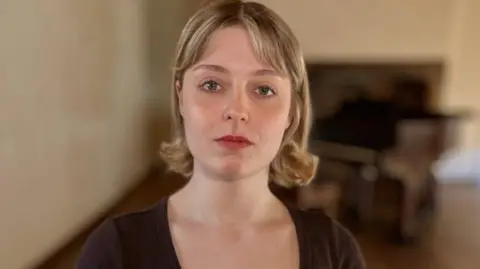
Female entertainers have described sexual harassment they have suffered at the hands of audience members and industry insiders.
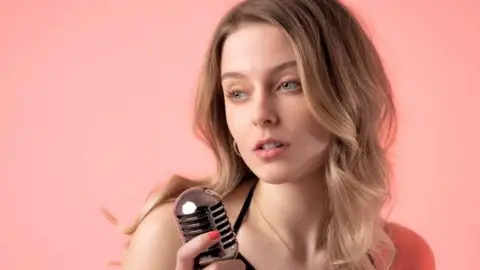
Norwich-based singer Lizzie Blissett said she had been groped after gigs, while Peterborough comedian Shona Hoey said men had grabbed and kissed her without consent.
"It makes it feel quite dirty. It doesn't make it feel enjoyable any more," Blissett told BBC Politics East.
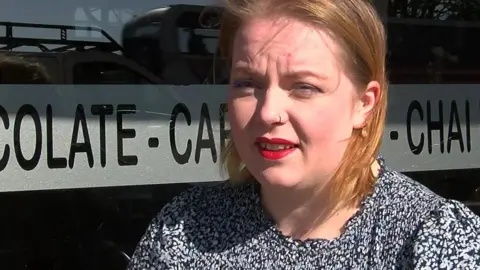
Sarah Owen, Labour MP for Luton North and chair of the House of Commons Women and Equalities Committee (WEC), said it was vital to "challenge the culture and change the behaviour".
 Andrew Sinclair/BBC
The performers' comments came after the WEC investigated the treatment of women in the music and comedy scenes.
Owen said many women "wanted to give evidence [to the committee] but were scared of what would happen to their careers in the future, and that is partly because they are self-employed and the huge amount of power of promoters and bookers".
Blissett said she had suffered a stream of sexist comments in person from audience members.
"They'll make comments about my legs or that they only came to see my body," she said.
"It might even be touching, so it can be an arm around our shoulder that ends up moving lower and lower down, and we have to step away from that.
"It can just be groping as well."
- Details of help and support with sexual abuse or violence are available at BBC Action Line
Hoey said pictures of her had been put online with "inappropriate captions and quite vulgar language".
She said she had been told "wear something short because then I can imagine bending you over on stage".
"And then they're telling you, 'Don't tell anyone about these messages that I've sent you'," she said.
"Guys come up to me and say, 'Oh, I don't usually find women funny' and then they'll grab your face and kiss you.
"In what world would you think that's appropriate, to kiss somebody?"
Hoey, who also works as a bus driver and photographer, said being blacklisted as a result of speaking out was a fear.
"When I said to my friend that I was going to do this interview, he said 'Oh, you have to be careful, because you might not get booked any more, because people will see that you're kicking up a fuss, and they don't like that'.
"They don't like it when you point out their behaviour, because they like getting away with it."
The WEC heard about a survey of 800 people involved in comedy conducted by campaign group Get Off Live Comedy between November 2021 and January 2022.
It found that more than one in five people had experienced or witnessed sexual harassment.
It also found that more than 70% had been confided in by a friend or colleague about unwanted sexual behaviour.
A 2023 survey of 2,500 female members of the Musicians' Union (MU) found that about a third reported being sexually harassed while working as a musician.
 Lizzie Blissett
Blissett said her experiences had made her question whether to continue as a performer.
"If it's three or four occasions in one night, it can make me feel that I don't want to do this job any more, because some people have said to me that it's a part of it – but it shouldn't be a part of it," she said.
Hoey said: "You just forget about it day to day, but then you take a minute and you stop and think about it and it goes 'Owww!' and it does – it hurts."
 Martin Giles/BBC
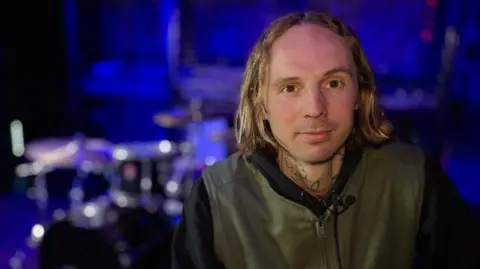
Ben Street, of Norwich music venue Voodoo Daddy's Showroom, said his club was doing all it could to protect female performers.
He said it had a "lovely green room space... that allows artists to have their own space" away from any difficult or inappropriate individuals.
"The industry as a whole has a lot of work to do," he added.
Jess Asato, Labour MP for Lowestoft, Suffolk, told BBC Politics East she was sad but not surprised to hear of the women's experiences.
"Women shouldn't have to think about giving up something that they love, being in comedy or being a musician, because of sexual harassment they are facing from their audiences," she said.
"It's just deeply depressing. We're now many years after the Me Too movement and really we just haven't seen the dial change enough on this."
She said the new Employment Rights Act placed a duty on employers to take specific and reasonable steps to prevent staff from being sexually harassed, and offered protection to those making complaints.
"Much of this is actually cultural so things like the government's Enough campaign, which is calling out all forms of violence against women and girls, backed by football clubs and big industry bodies, is part of making sure this isn't just about a legislative change, it's about the whole of society coming together," she said.
Follow East of England news on X, Instagram and Facebook: BBC Beds, Herts & Bucks, BBC Cambridgeshire, BBC Essex, BBC Norfolk, BBC Northamptonshire or BBC Suffolk.
BBC Politics East is available on BBC iPlayer.
