Vet says St Kilda's dying sheep left him feeling helpless

 NTS
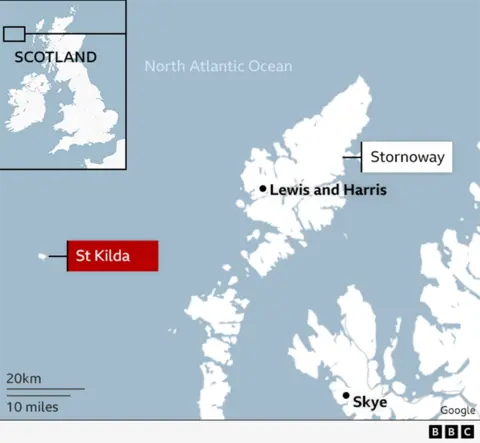
NTSA vet campaigning for greater protection for St Kilda's rare sheep says the sight of dead and dying animals left him feeling helpless.
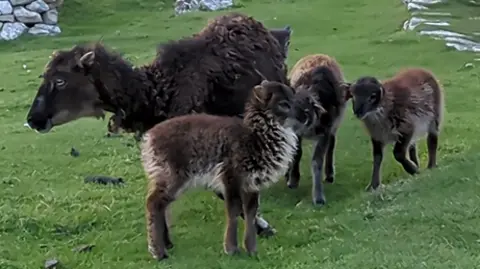
Soay and Boreray, two breeds that roam wild on the archipelago, are descended from animals first brought to the group of small islands and rocky sea stacks thousands of years ago.
David Buckland, who says a lack of winter grazing causes sheep to starve to death, visited St Kilda in April and was surprised to still find animals dying off even though more grass was available.
National Trust for Scotland, which owns St Kilda, said it and the Scottish Animal Welfare Commission (SAWC) were carrying out separate reviews of the sheep.
The Scottish government said the commission's report would be published in due course.
Buckland along with another Western Isles based vet, Graham Charlesworth, have made previous calls for St Kilda's population to be controlled.
NTS and the Scottish government say the sheep are wild animals and do not come under welfare laws that protect farm animals.
Buckland said the latest winter casualties did not appear to be as severe as previous ones, but still counted 39 carcasses.
The vet, who spent two days on the main island of Hirta, said the island's terrain made it difficult to make a proper assessment.
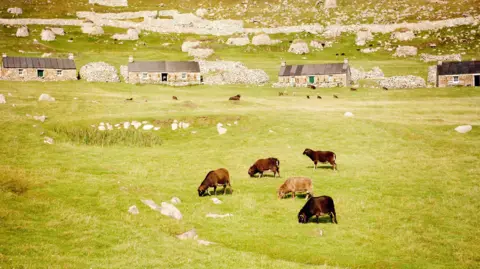
Sheep also graze around thousands of small stone-built stores called cleits, which Buckland said meant dead animals could be hidden from view and missed.
He said by April better grazing was available but still found dead or dying animals.
Warning: The following contains graphic details.
Buckland said many of the carcasses found were ewes that were late in pregnancy.
He said he was upset to find an emaciated ewe that was still alive but had a number of wounds and had lost an eye after being pecked by ravens.
A lamb was trying to suckle from the ewe.
The adult female was found dead the following day beside her still-living lamb.
"That was hard. We couldn't do anything about it," he told BBC Alba's An Là programme.
Buckland said there were means of euthanasia for sheep on Hirta, but he did not have the authorisation to do that.
There are also restrictions on removing sheep from St Kilda.
"As vets we are used to suffering animals, but we are not really so used to not being able to do anything about it," he said.
 Getty Images
NTS said SAWC's review would play a "critical role" in informing its own findings.
A spokesperson said: "It will be vital to consider the findings of the Scottish Animal Welfare Commission's independent review alongside our own, so we will finalise our own recommendations once the SAWC's findings are published.
"The SAWC's working group is expecting to conclude its review in July, and therefore our own review will be finalised in the second half of this year."
The trust said there had been mortality in a "small percentage" of the population over the winter and early spring.
The spokesperson added: "While the overall population is a healthy one, we do understand the public's concern for the welfare of the sheep, which is why we're conducting our review."
Uninhabited islands
Sheep were first brought to St Kilda in prehistoric times and are named after uninhabited islands in the archipelago.
The animals are small and their fleeces have a wide range of colours and shades, including dark brown.
Sheep taken from Soay were raised as livestock on Hirta, the largest island, until the last inhabitants abandoned St Kilda in 1930, taking their animals with them.
In the years that followed, about 100 sheep were moved from Soay to Hirta.
Today there are about 1,800 sheep on Hirta.
They are protected by the Wild Mammals (Protection) Act 1996, the same protection given to Scotland's wild deer population.
