Calls to replace 'high risk' Shetland hospital building

 BBC
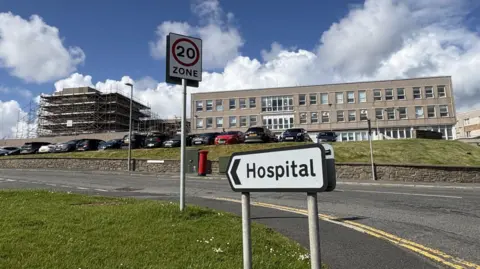
BBCGilbert Bain Hospital in Shetland has received a "very high risk" rating in a report which highlights concerns about the structural integrity of the building.
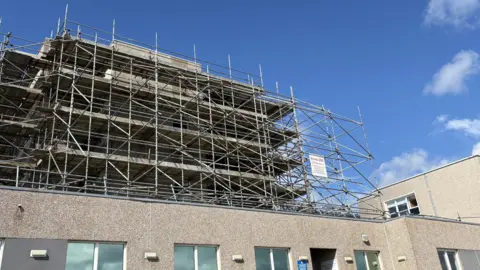
Supporting scaffolding has been erected in one part of the site, prompting fresh calls for a new hospital in Lerwick.
In April, NHS Shetland said problems with the external walls had the potential to "significantly impact" the delivery of care, but insisted the overall building was safe.
The Scottish government said investment was being considered as part of wider NHS infrastructure planning, which included work to support safe use of existing facilities.
Gilbert Bain opened in 1961 and a newer section was added in the late 1980s.
The hospital provides care for 23,000 people in Shetland and supports fishermen, cruise ship passengers and people working in the North Sea oil and gas industry.
With three wards, the facility includes day surgeries, maternity services and diagnostics. More complex procedures require patient travel to the mainland.
In April, NHS Shetland updated its risk register with details about the structural integrity of the newer section of the hospital.
It states: "If the external building envelope continues to degrade unchecked, then the external walls of the building could further separate from the inner walls and structural columns."
The report warned that this could result in the immediate decanting of affected areas, and lead to the "loss of over half the capacity and function of the acute hospital site".
Engineers concluded that the integrity of the outer leaf had been compromised, with walls "at risk of partial or complete medium to long-term collapse".
The report said this was putting services, staff and the public at risk.
Supporting scaffolding has been erected around the affected area but the health board concluded that current control measures were "inadequate".
In 2019, NHS Shetland said the building was "not fit for purpose" after a review found the hospital had been designed for a time when healthcare needs were different.
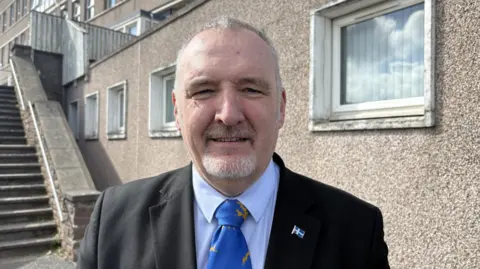
Gary Robinson, chair of NHS Shetland and depute leader of Shetland Islands Council (SIC), said water ingress had been causing problems in the newer part of the hospital:
"We've taken steps to make sure the risks are reduced," he said.
"In July, we expect to see a steel mesh fixed around the affected parts, to retain everything in place."
Robinson said the possibility of the building failing had lessened with the supporting scaffolding but said the site needed to be kept under review.
The risk register warned a "definitive remedial solution" could be 2031/32 at the earliest.
The health board said it was working with civil servants on a longer-term solution.
Despite structural challenges, the hospital has introduced new services and procedures, reducing travel to the mainland.
Lerwick is 216 miles (348km) from Aberdeen by ferry, and flights are not always reliable.
Chemotherapy, a treatment previously requiring travel to Aberdeen, started being introduced during the Covid pandemic.
Gilbert Bain also installed a permanent MRI scanner in 2024.
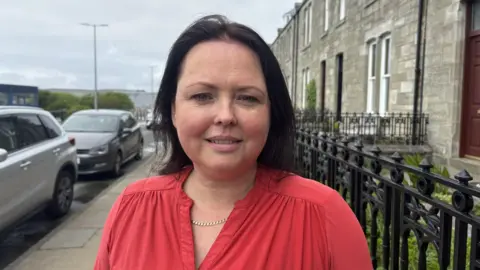
Joanne Williams, from Brae, was the first to use the new MRI facility when she was under investigation for multiple sclerosis (MS).
She said a previous scan in Aberdeen had not been a pleasant experience: "It meant going alone on a very early flight in the morning. It was quite a worrying time."
'Question of how and when'
Joanne said being seen locally was "100% better" because she could take someone with her.
"We deserve to have good healthcare in Shetland," she added.
Gary Robinson said the health board had reduced air miles by 39 per cent: "We've managed to provide better services for islanders."
Calls for a new hospital gained momentum during the Holyrood election campaign earlier this year.
Shetland's new SNP MSP Hannah Mary Goodlad, the Scottish government's public finance minister, said there was no doubt of the need for a new hospital.
She said: "The community wants to see infrastructure that is fit for purpose."
Goodlad said there was "cross party desire" to replace the Gilbert Bain.
However, the minister stressed it was a question of "how and when" given capital funding constraints.
 PA Media
In February 2024, the Scottish government paused plans to build new hospitals and other NHS construction projects because of budget pressures.
The SNP's 2026 Scottish election manifesto included a commitment to refurbish the Gilbert Bain Hospital and other NHS buildings.
A Scottish government spokesperson said investment at the hospital was being considered as part of its NHS whole system infrastructure planning:
"This includes work to support continued safe and effective use of the existing facilities through additional targeted funding for priority maintenance as well as determination of longer term investment priorities."
