The true story behind Peaky Blinders' Nazi banknotes plot

 Netflix
Widely considered the largest counterfeiting operation in history, Nazi Germany's plot to crash the British economy with fake banknotes sounds like a Hollywood script.
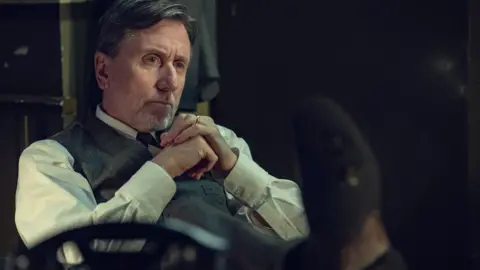
Now, those true events have inspired the latest twist in the Peaky Blinders saga, with the forged notes going on display in a new exhibition.
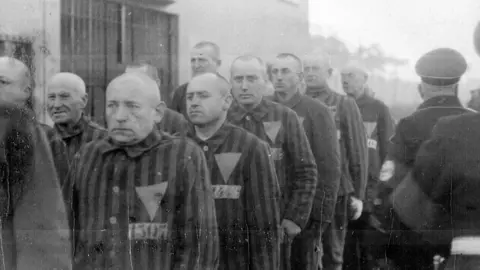
Operation Bernhard, named after SS Major Friederich Bernhard Krüger, forced more than 140 Jewish prisoners at a concentration camp near Berlin to study and create high-quality replications of £5, £10, £20 and £50 notes.
The attempt to break the Bank of England was not successful, but it did lead to thousands of genuine notes being removed from circulation and even put the printing of new ones on hold.
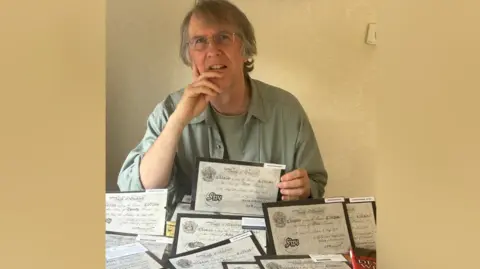
A number of the counterfeit notes have been donated to Holocaust Centre North at the University of Huddersfield by collector Andy Taylor.
His life-long interest in the notes started as a child - and completely by accident.
"I must admit at the beginning, I didn't really know that some of them were forgeries," says Taylor, who bought his first note in York when he was 12.
"The similarity between the genuine notes and the forgeries was negligible really, unless you really know what you're looking for."
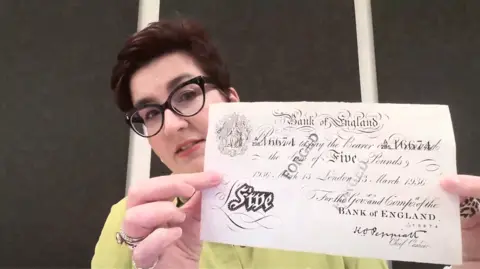
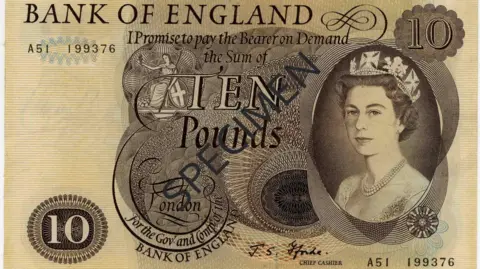
In stark contrast to the complicated modern notes, covered in security measures to deter counterfeiters, wartime banknotes were made of white cotton-rag paper.
Just one side of the paper containing black printed text, signatures and secret security marks.
 Andy Taylor
The notes were also much larger - around the size of an A5 piece of paper.
"They're very big, and this is what got me I think when I first saw them," he recalls.
"They're like works of art, the paper's beautiful."
Discussing their simplicity, he says: "It's basically just white paper with black ink on the front.
"There's no other colour, so they're known as 'white' notes."
The notes were made by those with expertise in engraving, banking and printing, with the Jewish prisoners taken to Sachsenhausen concentration camp to work on the fakes.
"All this counterfeit money was produced by people that would have been murdered," says Hannah Goldstone, from Holocaust Centre North.
"It's not some kind of crime ring that's come together that's gone, OK, we want to do this.
"These people were forced to do it."
Prisoners were housed separately from the general population of the camp and made to study thousands of genuine banknotes to identify around 150 different security marks.
All had to be recreated during the counterfeiting process.
The exact number of forged notes - or how many of them ended up in circulation - is not known.
"There is an estimate from bookkeeper Oskar Stein, who was one of the prisoners involved in Operation Bernhard," says Jennifer Adam, curator of the Bank of England Museum.
"He estimated that there were about nine million counterfeit notes made.
"The face value of that would have been the equivalent of about £5bn in today's money."
The initial plan was for the Luftwaffe to drop the banknotes over Britain in the hope it would drive inflation and crash the economy.
However, a change in approach eventually led to the money being used to buy supplies and pay for spies in neutral nations.
 Getty
Getty"We've got the real ones next to the forgeries, and it's almost like a spot the difference," says Goldstone.
"Some of them are really, really difficult to find, they are absolutely fantastic."
Despite being able to successfully duplicate many of the genuine notes' security marks, the Nazis were unable to devise a system to create new serial numbers for each note and were forced to recycle old numbers.
This eventually led to their discovery.
However, the first counterfeit note was not detected until 1943 when it passed through a British bank in Morocco.
"Banknotes have a unique serial number on them, but the prisoners who were trying to counterfeit the notes hadn't quite worked out the sequence behind the cypher that the Bank of England was using," says Adam.
"So when a counterfeit note was sent back to the Bank of England to be paid, as was the case, they checked against the register and found that the note had already been paid."
In response, the Bank of England withdrew all notes with a face value higher than £5.
£10 notes were not reintroduced in the UK until 1964, with £20 notes following in 1970 and £50 notes in 1981.
Between April 1945 and February 1964, the highest denomination in circulation was £5.
"£5 in those days had a purchasing power of about £200 today," says Adam.
"The currency is not just important in Britain, it's an international currency being used around the world, so it was a huge task to withdraw all the bank notes."
The new notes contained colour and were more sophisticated in design, making them harder to counterfeit.
 Bank of England
Close to the end of the war, Operation Bernhard's prisoners were moved from Sachsenhausen to Austria under plans to continue the counterfeiting operation.
However, production never resumed and the prisoners were scheduled to be executed until they were freed by Allied forces.
It is thought the majority of the counterfeit notes were either burned or dumped into nearby Lake Toplitz, with a number of notes recovered by divers in the 1950s.
 Netflix
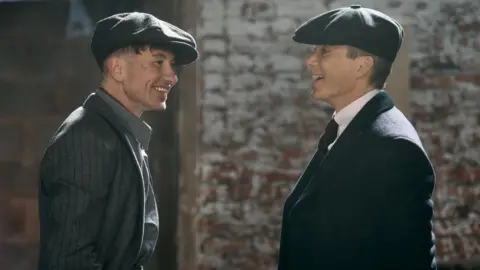
Elements of the Operation Bernhard story have been included as part of the plot of Peaky Blinders: The Immortal Man, with Holocaust Centre North hoping the film will lead to further interest in the museum.
"We want to take advantage of people's interest in the film and the history and we want to help educate people," says Goldstone.
This is a sentiment echoed by Taylor, who has donated around half of his collection to Holocaust Centre North.
"I think they're really fascinating bits of history that not many people know about," he says.
"I'd really like to see them in museums rather than stuck at home in private collections."
Taylor eventually wants his remaining notes to be displayed at Sachsenhausen Memorial and Museum in Germany.
"I'd be over the moon with it because it's like they're going home," he adds.
Listen to highlights from North Yorkshire on BBC Sounds, catch up with the latest episode of Look North.
