Care support workers 'deserve same pay as NHS colleagues'

 BBC
BBCThe difference between the pay for care support workers and their NHS equivalents "absolutely isn't fair", a charity has said.
Community Integrated Care in Widnes, which runs hundreds of services around the country for adults with learning disabilities, mental health and complex needs, are campaigning for care support workers to be paid in line with NHS workers with equivalent roles, who earn on average £7,000 more a year.
The charity said that while costs had gone up by nine percent in the past year, some councils were offering funding increases of less than half that.
The government said it had promised an extra £4.6bn for adult social care in England by 2028/29.
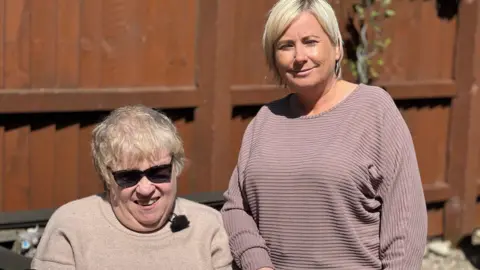
It is a glorious sunny day and the flowers in the planters around Mill Point supported living complex are a riot of colour.
The complex, in St Helens, was established in 2019 specifically for adults whose parents were getting too old for them to care at home.
Linda, 59, has been here since it opened and is a keen gardener.
"I just love it," she said. "I like being out in the fresh air. I don't like being stuck in."
The nine residents each have their own flat with shared dining and community facilities, combining independence with support.
"It's a lovely place. I just like the company," says Linda, who also volunteers as an office administrator at a local day care centre.
"I've got my own little flat and I just love being in it. I've got my independence"
'You can take your work home with you'
Donna is on hand to assist Linda, helping her to tend her plants, pointing out new flowers.
"It's about being able to support people to live the best lives possible - going out, meeting people, building friendships, joining in activities," Donna said.
"I love my job and I wouldn't want to work anywhere else."
But Donna's job is about much more than assisting with gardening. She is trained in psychological and medical support.
She needs to know about safeguarding and care planning and her role carries a lot of responsibility and requires long hours.
"It can be quite challenging at times and sometimes you can take work home with you," she said.
Many feel the pay doesn't reflect those demands. Unlike many in the care sector Donna gets more than the minimum wage (currently £12.71 an hour) but less than the £13.45 voluntary "real living wage".
She says she has seen colleagues leave for better paid work elsewhere. Keeping hold of staff is a real issue in the social care sector - not least because jobs requiring similar qualifications in the NHS can pay considerably more.
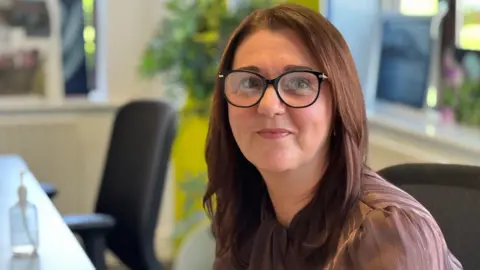
Donna is employed by a national social care charity called Community Integrated Care. In 2021 they launched a campaign called "Unfair to Care", calling for care support workers to be paid the same as their NHS equivalents.
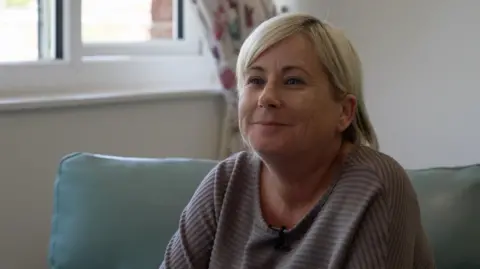
"The pay gap between NHS colleagues and social care colleagues is about £7,000 on average a year. So that's quite a significant pay gap for such a skilled role, " said the charity's managing director Samantha Brennan.
"It absolutely isn't fair."
So why doesn't the charity simply pay more? Their problem is that they are reliant on councils for funding, and many are struggling to find the money for the charity's increasing costs.
"Our cost pressures have increased by nine percent this last year. Some of that's national insurance, some cost of living," said Ms Brennan.
But she said some councils were offering increases of half that amount or less.
"There's an average of four or five percent in some local authorities. We've seen as low as two percent.
"I do understand and I do sympathise with local authorities because their budget comes from central government."
The government is promising an extra £4.6bn for adult social care in England by 2028/29.
To put that sum into context, in the 2024/25 financial year, English local authorities spent £29.4bn on adult social care, a £2.3bn rise on the previous year.
'Social care touches everyone'
So if those increases carried on at the same rate, all of that £4.6bn would be swallowed up in extra costs.
Ms Brennan said the money would help but described it as "a drop in the ocean".
"Social care touches each and every one of us in our lives at some point," she said.
"Our workforce needs to be recognised for the skills that they have and the roles that they play in our communities. We still see people who need brilliant social care providers across the sector doing what they do best every day. To do that we need the funding."
Back at Mill Point, Linda says she still enjoys staying with her family one weekend a fortnight. But she is in no doubt over where she calls home.
"I call that my holiday home and this is my home now," she said.
"This is where I'm settled and this is where I want to be."
A Department of Health and Social Care spokesperson said: "We are addressing the adult social care sector's urgent need for support by providing a funding boost of over £4.6bn, introducing a new fair pay agreement for care workers, and increasing the carer's allowance earning limit by more than £2,750 in two years.
"To address the long-term, structural issues we inherited, we have commissioned an independent review into adult social care."
Listen to the best of BBC Radio Merseyside on Sounds and follow BBC Merseyside on Facebook, X, and Instagram. You can also send story ideas via Whatsapp to 0808 100 2230.
