Family of Bloody Sunday shooting victim gets £275,000 in damages

 PA Media
The family of a man shot and wounded on Bloody Sunday are to receive £275,000 in damages, a High Court judge has ruled.
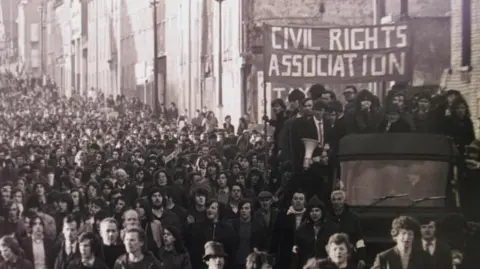
Daniel McGowan, a father-of-nine, was left with life-changing injuries and unable to work again after being shot when the Army's parachute regiment opened fire on civil rights demonstrators in Londonderry on 30 January 1972.
Thirteen people were killed and 15 injured.
The father-of-nine, who died in 2004 at the age of 69, was said to have suffered psychological trauma similar to Vietnam War veterans.
The judge, Mr Justice Rooney, held that part of the payout is to cover the wrongful actions of British paratroopers who opened fire in the city.
"The deceased was exposed to humiliation and degradation and the soldiers behaved in a malicious and oppressive manner," he said.
An initial inquiry into the shootings, the Widgery Tribunal, cleared the soldiers of blame and was derided as a whitewash by the victims' families.
In 2010 the Saville Inquiry into the shootings found that none of the casualties were posing a threat or doing anything that would justify their shooting.
The British Prime Minister at the time, David Cameron, issued a public apology for the soldiers' actions and described the killings as "unjustified and unjustifiable".
'Highly probable' that Soldier F was responsible
A number of compensation cases have already seen the Ministry of Defence pay out significant amounts to those bereaved or injured.
The case brought by Daniel McGowan's estate centred on a dispute over the scale of the compensation.
He attended the civil rights march as a 37-year-old, while his wife was pregnant with her ninth child.
McGowan was shot in the leg close to the Rossville Flats area, the court heard, with the inquiry finding it "highly probable" that Soldier F was the paratrooper responsible.
He lay wounded at the scene for about an hour before being taken to hospital and undergoing repeated surgeries.
Due to the injuries he was unable to return to his job as a maintenance operator in the local Du Pont factory.
He later began drinking heavily and suffered from anxiety, neurosis and depression.
With McGowan believed to have also witnessed others being shot and killed, a consultant psychiatrist likened the consequences to the concept of post-traumatic stress disorder (PTSD) developed after US troops returned from the Vietnam War.
'Sense of grievance was essentially life-long'
Lawyers for the family argued that the pay-out should reflect both his wrongful vilification and the loss of earnings when his life fell apart after Bloody Sunday.
The court was told McGowan's death meant he never got to experience the exoneration and vindication of the Saville findings.
"His sense of grievance was essentially life-long," Karen Quinlivan KC said.
Ruling on the claim, Mr Justice Rooney highlighted the victim's "impeccable good character and work ethic".
He was never involved in any form of criminal or paramilitary activity and had no political affiliations.
The judge also highlighted how Daniel McGowan was unable to play football or take part in other activities after Bloody Sunday.
A lawyer for the family, Fearghal Shiels, said the outcome was a final vindication of his innocence.
"Danny McGowan was a loving husband, father and keen and proud breadwinner for his large but young family.
"The impact of his unlawful shooting, which the Bloody Sunday Inquiry found was most likely caused by Soldier F, had profound and everlasting implications for all of his family."
