'You're fully accepted': Being nude in public can make us feel better about our bodies

 BBC/ Prashanti Aswani
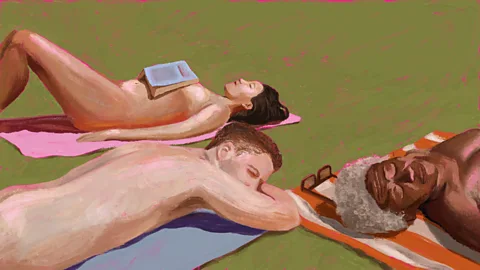
Research suggests that naturism, the practice of non-sexual social nudity, can help people improve their body image. Naturists and experts tell the BBC how it works.
Helen Berriman believes she would have had a "much better understanding" of her body had she discovered naturism, the practice of non-sexual social nudity, earlier in her life.
In the summer of 2020, Berriman bought herself a bikini to wear during a heatwave. She hadn't worn one in 20 years, having struggled with body dysmorphia (a condition where someone fixates on perceived flaws in their appearance) for most of her life. Around a year later, her husband introduced her to naturism.
"Naturism is engaging in social nudity with no expectation, no presence of sexual stimulation," says Kerem Soylemez, assistant professor of psychology at Regent's University London.
Research suggests that being around other naked bodies can help people improve their body image. Naturists and psychologists explain why it can be a powerful way to redefine our relationships with our bodies.
 BBC/ Prashanti Aswani
Naturism and body image
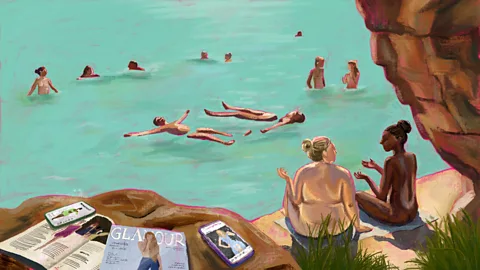
Martha Vickery "genuinely hated" every single bit of her body before she went to her first naturist event.
Poor body image – which is prevalent on a global scale – involves preoccupation and dissatisfaction with one's body, typically regarding its shape, weight, or specific features. In the US, around 51% of adults feel pressure to conform to a certain body type. In the UK, around 1 in 8 adults have experienced suicidal thoughts or feelings because of body image concerns.
Poor body image can affect how an individual behaves because of these concerns – for example, failing to achieve an ideal body can lead people to avoid social situations or obsessively exercise, or even get cosmetic surgery.
Encouraging a positive body image is important for a host of reasons, including our self-esteem, optimism, safer sex and general health.
But body image is complex and how it impacts people can vary – for example, people in the LGBTQ+ community might experience heightened body image concerns due to discrimination or their gender identity.
A quick history of social nudity
• Some indigenous cultures and tribes have perhaps the longest history of wearing little to no clothing
• In the Western world, athletes often competed in the nude in ancient Greece's Olympics
• In late 19th-Century British India, modern naturism clubs emerged
• In the US, organised naturism traces its origins to 1929 when three German residents of New York met to discuss founding a nudist association in the Micholob Café
• In 1974, the New York Times reported that social nudity was experiencing a wave of popularity in the US
• In the 1920s and '30s, naturism gains popularity in the UK
Naturism, however, seems to undo some of the expectations of what is a desirable body type.
Vickery says naturism was the "catalyst" for her body image improving. "I went along and realised that despite the fact that my body was bigger than I wanted it to be, or that society said it should be, it didn't matter," she says.
Naturism helped Vickery to see her body as neutral and encouraged her to stop criticising it. "[I realised] my body is the reason I get to wake up every morning and hug my friends and drink coffee and feel sun on my skin," she says.
Comparison culture
Soylemez, who is not a naturist but has spent years researching the stigma faced by naturists and public understanding of naturism, says that media distortion of body image can be addressed by "being around real bodies, real humans".
"It's not only about other people accepting you, but learning to accept yourself," he adds.
Marina Rachitskiy, a senior lecturer in psychology at the University of Roehampton, in London, agrees. Society dictates what "normal" is, she says. "Social media and our environment is pressuring us to conform to this idea of normal, which is not necessarily what the average is."
Extensive research suggests that social media has exacerbated negative body image, as it shapes what is deemed attractive or desirable. This has a detrimental effect on users, as for many, the pressure to attain an "idealised" body is often a predictor of eating disorders and anxiety, as well as fuelling feelings of shame.
Modern technology, such as AI bots and smartphone beauty filters, can encourage self-comparison and even body dysmorphia. One study showed that when adolescents reduced their social media use over a three-week period, their attitudes towards their appearance and weight esteem improved.
"Being exposed to average bodies, to average humans, makes you readjust your perspective about what is normal, and what is acceptable, and what is beautiful," says Rachitskiy.
So far, the relationship between social nudity and body image has been relatively understudied, but there has been a promising and encouraging start from the first controlled trials over the past decade or so.
One study of 849 people found that the participants who engaged in naturist activities reported greater life satisfaction – mediated by more positive body image and higher self-esteem. Among participants in naturist activities, seeing other people naked appeared to be an "important predictor" of positive body image.
In another smaller study, participants were assigned to one of two groups – one being "clothed" and the other being "non-clothed", to try and find out how nudity affects body appreciation. Participants in the naked condition reported more body appreciation, an effect mediated by reductions in social physique anxiety (the concern that your body is being judged by others).
"The more we cover up," Rachitskiy says, "the more uncomfortable we start feeling about ourselves, because psychologically, we're thinking, 'if I need to cover it up, that means there's something wrong with it.'"
 BBC/ Prashanti Aswani
Berriman, who is now the women's officer for British Naturism, the UK's national naturist organisation, suggests that naturism could help with comparison culture too (the idea that social media encourages people to compare themselves with others, often in a negative way).
"On social media… [people are] trying to look a certain way [and] throw a load of money at trying to look good. What we're doing as naturists is counteracting that, if you like – you don't need to spend a lot of money. You don't need to look a certain way. Every body is beautiful."
Berriman has scars on her body, which she says she is "no longer ashamed of. They're part of a story – they're part of living."
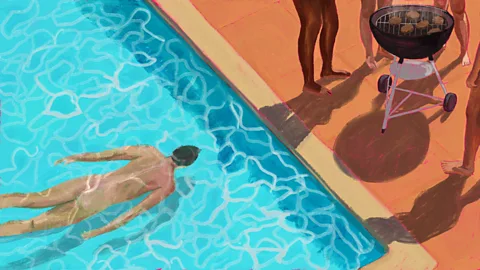
At naturist events, she says, there is a huge diversity of bodies – from normative bodies to cancer survivors to people with a stoma, and people with limb loss or other physical differences.
Linda Ashmore can attest to the benefit of attending such events. She describes her body image as having been poor since the age of 12, which was later exacerbated by a series of health complications. After an infection that couldn't be cleared, she had to have two toes amputated. She was also diagnosed with type 1 diabetes and had to inject her stomach with insulin. She describes feeling incredibly self-conscious. But in 2019, at 50 years old, she got into naturism, which "transformed" her.
It felt "absolutely brilliant… sitting around, talking to people with no clothes on. It just felt normal."
Reflecting on her body now, she says, "Your skin just fits you. It might be saggy here and there…but everybody is all shapes and sizes."
An undeserved reputation
Despite the benefits many naturists report, the practice is typically demonised in the media, Soylemez says, having long been regarded as a controversial behaviour. The stigma is largely rooted in the assumption of sexual deviance and often stems from cultural, religious and moral values.
The legality of naturism is complex in the US, with social nudity laws varying from state to state, though there are plenty of naturist organisations, such as The Naturist Society Foundation and the American Association for Nude Recreation. Today, the practice is legal in the UK unless a person removes their clothes with the intent to upset or shock. In other European countries, naturism is popular, particularly in Denmark, Germany, France and Spain.
So far, research has found few negative impacts of naturism on adults or children – and those often depend on external perceptions.
"It's quite rare to get any kind of detrimental experience. Most of the time, [if someone had a negative experience], it is not necessarily because of the naturism, but because of the constraints – that pressure of shame," says Rachitskiy. Although, Rachitskiy adds that when studies are advertised, it is typically people who enjoy naturism who come forward.
While organised naturist events have safeguarding measures in place and strict guidelines, naturist organisations are unable control who visits public nudist spaces like beaches.
Of course, naturism isn't just about removing clothes – it's also about connecting with nature and finding community. "Naturism means different things for different people," Berriman says. "Some people literally cannot bear the feeling of clothes on their skin." For others, it's more about the community and not what you look like, she adds.
More like this:
It's also worth noting that alongside naturism, other activities involving naked bodies could help with body image – for example, there is a body of research around life drawing, where a person draws a figure from the observations of a live, naked model, and how it can improve body image – particularly for women.
People are often apprehensive when they first come to a naturist event, Terry Lane, a committee member for British Naturism, says. But after 10 minutes or so, you can see them relax. He felt similarly at his first event, too, having only been to nude beaches before.
Describing himself as a "skinny lad" when he was younger, he had put on weight in his thirties and was self-conscious of his stomach – but naturism helped him to challenge any negative thoughts about his body and become more confident. "It's a way of discovering who you are," he says.
"You're not hiding behind any labels, any clothing," he says. "When you strip yourself bare it's actually quite liberating… you think, this is who I am."
--
For trusted insights on health and wellbeing, sign up to the Health Fix newsletter by senior health correspondent Melissa Hogenboom who also writes the Live Well For Longer and Six Steps to Calm courses.
