Pangolins are the most trafficked mammal in the world. This is how two of them were returned to the wild

 Kelsey Skinner
Pangolins require huge amounts of care to rehabilitate, but even those caught up in the illegal trade can be saved. Here's how Stevie the pangolin was returned to the wild – and is now thriving.
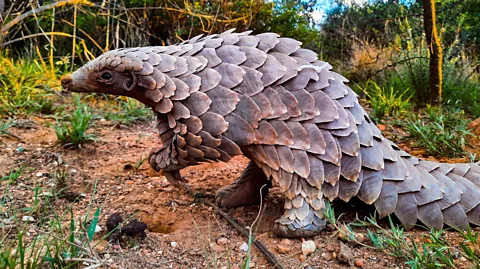
It took a painstaking effort to save three-month-old pangolin pup Stevie.
Stevie was rescued from the illegal pangolin trade in the streets of Johannesburg, South Africa, in 2021. For the next six months, specialist veterinarian Kelsey Skinner meticulously carried out his medical care, fed him meals of cat milk formula and helped him learn to forage naturally.
A Temminck's pangolin, Stevie is named after Steven Koen, a South Africa Police Service (Saps) K9 officer who played a big role in arresting an "elusive" pangolin wildlife trafficker who was trying to sell the pup, says Skinner. It took several days and lot of intensive negotiations to catch the trafficker during a sting operation, she adds.
The pup should have still been with his mother, but she was nowhere to be seen, says Alexis Kriel, co-chair and executive director of the African Pangolin Working Group (APWG), a South Africa-based non-profit.
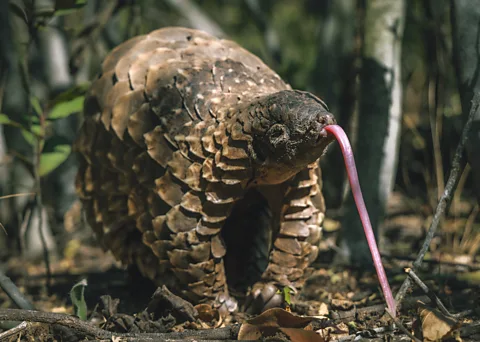
Sometimes known as scaly anteaters, since their diet mainly consists of ants and termites, pangolins are the world's only truly scaly mammal. They are often considered to be the most trafficked wild mammal in the world. Over a million pangolins are thought to have been illegally traded internationally from 2000 to 2016, while seizures of pangolin products from 2016 to 2024, which capture only a fraction of the overall trade, show at least half a million more being traded during this time.
Over the past few decades, law enforcement and non-profits in African countries have increased their efforts to rescue wild pangolins caught up in the black market. In South Africa, some 80% of the Temminck's pangolins retrieved are still alive.
Still, rescuing them is only the first step. Trafficked pangolins are often young or injured but also don't fare well in captivity, making them notoriously difficult to rehabilitate. That's where specialists like Skinner come in. After many months of her and others' support at the Johannesburg Wildlife Veterinary Hospital, followed by several more months acclimatising him to his release site, Stevie was successfully returned to the wild in 2022.
His rehabilitation is part of a growing effort to return trafficked pangolins back into their natural habitat – a long, tricky process that may be essential to saving this bizarre, often overlooked mammal.
A persecuted animal
African pangolins are now at the very heart of illegal wildlife trafficking, one of the world's largest organised crime sectors. Demand for them comes largely from East Asia, where their scales are used in traditional medicine and their meat considered a delicacy, although the US is also a major market, driven by the fashion industry. Countries passed a total international trade ban on pangolins in 2016, but the illegal trade persists.
 Claire West
As trafficking has pushed Asian pangolins to the verge of extinction, Africa has now become the main source for this illicit global market. Together, trafficking, habitat loss and hunting by locals (for traditional medicine and bushmeat) mean all four African pangolin species are now threatened with extinction.
South Africa is among the countries that have become a source for illegal pangolin trading, as well as domestic consumption. Non-profits including the APWG support the country's law enforcement to conduct sting and anti-poaching operations, and in recent years the country has had a significant number of pangolin seizures.
Most of the pangolins in the APWG's care are rescued from traffickers in intelligence-led sting operations or stop-and-searches, where pangolins are recovered from vehicles, says Kriel. "We are able to save a small fraction of pangolins in the illegal trade but we don't know where the rest are going," she says.
Nicci Wright, co-chair and executive director of APWG, remembers being unable to do much to help the first pangolin that was brought into her care after being rescued from trafficker in 2008. "Having no experience with pangolins at that stage, the best thing I could do was release it back into a safe habitat and hope for the best," she says.
She has since grown a far deeper practical understanding on how to support pangolins seized from wildlife traffickers, which are usually physically and psychologically compromised.
"Some are concealed in bags and placed in car boots," says Wright. "They may be kept for weeks under these conditions that could lead to injuries, dehydration and compromised immunity."
Without medical attention, there is a high chance the pangolin could die soon after being returned to the wild, she says. "Hence the need to treat and rehabilitate the pangolin before its release."
Stevie's return to the wild
During the sting operation that led to his rescue, Stevie the pangolin was found in a cardboard box in a car boot, says Wright. "There was a cabbage leaf inside with him which may have been a food offering, but pangolins obviously do not eat cabbage."
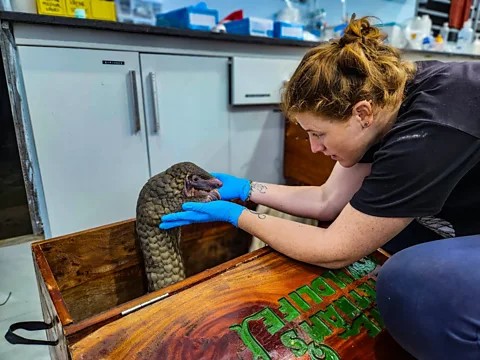
Stevie was moved to the Johannesburg Wildlife Veterinary Hospital, where Skinner put him through the usual checks for rescued pangolins. She weighed him, examined him for possible injuries or infections, gave him fluid therapy to address his dehydration, and drew blood to check the health of his organs. He was also given immune boosters and a small supportive electrolyte tube feed.
Thankfully, unlike many rescued pangolins, Stevie was in a healthy condition – in fact, he was alert and could move around with ease. Still, the pup – whose scales were still too soft to defend him from predators – was nervous, curling into a ball whenever he was approached, Skinner says. She took plenty of quiet time with him alone to get him used to her.
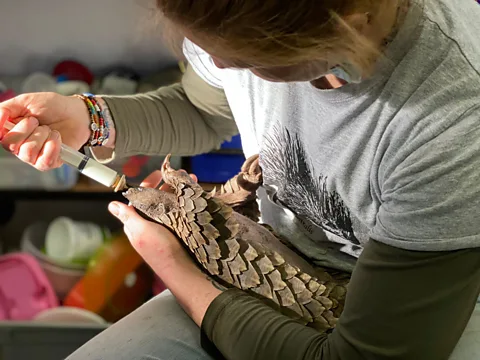
Since he would still have been feeding from his mother, she bottle-fed him cat milk formula, although it took him 10 days to fully accept the artificial milk and bottle. "Initially, he disliked the artificial teat but with patience, he got used to it and fed well," says Skinner. She walked him out daily in natural habitat, where she would flip rocks and expose ants and their eggs for him to forage. "At his age he would have been out foraging with his mother in the wild," says Skinner.
Once weaned off the milk at six months, he began to grow stronger every day, and after reaching 6kg (13lb) at nine months was transferred to his release site, the Manyoni Private Game Reserve in Zululand. "At this weight, pangolins are strong enough to maintain their protective curl and their scales are hard enough to withstand predator attacks," says Skinner.
More like this:
For five more months, Stevie was cared for by the reserve's pangolin monitor Donald Davies and his team, who let him outside daily to forage in the reserve and monitored his adaptation. By the time he was 14 months old, he was ready to fend for himself. He was fitted with two telemetry trackers and released for good.
Trackers help experts observe the natural movements and behaviours of released pangolins, as well as threats. "Electric fences pose a threat to pangolins though there have been other natural incidents: one pangolin was trampled by an elephant while one was eaten by crocodile," says Wright. "This information would have been unknown if the pangolins did not have telemetry tags fitted."
They can also help reveal whether the final step of the rehabilitation process has occurred: reproduction. Stevie's tracker shows he has now begun regularly crossing paths with females, including visiting them in their burrows, says Wright. "It's pretty guaranteed that he is now a father to a few pangolin pups," adds Skinner.
'Pangalorium'
Lesser-known species like pangolins often struggle to secure the funding and policy protections that flow more readily to more familiar wildlife such as elephants and big cats, says Araluen Schunmann, director of the Pangolin Crisis Fund at the Wildlife Conservation Network, a US-based non-profit.
 Gareth Thomas
Rehabilitation plays "a crucial role not only for the individual pangolins saved from illegal trade and eventually released back into the wild, where some go on to breed successfully, but also for broader conservation landscape initiatives", says Schunmann. "Conservation requires public awareness and support," she adds, praising the APWG's efforts to keep pangolins in the public conversation as filling a critical role.
Since 2016, the APWG has facilitated the release of 85 pangolins into suitable pangolin habitats across South Africa, including areas where they were locally extinct such as the Manyoni Private Game Reserve. In February 2025 the APWG set up the Pangalorium, a purpose-built pangolin rehabilitation facility, in the Lapalala Wilderness Reserve in South Africa, with Skinner as its first resident vet. The centre gives specialist care to pangolins rescued from the illegal trade and serves as a base for research and education.
While the APWG was the first pangolin organisation in South Africa, in recent years a wide landscape of other bodies has developed, sharing the load of campaigning, retrieval, rehabilitation and release. The release of each pangolin involves a myriad of people, says Wright.
Action on every level is needed to dismantle the vast pangolin trade networks, adds Wright – everything from raising public awareness to building legal capacity and changing policies around pangolin-related crimes. "The key to saving pangolins species from extinction is collaboration and the sharing of knowledge with other pangolin range states across Africa," she says.
Still, rescuing and rehabilitating pangolins should always form part of pangolin conservation, Wright says. "You cannot conserve a species if there are no individuals left to conserve."
A pup for Ditsi
Ditsi, another pangolin pup, was rescued by South African law enforcement from a trafficker near Vryburg, a town in northwestern South Africa, in 2021. While Ditsi did not have injuries, says Wright, she was extremely traumatised and stressed.
Though Ditsi was shy and scared, she was able to forage when she was taken out for her daily walks, says Wright. Ditsi later joined Stevie at Manyoni Private Game Reserve where she went through the same soft release process of daily foraging walks followed by a safe location to sleep.
 Kelsey Skinner
"It was a process that was repeated until we were satisfied that she was doing exceptionally well at foraging on her own and displaying natural behaviours," says Wright. "We also wanted to ensure that she had met the right target weight of 6-6.5kg [13-14lb] for release."
A telemetry tag was fitted on Ditsi and she was released in February 2023.
Several pups have now been born from APWG's released, tagged females, says Wright. They include Ditsi. "Two years [after her release], camera traps stationed outside her burrow caught footage of a pup coming out from the burrow with Ditsi. She was now a mum."
Seeing successes like these makes it worth all the work, Kriel says. "Rehabilitating pangolins is very challenging process with many ups and downs and losses. So those that make it back to the wild after all the efforts keep you motivated to continue saving as many of them as you can."
--
For essential climate news and hopeful developments to your inbox, sign up to the Future Earth newsletter, while The Essential List delivers a handpicked selection of features and insights twice a week.
