Farm's delight after six white owlets found nesting

 Robert Jacobs
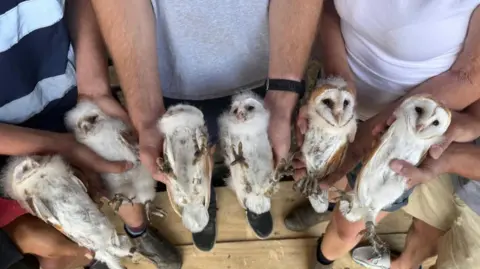
A nest of six barn owlets has brought good news to a farm after a challenging period.
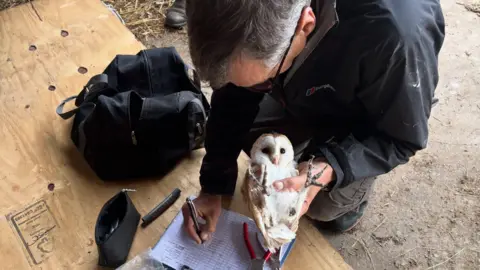
The fluffy birds - which are estimated to be between 40 to 50 days old - were discovered at Moor Farm, near Peterborough, and were ringed on Thursday as part of ongoing conservation work.
Judith Jacobs, the farm's owner, said the owlets were thriving and had lifted spirits after the farm was the target of six suspected arson attacks this summer.
Simon Dudhill, who monitors the birds for Peterborough City Council's barn owl recovery scheme, said finding six owlets sharing a nest was "exceptionally good" and was the largest brood he had encountered in 2026.
He added he had ringed more than 260 owlets in Cambridgeshire this year.
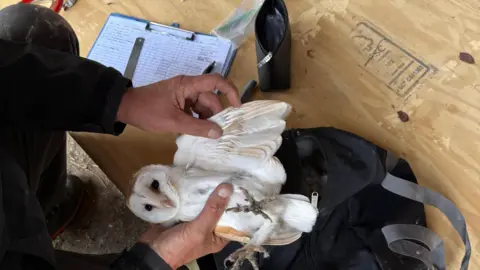
Each bird from Moor Farm was fitted with a metal ring carrying a unique identification number issued by the British Trust for Ornithology.
The ring's details allow conservationists to track individual birds and provides information about their movements.
 Robert Jacobs
Jacobs said: "It's very exciting as we had none last year. We try and encourage wildlife as much as we can.
"We have created a lot of hunting paths for the owls away from the main road, so they can hunt safely, because the biggest predators for barn owls are cars."
She said the six owlets, which include three females and three males, are each about three days apart in age.
"Simon measured the length of their fourth feather, which tells their age, and from the colour of their feathers, if they are spotty they are females and the non-spotty ones are males," she added.
 Robert Jacobs
Dudhill, who works for the Wildlife Conservation Partnership, said 2026 had been a much stronger breeding year for barn owls.
"I have ringed quite a few groups of five and four owlets this year. But this is the first brood of six I have found," he added.
"Over the last couple of years, we have seen a decline in the number of babies but not adult barn owls.
"Last year we found a lot of adults in boxes but they did not breed. This is all related to food. If there isn't enough food around, then they don't breed.
"This year has been completely different. I personally found barn owl numbers have increased dramatically. But there are still some areas in Cambridgeshire that have not found as many babies as I have," he said.
Despite monitoring barn owls for 15 years, Dudhill said the experience "never gets boring".
"When you open a box, you have one or two or three little faces looking at you. It's just as exciting now as the first time I opened a box," he added.
Do you have a story suggestion for Peterborough? Contact us below.
Follow Peterborough news on BBC Sounds, Facebook, Instagram and X.
