Jeff Koons: Sex, shock tactics and cold hard cash


Cheesy purveyor of ostentatious kitsch or witty satirist? Alastair Sooke examines the questions and controversies surrounding the celebrated artist Jeff Koons.
Is any artist in the world more controversial than Jeff Koons? Since emerging in the 1980s, the American has been a media sensation – perhaps not quite in the same league as Madonna or Lady Gaga, but not far off them. Admired and reviled in almost equal measure, he is manna to magazine and newspaper editors and television producers, who have profiled him and passed judgement on his artistic provocations for decades. Vanity Fair is the most recent publication to run a substantial piece about him, ahead of a new retrospective of his work – the first major chronological overview of his career for more than 20 years – which opens at the Whitney Museum in New York City later this month.
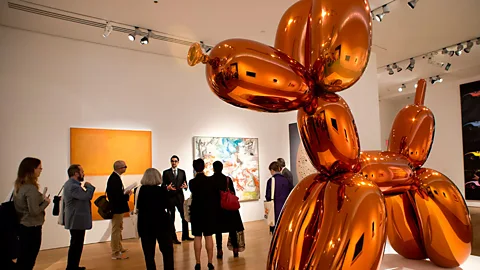
All of the publicity that Koons has garnered has done little to harm the market for his work: last November, his stainless-steel sculpture, Balloon Dog (Orange) sold for $58.4m, making it the most expensive work by a living artist ever sold at auction. Not since Andy Warhol has a single artist been so scrutinised, attracting this much excitement, opprobrium – and cold, hard cash.
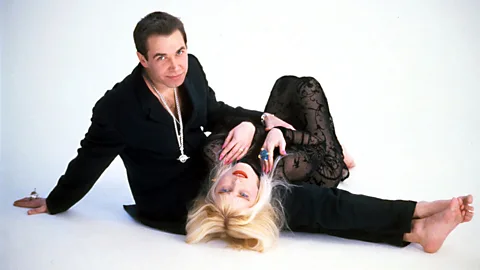
So what’s his secret? On one level, it is simple to understand why Koons is so controversial: he makes frank art about sex. Sometimes this art is explicit, even on the cusp of pornographic, as in the case of his series Made in Heaven (1989-91). In sculptures, photographs and a billboard displayed in lower Manhattan, Koons presented himself in graphic clinches with his former wife Ilona Staller, aka the Italian porn star ‘Cicciolina’.
Often, Koons imbues seemingly innocent objects with surprising sexual energy and significance. Thus, in the artist’s world, a vacuum cleaner can display both male and female sexuality (“It has orifices and phallic attachments,” he once said). A sculpture of a half-naked blonde woman embracing a Pink Panther cuddly toy is, he suggests, “about masturbation”. Even a large vase filled with 140 colourful flowers can have carnal associations. According to Koons, “They are very sexual and fertile, and at the same time they are 140 assholes.”
Kitsch or cool?
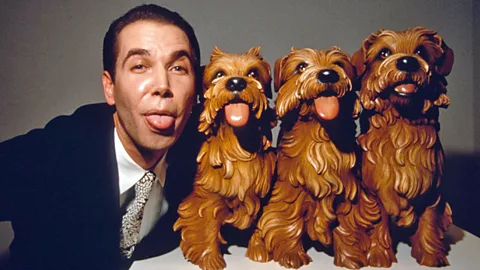
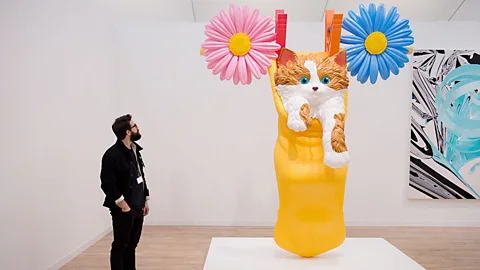
But the sexual content of his work isn’t the sole reason why some people get riled by what Koons makes. His art can seem shocking because it appears to be in such appalling taste. Taste is a subjective, slippery thing to define – but when we look at a painting or a sculpture by Koons we know instinctively that it more closely resembles the “low” world of bad taste than that of “high” art. Take his polychromed wood sculptures of poodles and puppies, two smiling “Winter Bears” or a children’s toy: these garish images are saccharine and sentimental – the sort of stuff that ordinarily we would encounter in a Disney theme park or, on a smaller scale, as kitsch trinkets on a granny’s mantelpiece.
“Koons’s art rarely feels chic,” Scott Rothkopf, the curator of the Whitney retrospective, writes in the accompanying catalogue. Unlike other contemporary art, which can politely “fit” with the tasteful decor of a wealthy collector’s home, Koons’s art, says Rothkopf, “seldom matches the sofa”.
On the face of it, this doesn’t sound tremendously contentious: so Koons gives expensive interior designers a few headaches. Who cares? But what really bothers some commentators is that nobody can tell whether or not Koons makes his art with a straight face. When he employs complex and expensive casting techniques to replicate perfectly in aluminium inflatable pool toys in the shapes of dolphins, monkeys, caterpillars and lobsters, does he genuinely believe that they look beautiful and are worth commemorating as art? Or, as many people assume, is he being somehow ironic – drawing upon the kitsch, everyday imagery of popular culture to make satirical points about society?
Presenting domestic appliances such as vacuum cleaners beneath flattering fluorescent lighting and within acrylic display cases as though they were objects to be venerated, as he did in the ’80s: Koons must have been making a joke about the corrosive and insidious way in which capitalism has us all in thrall, right? Certainly, Banality – the title of arguably the most important exhibition of his career, staged across three international galleries simultaneously in 1988 – suggested that something was rotten within the soul of the West.
Greed is good
According to one curator I spoke to, the debate about his sincerity – of whether or not he is “for real” – is “the million-dollar question (or much higher in Koons’s case). My hope is always that he is a satirist of Jonathan Swift-like proportions, but it remains unclear.” This question is complicated by a little knowledge about the artist’s biography. Born in Pennsylvania in 1955, Koons studied art before moving in 1977 to New York, where he got a job at the Museum of Modern Art, recruiting new members at a desk in the lobby.
For aficionados of the artist, a kind of mythology has sprung up around this job. Supposedly Koons would wear flamboyant outfits including an inflatable flower hanging from his neck, and he was very good at it: “I was the most successful salesman in the museum’s history,” he recalled. During the ’80s, he also worked as a commodities broker on Wall Street, in order to raise money for the production of his flawless sculptures.
All of this has led some people to believe that Koons is a genius as a salesman rather than as an artist. For his critics, he is synonymous with the decade in which he made his name: the ‘80s – an era of greed, spectacle and excess. In other words, for some people the meaning of Koons’s art is bound up, above all, with money – an idea reinforced by the record-breaking success of Balloon Dog (Orange) at auction last year.
As a result, following the financial crisis of 2008, perhaps Koons is losing some of his relevance and importance. After all, now we live in an age of austerity, increasing inequality and anti-capitalist protest – the antithesis, you could argue, of the sort of world that brand Koons has come to represent. Today we are no longer so interested in monumental shiny sculptures traded as totems for the super-rich.
Perhaps. But there is another school of thought regarding Koons – one that casts him neither as Swiftian satirist nor as artist-lapdog for international billionaires. And according to this view, Koons is the most important artist of his generation.
“The expense of fabricating Koons’s pieces to his exacting standards is certainly a factor in their sky-high prices,” Rothkopf tells me. “But Jeff’s prices also have something to do with the fact that he is that rare artist who has experienced great popularity, as well as critical and curatorial acclaim. An artist is usually lucky to get one or the other, but – like Warhol – Jeff hit a sweet spot in garnering all three. For the market, that’s probably a sign that his work will have traction for the long haul.”
One man who has already been involved with Koons for a long time is his British former dealer, Anthony d’Offay, who has donated more than 20 important works by the artist to the National Galleries of Scotland and the Tate as part of the Artist Rooms collection. Back in the ’90s, it was d’Offay who put up the money so that Koons could start work on his Celebration sculptures. These included Balloon Dog (Orange), which d’Offay subsequently sold to the American industrialist Peter Brant for $3.5m – nearly one seventeenth of the price achieved when Brant consigned it to auction last year.
“Jeff is never a satirist,” d’Offay tells me. “He is always dead-on serious.” Really? “Yes, really. He means it. He is a sort of preacher man: he has a vision and he believes that art can change people. When you read all the stuff he says, first of all you think: he can’t be serious. But he is serious.”
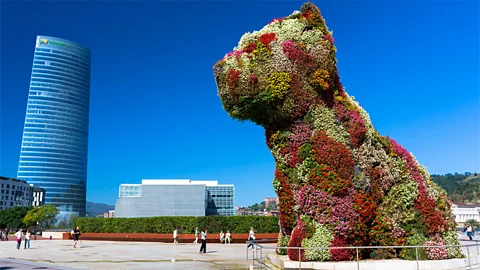
Even when he calls one of his exhibitions “Banality”? “Yes,” d’Offay replies. “Banality means that you don’t have to go to the Courtauld [Institute of Art] and study Cezanne to love art, or let it strengthen and help you. Jeff is saying, there isn’t high art and low art – one in the museum that is the real thing, and then everything else trying to get there. He means that art isn’t for sophisticated people, it’s for everyone.”
He pauses, before talking about Koons’s sculpture Puppy (1992), a 40ft-high piece of flowering topiary shaped to look like a terrier. “What a wonderful thing. Once you’ve seen it, you never forget it. I think Puppy is one of the most remarkable sculptures in the history of art. Everybody loves it. It’s like Michelangelo’s David: there isn’t a person who looks at it who doesn’t think what a miracle this is.”
Alastair Sooke is art critic of The Daily Telegraph
