The lonely road to Europe's Arctic edge

 Fredrik Ahlsen/ Visit Norway
Most visitors come to Norway for its dramatic western fjords. But the country's most extraordinary drive heads in the opposite direction – into a treeless Arctic wilderness where Europe finally runs out.
In Norway's remote far north-east, the small town of Tana Bru sits at the crossroads of four very different worlds. Across the river and to the north, a quiet road leads over a high plateau to the forgotten fishing village of Kongsfjord. South lies the Sami community of Karasjok. South-east is Kirkenes and the Russian border. But the true treasure lies in a shore-hugging road that takes you further east than any other in Western Europe.
This is the E75. It branches east from the E6 – Norway's longest road, which runs 2,578km (1,602 miles) from south of Oslo to Kirkenes. Here, the traffic falls away and the landscape begins to feel like nowhere else in Norway. Unlike the country's natural drama further south-west there are no cliffs, no green meadows; only a narrow strip of tarmac that unfurls beneath a long line of mountains, along a narrow coastal plane above the widening inlet of Varangerfjorden. I can no longer see tourist Norway, not even in the rear-view mirror.
Into the true Arctic
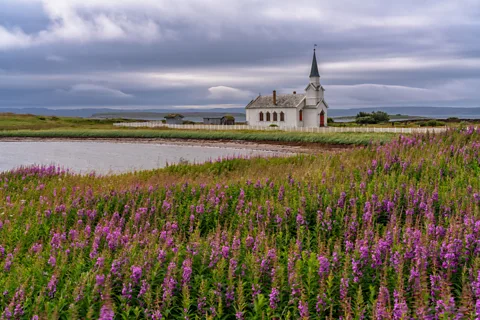
I've only been driving for about 20 minutes when, out on the shoreline, the sun picks out the white-spired structure of Nesseby Church, one of the loveliest in Norway, as storm clouds gather and purple mountains that could be Norway, could be Russia, provide a backdrop far across the water. Poignant and glistening from a distance, the church is so perfect it feels like a miracle. And perhaps it is. Built in 1858, it was one of few buildings to survive the scorched-earth destruction of defeated German soldiers as they retreated at the end of World War Two. Up close, wild seabirds wheel and screech in strong winds, dodging the spire as they go.
 Getty Images
A little further on, after rounding a headland where the road is all that separates mountain and sea, the E75 eases down into Vestre Jakobselv, a narrow village of colourfully painted wooden homes fringed with A-frame racks where salted cod, hung like Polaroid prints, dries in sub-Arctic winds.
Drive it
One of Norway's 18 National Scenic Routes, the Varanger Scenic Route follows the E75 and Fv341 for 160km (99 miles) from Varangerbotn to Hamningberg, tracing the country's remote Arctic coastline. Allow a full day, although two days gives time to explore Vadsø, Vardø and Ekkerøy.
Best time to go: June to September for long daylight hours and wildlife. Winter offers snow-covered landscapes and the Northern Lights but requires confidence driving in Arctic conditions.
Around 18km later, I reach Vadsø. Vadsø is what passes for a city in these parts despite a population of fewer than 6,000 souls. It is shrouded in low clouds and its streets are empty. The view out into the frigid Barents Sea runs only for a few hundred metres before disappearing into sea-level mists. On land, the rain comes in horizontal sheets. It feels like Siberia.
"In winter, this would be a good day," Astrid Carlsen, a local hotel manager out walking her dog, tells me.
When I venture that it must be a difficult place to live, she looks out to the horizon.
"Yes, it can be hard. But there is a strange beauty to this place in winter. It makes you appreciate things, like sunshine, a warm house, family. Live here long enough and you come to see the wintertime as something special. You even look forward to its return."
 Getty Images
And yet, by morning the clouds have gone, the sun is shining; there is no sign of Astrid.
Bathed in the crystalline light of the north, Vadsø is a place transformed. It is possible to see across the Barents Sea to Kirkenes and beyond to Russia. Small clusters of birders stake out the Steller's eider, a celebrated summer visitor to these parts, while elemental blues, greens and whites define the boundaries of land, sea and sky. It no longer feels like Siberia. As I travel beyond Vadsø, all trees are gone and the mountains flatten; the landscape held in thrall to an austere moor-like beauty.
The true Arctic, it turns out, is defined not by the Arctic Circle, says Rolf Anker Ims, who knows this land better than anyone. A professor of ecology at the University of Tromsø, Ims is a world renowned expert in Arctic ecosystems. He spends part of every year along the road, studying what he describes as the only truly Arctic system in mainland Europe.
"If you use the ecological definition, the Arctic is defined by those areas north of the Arctic treeline," he later explained to me. "The Arctic is restricted to those areas where there are no trees, no forests, at sea level. You cross that border between the Arctic and the Sub-Arctic at Vadsø."
 Getty Images
Another way of looking at it, he says, is that the Arctic is where the average daily temperature in July is lower than 10C.
Apart from here on the Varanger Peninsula, only small strips of mainland Europe – found around Nordkapp, on the remote Nordkyn Peninsula, some areas in Iceland – qualify. This peninsula covered by the E75 is by far mainland Europe's largest slice of the Arctic.
As I drive, villages come and go. At Ekkerøy, the village occupies a narrow isthmus between two bays, a charming hamlet with little to shelter it from the force of Arctic wind and weather. The road continues into the east, passing empty beaches and tiny, one-street towns.
At Europe's outer edge
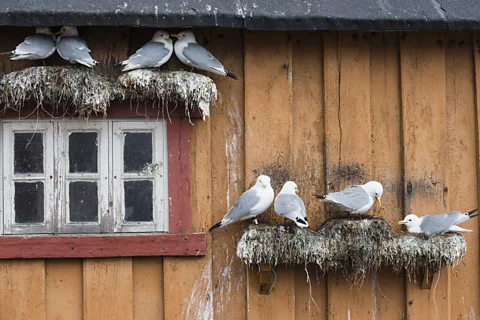
At Vardø, the E75 reaches its eastern end. Vardø is actually an island but an undersea tunnel connects it to the mainland. The road emerges from beneath the sea alongside a quiet harbour, where gulls have colonised every available ledge to nest and squabble. Here, further east than St Petersburg, Vardø sits upon the outermost rim of Western Europe.
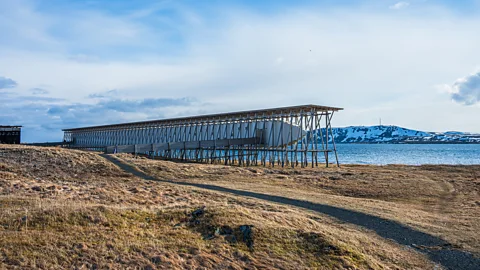
This remote isle is also known as the Salem of Norway. In the 17th Century, 91 local women were tried and executed as witches. Now, the Steilneset Memorial, designed by Swiss architect Peter Zumthor, is reclaiming these women and their stories from the past on the site where many of the executions took place. In the striking memorial hall, there is an illuminated window for each of the victims.
 Getty Images
Burnt at the stake here in 1612 was Lisbet, convicted of "having cast a fatal spell on a child and two goats". On 13 May 1620, it was the turn of Karen Edisatter, for calling down sickness and death on several persons, her guilt proven when she was "subjected to the water ordeal and floated like a bob". Find Thorsden died on 31 August 1621 for "giving Christen Nilsen pains every time the two of them quarrelled". Each story is a fascinating tale of superstition and hardship, a strangely intimate catalogue of neighbourly bickering that cost these women their lives.
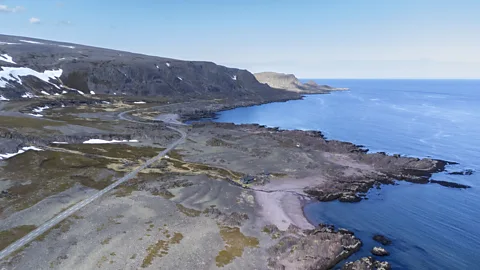
Haunted by these tales, I turn off onto the Fv341, a northbound road that hugs a coastline that itself seems otherworldly. Nightmarish black shards, great striations of geological time, jagged ramparts of petrified waves – all along this road, there is a feeling of an entire continent groaning and pushing the mountains towards the water. At a narrow pullover, I step out of the car and look out to sea, feeling the weight and shadow of an entire continent behind me.
More like this:
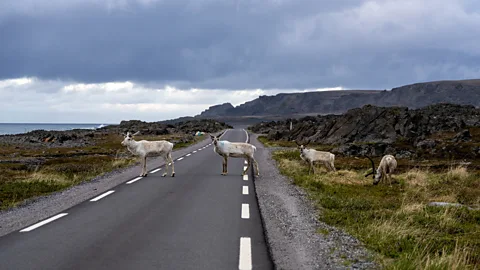
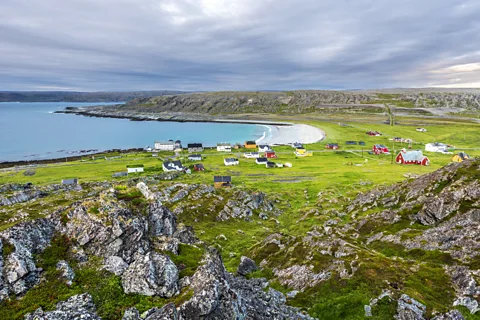
But all roads must end somewhere, and the Fv341 does so just beyond a small, grassy river delta populated with small herds of wild reindeer. Here, Hamningberg huddles beneath high hills on the northern shore of a perfect arc of bay. Once one of the largest fishing villages in north-eastern Norway, it was abandoned in the 1960s.
 Getty Images
What must it have been like to live here, I wonder. To live somewhere not just physically remote but a place where an awareness of isolation hangs above everything, like the low winter clouds of Varanger. There is no one left to tell us, and the gulls that screech in the wind are having none of it.
I stay, and sit in silence by the old church, then the crumbling docks, before the wind drives me back into the car. Reluctantly, I start the long journey back towards the world and its noise.
CORRECTION: A previous version of this story stated that Vardø was further east than Moscow. That has since been corrected.
--
If you liked this story, sign up for The Essential List newsletter – a handpicked selection of features, videos and can't-miss news, delivered to your inbox twice a week.
