An epic Dubrovnik journey that ditches the crowds

 Ivan Vuković
Dubrovnik has long been one of Europe's most over-touristed destinations. Now, a new Camino footpath is revealing a different side of the city beyond its medieval walls.
"Five-thirty in the morning?" I asked, incredulously.
"Yes, before it gets too hot," my friend Ivan Vuković (no relation) replied.
After I discovered Europe's newest Camino pilgrim trail had opened in March, I convinced Ivan to lace up his trainers and join me for a three-hour hike in July – peak season in the world's most overcrowded city, Dubrovnik, Croatia. Each summer, throngs of tourists flood the medieval town's cobblestone streets, leaving a lingering aroma of sunscreen. I was staying in the heart of the bustling Old Town, and I was looking forward to escaping the crowds and connecting with nature.
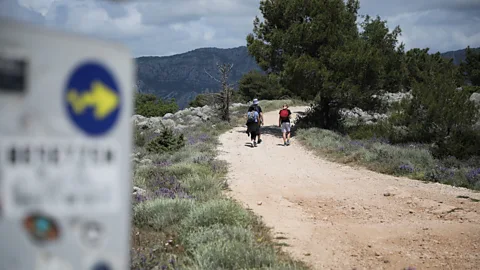
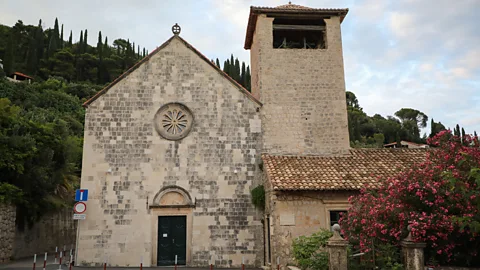
Known as the Camino Dubrovnik – Međugorje, the seven-stage route starts in front of the Church of St James in Dubrovnik, and winds 145km north-west, crossing the border with Bosnia and Herzegovina and ending at the Church of St James in Međugorje, one of the Balkans' most important pilgrimage destinations. The route follows centuries-old trails used by traders and pilgrims to journey from the southern Adriatic coast into the remote Herzegovinian hinterland, offering modern-day travellers a new perspective on the history of one of Europe's most popular cities and its surrounding landscapes.
 Ivan Vuković
For centuries, Dubrovnik was an independent maritime republic that relied on trade, and until the early 1990s, Bosnia and Herzegovina and Croatia were part of the same country, Yugoslavia. "Pilgrims walk along historic infrastructure, including medieval water systems, traditional rural paths, railway routes and areas marked by continuous Christian pilgrimage tradition," said Miroslav Drašković, Director of the Dubrovnik Tourist Board.
Approximately 61km of the hike is in Dubrovnik-Neretva County. The entire route takes around seven days to hike and passes through Dubrovnik, the suburb of Mokošica and the villages of Orašac, Slano, Ravno and Hutovo, ending in Međugorje, luring intrepid travellers out of the Old Town tourist bubble and into rural local life.
According to the city's mayor, Mato Franković, the idea to create a Camino was hatched three years ago as part of its "Respect the City" initiative to guide travellers away from the overcrowded Old Town and focus on sustainable tourism. "We also saw it as a great opportunity that tourists, [local residents] – all those that are going to walk – would see for the first time some areas that are completely hidden," he told the BBC.
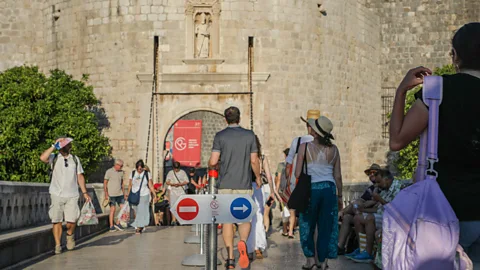
Ivan, a local tour guide, grew up in Dubrovnik, and has seen this medieval walled city's transformation firsthand. He explained that in the 1980s, 4,000 to 5,000 people lived in the Old Town. "Now, there are a maximum of 700 people living in the Old Town. It's Airbnb business." By 2019, Unesco had warned that Dubrovnik's World Heritage status was under threat as cruise ships, tour buses and record visitor numbers put increasing pressure on the city. To help control traffic flow in and out of its historic centre, the city has since installed directional ropes at the Pile Gate where most visitors enter.
 Ivan Vuković
In the soft early morning light, we set out to hike part of Stage 1 of the Camino, an 8km stretch starting at the Church of St James to the Strinčjera plateau on Mount Srđ, taking in spectacular Adriatic Sea views along the way. After passing Buža gate – the northern entrance to the Old Town – we followed roads leading out of the city and climbed a steep series of stairs. The crowds disappeared and it was so quiet we could hear the beats of our footsteps.
"The aqueduct is beneath us," Ivan said, explaining that part of the Camino follows this little-known monument.
Today, gaggles of visitors in Dubrovnik's Old Town fill their water bottles at the large Onofrio Fountain, yet few realise that the city owes much of its development to the aqueduct that historically carried that water. Located 12km from the Old Town, the limestone aqueduct was built in 1438 and delivered fresh water to Dubrovnik via a revolutionary system.
"It's a marvel of engineering, because you have to bring the water over the hill, through the canals to the Old Town," Ivan said. He explained that since this ingenious gravity-fed aqueduct system channels water down to the walled city, "it goes through the limestone and purifies everything and makes it drinkable".
 Ivan Vuković
After two kilometres, we stopped to take in the views of the Old Town at a lookout spot. Onofrio's aqueduct depositories were visible, as were the lines of tourists snaking through the Old Town below us. We then continued along part of the Camino known as the Križni put (Way of the Cross). Ivan and other guides are now encouraging visitors to walk this part of the Camino to the 412m-high peak of Mount Srđ to better understand Dubrovnik's religious roots.
Plan your trip:
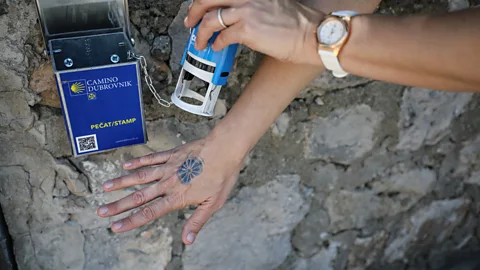
Download the Camino app to map your route and book accommodations along the way. The full Camino is best for experienced hikers, but beginning and moderate hikers can walk the Camino from the Križni put (Way of the Cross) to the Strinčjera plateau on Mount Srđ in the early morning hours to beat the heat and avoid crowds. You don't need a Camino passport to travel the trail, but if hikers would like to purchase one and collect stamps along the way, they're available at Narodne Novine, Vukovarska 18.
"The switchbacks climbing up Mount Srđ, which once served as vital trade and military routes, have naturally transformed over time into the [Way] of the Cross," Dubrovnik tour guide Ivona Čović told me over coffee the following day.
The majority of Croatians are Catholic, and when the nation gained independence in 1991 from the former Yugoslavia, the Way of the Cross was established along this zigzagging route, with stations commemorating Christ's Passion. Fourteen bronze plaques sit on each corner of the switchbacks and represent the Stations of the Cross, depicting Christ's final journey.
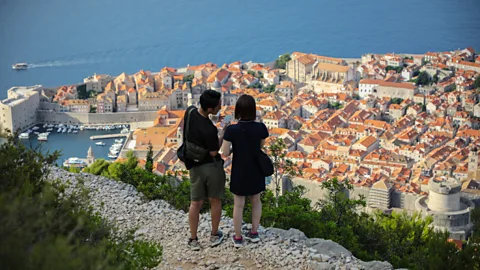
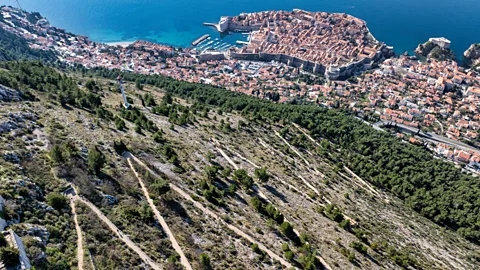
I counted each station on the steep, rocky trek up Mount Srđ, sweat trickling down the back of my neck. By the fourth switchback, I could see the Old Town and the island of Lokrum. "Hello, beauty," Ivan said, stopping to take a photo of the city below. As we climbed higher and higher, the Old Town spread out before us like a grand white castle perched on a cliff, the Adriatic Sea dotted with boats that left long trails in their wake.
 Šime Fabris
The Camino winds around half of Fort Imperial, which crowns Mount Srđ. This stretch of the trail offers sweeping views over Dubrovnik, but Fort Imperial is also a great pitstop for hikers wishing to learn more about the layered history surrounding them. The Homeland War Museum, which highlights Croatia's war of independence from 1991-1995, is located here, and tells one chapter of Dubrovnik's tangled history.
"Some members of my family born during World War One, when [Dubrovnik was part of the] Austro-Hungarian Empire, could live in six different countries without moving," Ivan said. "There is a saying from Dubrovnik's grannies: 'When you wake up, take a look at the top of the hill to see which flag is there.'"
More like this:
Napoleon ruled Dubrovnik from 1806 to 1813, leaving a lasting mark on Mount Srđ. "Fort Imperial was built in 1812 by the French army," Dubrovnik tour guide Lidija Begić later explained. "However, its more recent history holds particular significance for Dubrovnik and its people."
In October 1991, the Yugoslav People's Army (JNA), supported by Serbian and Montenegrin forces, attacked Dubrovnik. The communication tower on Mount Srđ was heavily damaged, cutting off all telephone and radio communications and leaving the city in an information blackout during the first days of the Homeland War.
 Ivan Vuković
For many locals, Fort Imperial is a symbol of Croatian defence – a stronghold that helped prevent the Yugoslav People's Army from capturing Dubrovnik. After looping around Fort Imperial, Ivan pointed out the MiG-21 aircraft donated by the Croatian Ministry of Defence that commemorates the role pilots and aircraft played in the defence of Dubrovnik in July 1992.
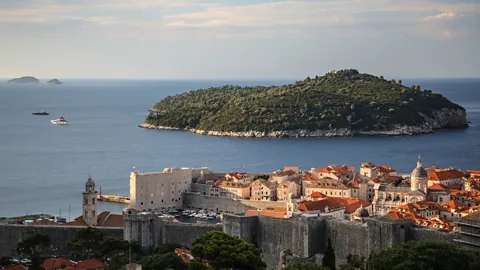
We continued walking the Camino along the Strinčjera plateau on Mount Srđ, pausing to take in the sweeping vista. We weren't alone: some hikers had stopped to rest on limestone rocks and admire the postcard view overlooking Dubrovnik's scenic Lapad peninsula, Daksa island and the Elaphiti islands. Although I've visited Dubrovnik roughly 20 times, I'd never seen it from this vantage point.
Many locals have also embraced the new Camino, saying it's reconnecting them with the same paths their forefathers once used. "My favourite part [is] the walk along the old aqueduct in Rijeka Dubrovačka," said Begić. "I am emotionally attached to everything that our ancestors achieved and left to us, and as well the views from the trail are breathtaking – particularly at sunset."
Franković said that he's walked different sections of Stage 1, which extends 18km from the Church of St James to Mokošica, a suburb of Dubrovnik, but one part of Stage 3 (which goes from Orašac, a scenic village, to the seaside village of Slano) bowled him over: the hike from above the historic village of Trsteno to Slano.
 Ivan Vuković
"That route over there, it's unbelievable," Franković said. "It just suddenly opens in front of you. The sea, archipelago, Elafiti islands... you see Mljet island, you see Korčula. And it was clear weather, you could see all the way out to the Lastovo [island]. You just would want to stay there."
By the time we backtracked to Fort Imperial, we'd hiked nearly 10km; not bad for 09:00 on a Monday. We decided to treat ourselves to a gigantic bottle of water, bijela kava (white coffee) and dessert for breakfast at Panorama Restaurant and Bar, which is adjacent to Fort Imperial and aptly named for its bird's-eye views.
I took in the beauty surrounding us, gazing down at the Old Town's terracotta rooftops and the clear Adriatic Sea. "We live such fast-paced lives that sometimes we don't even know where we're going," Čović said the next day. "Camino Dubrovnik is exactly what reminds us to slow down and reconnect with what truly matters."
--
If you liked this story, sign up for The Essential List newsletter – a handpicked selection of features, videos and can't-miss news, delivered to your inbox twice a week.
