Why 'Asia's cleanest village' bans tourists on Sundays

 Jamie Fullerton
Tourism transformed Mawlynnong's fortunes. But after decades of welcoming visitors, residents decided one day a week should belong to themselves.
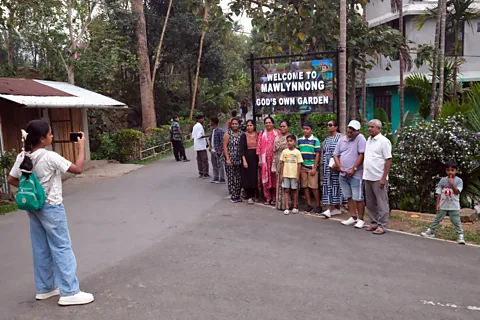
Each Saturday up to 1,000 tourists stream into Mawlynnong, a village of 600 people in India's far north-east. Visitors come to wander its flower-lined lanes, take selfies in its spotless streets and see whether it deserves the title that made it famous across India: Asia's cleanest village.
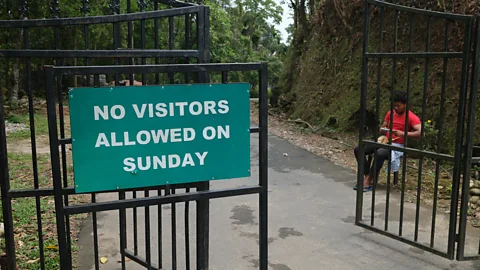
But since January 2026, the black metal gates built across the single road leading into the village have been locked and guarded once a week. Residents have taken the unexpected step of banning day-trippers on Sundays, turning away tourists and the income they bring.
Why would a village whose fortunes were transformed by tourism choose to shut itself off for one day each week?
According to residents, the ban is an attempt to reclaim what they call "real village life".
A culture of cleanliness
Located a few kilometres from the border with Bangladesh in India's Meghalaya state, Mawlynnong became a popular tourist attraction after Discover India magazine named it Asia's cleanest village in 2003. In a country known for its lack of sanitation, this is no small feat. But in Mawlynnong, children are taught to tidy up from a young age, with many taking to the streets each morning before school to sweep the town of dead leaves and empty rubbish bins. Villagers see to the disposal of biodegradables and take pride in public landscaping.
 Jamie Fullerton
Shortly after launching his national Clean India Mission campaign in 2014, Prime Minister Narendra Modi drew further attention to the village in a radio address.
"It has become the habit of the residents to maintain cleanliness," he said. "All this infuses confidence in us that our country will surely become clean through the efforts of fellow citizens."
The accolades made Mawlynnong famous across India. Residents pivoted from agricultural work to tourism, opening guesthouses and restaurants. They built a car park bordered with souvenir and tea stalls, all serving the daily procession of tourist vans filled with visitors.
Two decades after tourists first started coming to the village, with social media attracting new generations, Mawlynnong's village committee decided that rebalance was needed and imposed the Sunday ban on day trippers. The main reason, residents said, was that it allowed the village's predominantly Christian population to spend Sundays at church rather than catering to visitors.
Precious Khongdup, a committee member, told Indian media that the proposal was introduced "to preserve both the cultural identity of the village and the discipline that once made Mawlynnong stand out in the first place".
"It's good for us," said local resident Festival Kharrymba, who charges tourists 30 rupees (23p) to cross the large bamboo walkway in the village centre. "We have time to go to church, for service, for praying," she added. "If tourists are here on Sunday, it's a problem for us."
 Alamy
AlamyEven before the ban, most tourism businesses chose not to open on Sundays. Khongdup said only two restaurants operated, leaving visitors able to walk around the village but with few places to eat or buy drinks.
"We don't want visitors to feel uncomfortable," Khongdup said. "If they want to buy a water bottle [on Sundays before the ban] they couldn't get it, because all the shops were closed… We want visitors to feel the hospitality of the villagers, so that's why we are closing on Sundays."
The cost of success
Visitors who book guesthouse rooms in Mawlynnong through Saturday and Sunday are exempt from the Sunday ban. Taking advantage of this exemption, I decided to spend a weekend here to learn more.
On arrival, I strolled from the carpark towards the village centre, passing wooden benches and "Do not spit" signs warning that "violators will be fined". The gentle snip of secateurs accompanied my walk as I passed men pruning bushes. A tourist in a red dress asked a gardener if she could buy the cuttings piled at his feet. "Have some free!" he said, offering her a handful of branches.
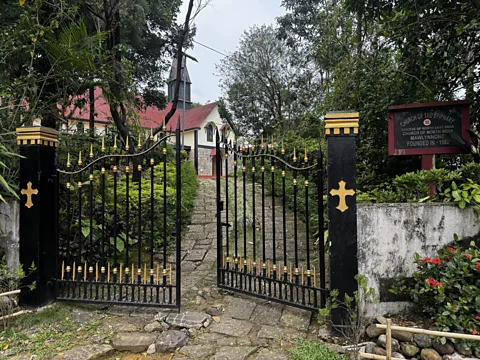
I passed a large, red-roofed church whose sign stated it was founded in 1902. Around 80% of India's 1.5 billion population is Hindu, but European Christian missionaries' visits to Meghalaya from the mid-19th Century influenced strong Christian faith among many members of the Khasi: the state's largest indigenous group.
The church's central role in village life helps explain why residents were willing to prioritise worship over tourism income. Yet tourism has also transformed Mawlynnong in ways that would have been difficult to imagine a generation ago.
 Jamie Fullerton
Khongdup told me that before 2003 Mawlynnong wasn't connected to nearby villages by proper roads, and its change from isolated village to beautiful tourist destination had been swift. When I asked if this change had been good for the villagers, he pointed to some new concrete homes, which he said were bought with tourism income. Just one generation ago, he added, many families here could only afford thatched grass houses.
I wondered if some business owners were frustrated with the church-inspired tourist ban limiting weekend income. But if such dissent existed, it wasn't revealed to me. Outside the church, a local man told me that the village's population was "100% Christian" and that support for the ban was unanimous.
More like this:
Khongdup was quick to acknowledge the benefits tourism has brought. But as well as giving the villagers more time to praise God, the Sunday ban gives them a break from visitors who don't respect the hygiene standards embedded in Mawlynnong culture.
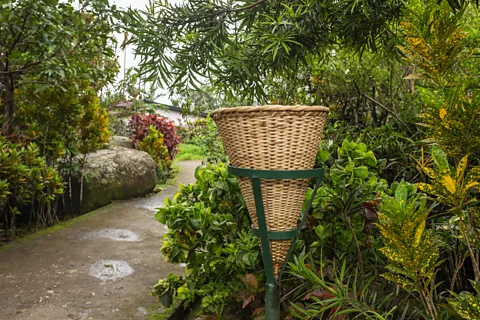
During my trip most visitors seemed to follow the locals' cleanliness lead, carefully placing rubbish in the handmade wicker baskets that lined the village paths. But around the time the Sunday ban was introduced, a video showing plastic bottles tourists had left strewn around Mawlynnong went viral. "If you can't keep our beautiful Northeast clean… please don't come here," one video comment read.
When pressed for reasons for the ban beyond church, Khongdup suggested that after two decades of daily tourist visits, the villagers had finally reached the point where they needed an enforced break from the influx. A chance to briefly revert to a time when people didn't walk around Mawlynnong with GoPros strapped to their heads and throwing bottles on the ground was unthinkable.
"We have to have a break," Khongdup said. "If we close one day from the tourists, then we can have real village life."
 Jamie Fullerton
Sundays belong to the villagers
On Sunday morning the tourists were gone and the only people I saw on Mawlynnong's paths were locals in their Sunday best, strolling to church, Bible in hand. Wood panels were padlocked over souvenir stalls, the car park was empty, and as I walked to the village gate, I heard hymns floating from houses.
On the other side, I met Vijaya Debnath, a language professor from New Delhi who was exploring Meghalaya on holiday. The gate guard had politely but firmly turned her and her husband away. Some tourists have complained about the ban, saying it should have been implemented on a weekday instead, but Debnath said she accepted that church time was important for the villagers.
"These people are continuously keeping this village so neat and clean," she said. "We wanted to see that. It's very unusual here, seeing this kind of thing."
Modi's Clean India Mission aimed to transform sanitation standards across India. However, almost 12 years on, Mawlynnong's community-driven cleanliness still remains an exception rather than the norm.
Debnath said that simply learning about Mawlynnong's existence gave her hope that India's reputation for grime and questionable public hygiene might one day be scrubbed away. "We can learn through this example that we can – we should – keep places clean," she said.
She added she would return to visit Mawlynnong, just not on the village's new day of rest. As she climbed back into her rental car, I could still hear the faintly joyful sound of hymns drifting up through the village, past the closed restaurant doors and between the gate's bars. For six days a week, Mawlynnong works for its visitors. On the seventh, it rests.
--
If you liked this story, sign up for The Essential List newsletter – a handpicked selection of features, videos and can't-miss news, delivered to your inbox twice a week.
