Living in: Moscow

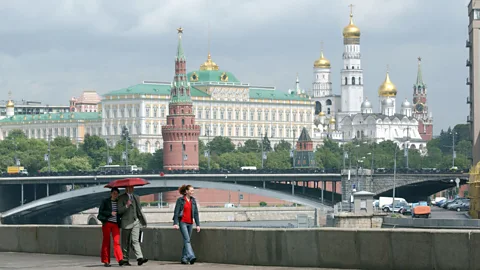
The capital is a city of romance and revolution, and living here means a deep immersion in the mysteries of the Russian soul.
From the snowflakes that fall on Moscow’s Red Square to the rows of Soviet housing blocks, from the gorgeous Metro station interiors to the ugly rings of traffic-clogged roads — the city’s contrasts are particularly sharp. The capital is a city of romance and revolution, and living here means a deep immersion in the mysteries of the Russian soul.
What is it known for?
Twenty years after the 1991 coup that ended the Soviet Union, Russia’s democratic process is still a work in progress. The protests that erupted across Moscow in December 2011 over Vladimir Putin’s campaign to be the president of Russia — after he had previously held that position for two four-year terms that ended in 2008 -- showed that a new generation of Russians expect a more transparent political system. Although Putin was re-elected on 4 March 2012, the protests from last winter created a level of civic activism and engagement previously unseen in Moscow.
The city is also bursting with creative energy, from the reopening of the Bolshoi Theatre after a six-year renovation to the Garage Center for Contemporary Culture, an art-scene monster paid for and created by Dasha Zhukova and her boyfriend, the oligarch Roman Abramovich, who are part of the new Russian elite. Abramovich, the ninth richest person in the world, is also funding the renovation and rebuilding of Gorky Park, Moscow’s famous recreation spot, and sponsors local theatre troupes performing in London.
Moscow is home to the most billionaires in the world (79 of them), most of whom made their fortune out of the privatization of Russia’s immense natural resources, such as oil, natural gas and minerals, and it is one of the world’s most expensive cities for expats. But Moscow’s rich past, mingled with a sense of optimism about its future, makes it attractive to an international clientele.
Where do you want to live?
“The most popular areas both with buyers and tenants are undoubtedly those situated in the city centre, inside the Garden Ring [road] or very close to it,” said Oksana Kobzareva, public relations director for the Intermark Savills estate agents. The area near Tverskaya Street, the main shopping street of Moscow, is especially sought after by young professionals because of its nightlife, cafes, restaurants and theatres.
Other desirable neighbourhoods that lie inside the Garden Ring are Arbat-Kropotkinskaya, home to the Pushkin State Museum of Fine Arts and many foreign embassies, as well as Patriarch Ponds and Chystye Prudy (which means clean pond) where there is ice skating in winter. Traffic in Moscow is notoriously bad, so choosing where to live is very important in conjunction with where you work. “The majority of businesses are situated in the city centre,” Kobzareva said. “But even if the office is located on the outskirts or out of town, it is much easier to drive or take public transport there from the centre than driving in from the outer suburbs.”
That said, a few areas farther out are very popular with expats. Pokrovsky Hills is a planned community 13km northwest of Moscow’s centre, near the Anglo American School. Rosinka International Residential Complex is a similar type of community, in the Krasnogorsk area, home to the British School.
Side trips
As in all big cities, many locals try to spend weekends out of town. Many of them own dachas, or country houses, in little towns close to the city, such as Peredelkino. In summer, there are nearby forests to fish and hunt, and in winter, there is cross-country and downhill skiing in nearby resorts, such as the Volen Sports Park off the Dmitrovskoe Highway. The Moscow to St Petersburg Railway is a high-speed train that, when operating at its fastest speed of 250km per hour, does the trip in three and a half hours.
Sheremetyevo International Airport, about 20 miles from the city centre, has international and domestic flights, including to cities such as Sochi, which is hosting the 2014 Winter Olympics. Flights to London are less than four hours and it is more than seven hours to Beijing.
Practical info
Rents fell in 2009 when many ex-pats left during the economic crisis, but in 2010 many began to return. Now, average-sized apartments rent for about 102,000 rubles a month, and a townhouse for a family can cost between 440,000 and 875,000 rubles a month. Rents are increasing due to a lack of inventory, especially in the city centre.
“The most common purchase price range is 5,800,000 to 14,616,000 rubles,” Kobzareva said. “But [apartments] can go for as high as 40,385,000 to 73,000,000 rubles.” It is important to research the developer’s reputation and choose one who is well known in the market. And you will not find your dream house or cottage within city limits. “Another Moscow particularity is that within the city, residents can only purchase an apartment,” Kobzarevasaid. “Families who would like to have their own house can find it only out of town.”
Further information
The Moscow Times: English-language newspaper covering news, politics, business, city blogs
Element: magazine covering the city’s entertainment, restaurants and nightspots
Passport Magazine: culture, current events and lifestyle publication for ex-pats
