Brother of man trapped under rubble in Colombian quake clings on to hope

 BBC News Mundo
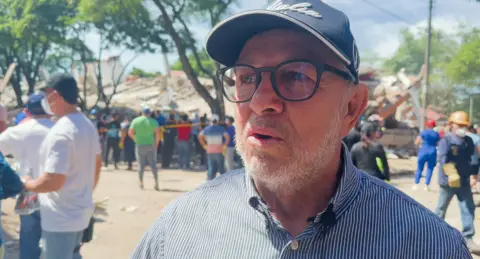
Efraín Gallego does not lose faith that his brother will be found alive, although when he speaks about him, trapped beneath the rubble of a building, his voice breaks and he swallows hard until he regains his composure.
"You feel anguish. Every time there is an alert about someone being alive, hope is reborn that we will find him," Gallego tells me emotionally.
His 80-year-old brother was buried along with his wife when the Torres del Limonar building collapsed in Cali.
This city in south-western Colombia is one of the hardest hit by the earthquake.
The building has become a symbol of the tragedy in the country's third most populous city.
Cali has more than two million inhabitants. According to Mayor Alejandro Éder, there are at least 95 dead.
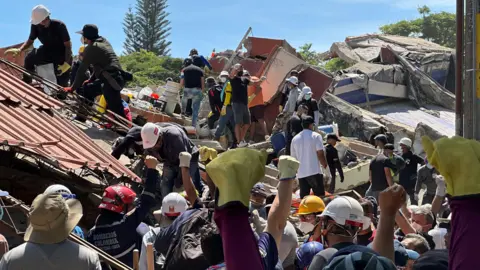
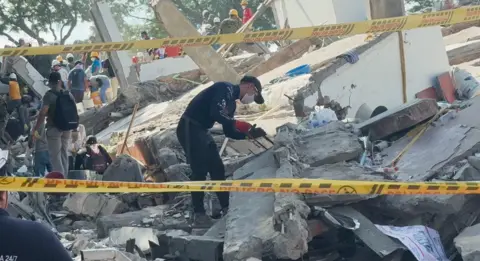
Under the scorching heat on Tuesday morning, Torres del Limonar is a shattered mountain of rubble, with mattresses, furniture, and belongings peeking out from the concrete.
On top of the remains are rescuers and volunteers: "Silence! We are firefighters. If you can hear us, shout or make any noise."
The phrase is repeated every time the teams dig deep enough to believe they may be close to a survivor.
These are the moments when Gallego regains hope, but the seconds pass and no answers come from below.
 BBC News Mundo
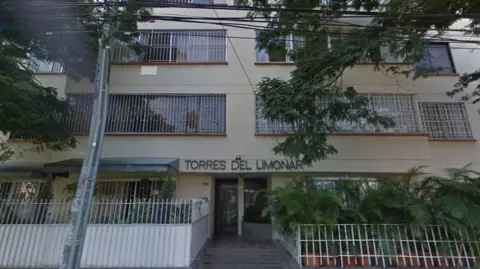
Torres del Limonar is one of more than 50 collapsed buildings in Cali.
It is located in its south, in the Capri neighbourhood. The four-storey building held dozens of apartments. The exact number of tenants who were inside when it collapsed is unknown.
Around it, apart from some cracks, the rest of the buildings seem to have escaped the fate of the Torres.
Rescuers, military personnel, volunteers, paramedics, firefighters, humanitarian workers, and journalists have come here.
There are more than 100 people waiting for news. According to Mayor Éder, as of Monday night, it was estimated that 25 people were trapped under the rubble.
 Google Maps / Captura
Éder declared a nighttime curfew to speed up rescue operations.
The night passed. Excavations continue. A rescuer at the site said about 10 people had been saved since the collapse.
Reports in local media, such as one from Blu Pacífico radio, spoke of six survivors up until a few minutes before my arrival, including an infant only a few months old.
In the midst of tragedy, figures are often closer to estimates than definitive data.
"What I can tell you is that right now there are at least two people detected alive. Tunnels are being made to get them out. One of them has to have his leg freed," rescuer James Velasco tells me.
 BBC News Mundo
The magnitude 7.4 earthquake that struck Colombia on Monday, 10 August, is the worst in this century, according to the National Geological Service.
In addition to Cali, it left destruction and death in other regions such as Chocó, in the north-west.
Around the remains of Torres del Limonar, unlike Gallego, many residents choose not to speak. They are visibly affected.
Some sleep exhausted on the ground or on a sofa placed in the street. Others gather together under the shade for support.
The hours are long, increasingly so, and the anguish grows.
Velasco offers hope.
"In the past I have participated in operations where we have pulled out survivors after seven days trapped."
"Those who are meant to survive, survive. Nothing is written," he adds.
"I wanted to help from the very beginning."
Amid his anguish, Gallego wants to acknowledge the work of ordinary citizens.
"We must mention all the people who have come to help with water, supplies, tools, equipment; there is a lot of collaboration. Volunteers are plentiful," he says.
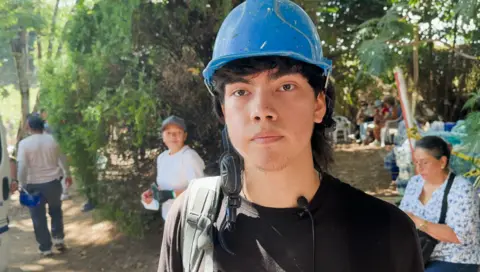
Alejandro Mahecha, 19, is one of those volunteers. He decided to come after spending the night safely with his family and overcoming the initial shock.
"I wanted to help from the very beginning. The earthquake affected my city and the homes of people I know. I came to this site because there has been a lot of talk about this building and the need for help here," the young man explains.
 BBC News Mundo
Together with several friends, Mahecha helps remove rubble, bring water to rescuers, and clear the street to facilitate evacuation efforts.
In the background, hammers and saws can be heard creating escape routes through the destruction.
They stop only when those present raise their arms.
That means everyone must remain silent. Gallego waits. This time, too, there was no news of his brother.
