UK unemployment rate unexpectedly rises

 Getty Images
The UK unemployment rate has unexpectedly gone up while the number of job vacancies has fallen to its lowest level in five years as the initial impact of the Iran war on firms starts to be felt.
The unemployment rate rose slightly to 5% in the three months to March from 4.9% in the three months to February.
Analysts said the figures show the first effects of the Middle East war on the jobs market, and warned demand for workers would likely continue to weaken the longer the conflict goes on.
The rise in unemployment combined with slowing wage growth will give the Bank of England more time to decide whether interest rates need to rise to contain inflation, experts added.
Early estimates from the Office for National Statistics (ONS) suggest the number of job openings fell by 28,000, or 3.9%, to 705,000 between February and April, its lowest level since April 2021.
"Lower-paying sectors such as hospitality and retail have seen some of the largest falls in vacancies and payroll numbers, both in recent months and over the last year," ONS director of economic statistics Liz McKeown said.
According to the ONS, the number of people on payrolls in April also fell. Payroll employment figures dropped by 100,000 last month.
McKeown pointed out the figures come at the start of the new tax year, and they "carry greater uncertainty and have often seen larger than average upward revisions".
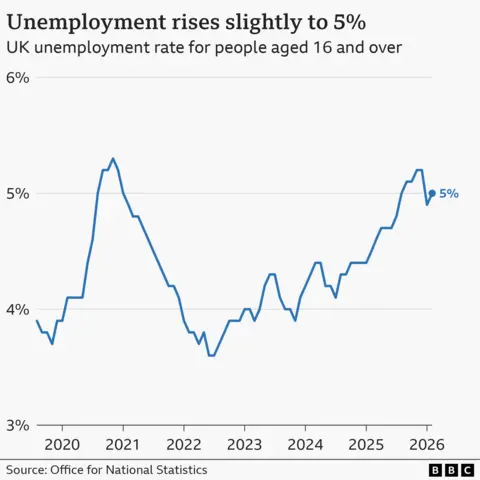
While the reliability of the unemployment figures has been affected by data collection issues, a similar picture is painted by other indicators including the drop in vacancies and a fall in the number of employees on payrolls.
Experts said the jobs figures showed there was a growing distress in the labour market. The drop in vacancies suggests businesses are pausing recruitment.
Kate Nicholls, chief executive of UK Hospitality, said the rise in unemployment was linked to higher labour costs, which included changes in employment taxes.
Wage growth was only slightly ahead of inflation, and Susannah Streeter, chief investment strategist at Wealth Club, said that would likely keep spending "subdued" as households brace for higher bills.
Average regular earnings growth fell to 3.4% in the first three months of the year, and was 0.3% higher after inflation was taken into account.
Normally that sort of cooling wage growth would increase expectations of interest rate cuts, but given inflation fears Streeter said "pressure is building for rates to stay higher for longer instead".
Sanjay Raja, chief UK economist at Deutsche Bank, said the jobs data should allow the Bank of England's Monetary Policy Committee to keep rates on hold for longer as it monitors the impact of the Iran war on the UK economy.
Fresh inflation figures will be published on Wednesday, and experts expect a slight fall from the 3.3% recorded in the year to March.
Secretary of State for Work and Pensions Pat McFadden said the ONS employment figures showed there were 416,000 more people in work than this time last year which was encouraging, but the Iran war was "casting a shadow on the labour market".
"Boosting opportunity and tackling youth unemployment in every area remains our priority," he said.
Shadow business secretary Andrew Griffith said the figures confirmed what businesses had been warning about, which was that "employment tax rises are piling costs onto employers and workers are paying the price".
'Particularly difficult' for young people
A higher unemployment rate means more people are out of work and looking for work, while a fall in the number of job vacancies means there are fewer jobs to compete for.
Ben Harrison, director of the Work Foundation at Lancaster University, said this was making life "particularly difficult" for young people as the youth unemployment rate has reached 14.7%, its highest since late 2014.
Separate research published by the Institute for Fiscal Studies on Tuesday shows the current fall in youth employment rates is approaching the level of decline seen during the 2008 financial crisis and the Covid-19 pandemic.
The IFS data relates to a different time period to the latest jobs and wages data.
It suggests between December 2022 and December 2025, the proportion of 16 to 24-year-olds in payrolled work fell from 54.9% to 50.6%.
Jed Michael, a research economist at the IFS, said the current trend was concerning because "we know that unemployment early in one's career can have lasting negative consequences".
Jonathan Townsend, UK chief executive of the The King's Trust charity, said the IFS's research indicated that "we cannot simply assume the problem will correct itself as economic conditions improve.
"We urgently need to understand what is pulling more young people away from work and education, including the role of mental health."
