'I waited six years for a knee operation - you begin to think no-one cares'

 BBC
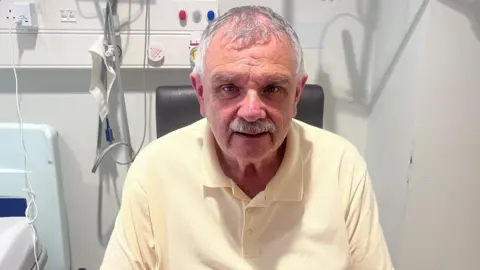
BBCPatrick McGonagle has been in constant pain for more than six years while on a waiting list for a new knee.
The 71-year-old was initially told he could wait two years for a right knee replacement, but it ended up three times that.
He described the pain as "bone rubbing on bone" affecting his mobility, driving and quality of life.
While the Strabane man has been on the waiting list, his left knee started to deteriorate and needs replaced, which, he said, is "another hurdle" he will have to cross.
Last Thursday, more money was announced to tackle Northern Ireland's hospital waiting lists, with £80m being ringfenced to help reduce the longest and most critical waiting times over the next 12 months.
It forms part of the Stormont Executive's programme for government commitment to cut health waiting lists.
What was the impact?
McGonagle, who finally had his operation last Friday, said he was prescribed very strong painkillers but in the end they did not "mask the pain anymore".
Speaking before surgery, he said: "I've been on Tramadol now for five years, so it's now got the stage where Tramadol doesn't work anymore with it.
"But if I don't take the Tramadol, I'm all shaky - I'm like a car on three cylinders all the time. It's a constant gnawing pain on both knees now, so I get the right one done now and the left one has to be done after that."
He said waiting meant worrying.
"You can think to yourself: 'I'm not going to be mobile'.
"I'm the kind of person that needs to be doing something all the time and I have to be up and active all the time, so it does worry you."
'Getting up off a chair is painful'
It had been affecting his life, especially walking, and driving any distances.
"You pre-plan everything before you go out of the door, so you don't have to walk any distance.
"I feel a lot older than I actually am because I'm planning where I'm going to walk and I'm planning where I'm going to stop.
"There's days you're in that much pain, getting up off a chair is very, very painful.
"Your life revolves around being mobile. And if you can't be mobile, your quality of life's not good," he said.
McGonagle said he did not think he was ever going to get his surgery.
"Every six or seven months somebody would phone you. They'd say: 'Do you still need your knees done?'
"You'd be going: 'Well, nothing has changed, if anything it's got worse'.
"But it's nothing to do the hospital really. It's to do with the government and money.
"Hopefully things will change now. Stormont can allocate more money for this type of thing."
McGonagle said he finally got his operation on the third attempt.
"Nine weeks ago, I came in and it was booked on a Thursday and on a Friday morning they called it off. Four weeks ago, I was on my way to here and they phoned me and called it off.
"But maybe people don't understand, you have to make arrangements outside - you're going to be away for a couple of days or a couple of nights.
"It's not only inconvenient but you reach a stage where you think this is not going to happen at all.
"You begin to think to yourself that nobody really cares anymore. "
Surgery day success
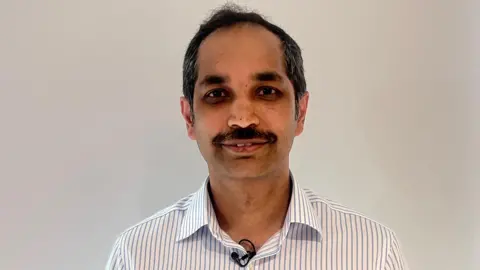
Ashok Ramasamy, a trauma and orthopaedic consultant, who carried out the operation, said McGonagle had arthritis in both legs.
"I see most of the patients who are being booked around 2020/21 time, so they are almost waiting for the last four or five years. Those are the patients I'm seeing in my clinic and then prioritising to get them to the surgery," he said.
Ramasamy said there has been an increase in the number of surgeries because of the waiting list initiative - many people are being treated after waits of up to eight years.
But, he added: "It's about what theatre capacity we have, how many patients we can admit, and then how much of a team are working with us, like a physiotherapist, ward staff.
"When we are able to improve the infrastructure with the increased capacity, definitely it's [reduction in waiting time] achievable. And it's very encouraging for us as well."
Back at home
McGonagle got home on Saturday, and while he is "very sore" and on crutches, he is happy to have the surgery completed.
"I need to just get over the initial pain and I'll see the benefit from it. And then we'll make a plan to do the left knee.
"At this stage, I'm happy I've got this length. And thank Altnagelvin very much for what they've done for me," he said.
Waiting lists fall in NI
For the second consecutive quarter, the number of people waiting for a first consultant-led outpatient appointment at hospitals in Northern Ireland has fallen.
While at the end of March 2026, 510,680 people were waiting, latest quarterly waiting time figures show more there are more than 16,000 fewer - and almost 32,000 fewer than the end of September.
There was also a fall in the number of patients waiting for inpatient or day case admissions to hospitals and in those patients waiting for a diagnostic test.
Separately, the Department of Health (DoH) has also published year-end results for the Elective Care Framework which shows progress across key waiting list priorities.
After being set a target of treating an extra 70,000 patients to reduce hospital waiting lists, figures show that more than 385,000 assessments, diagnostics and treatments were delivered during the year.
This includes activity for red flag and time-critical patients, backlog clearance for long waiters, and the delivery of primary care elective services.
The DoH said this does not include validation activity - which means people being removed from lists because they no longer need the appointment because they have been treated elsewhere or have died.
What has the Health Minister said?
Health Minister Mike Nesbitt said on Wednesday that "collective effort" has delivered "significant reductions in longest waits for patients" in relation to diagnosis and treatment across key waiting list priorities.
"I am determined that we continue to build on this momentum," he said.
"Challenges remain and demand continues to grow, but we are demonstrating that focused action, regional working and reform can make a real difference for patients."
