Reunion marks 50th anniversary of historic tapestry

 BBC
BBCA group of stitchers have reunited to mark 50 years since the completion of a huge tapestry which depicts nearly 1,000 years of history.
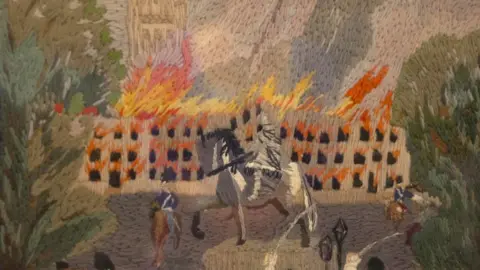
The 22m (72ft) Bristol Tapestry, on display in the Bristol Museum and Art Gallery, tells the story of key moments in the city's history through 27 handcrafted scenes.
The project was completed on 2 June 1976, having involved more than 90 volunteers creating intricate designs using embroidery, appliqué, and screen printing methods.
The four women reunited at the museum on Wednesday to reminisce on their contributions and take a look back at the tapestry's "own rich history".
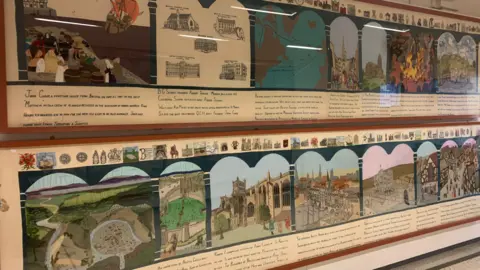
The Bristol Tapestry was the idea of Jean Tanner and Marjorie Bleasedale in the late 1960s and was made to record important events from the city's past.
Its four panels illustrate key milestones such as John Cabot's exploration, the Civil War, rise of Methodism, Brunel's engineering works and the maiden flight of Concorde.
In a statement on its website, the museum recognises: "Since 1976, more people have become aware of the negative impacts of Bristol's participation in and profit from colonisation and the transatlantic traffic in enslaved Africans.
"A tapestry made today might better reflect the contributions of a wider range of people to Bristol's history."
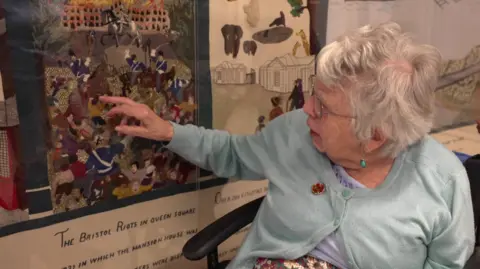
Dorothy Nicholls, one of the first volunteers, said the tapestry had been a family affair, with her father producing a lot of the original drawings.
"The pictures were in black and white so we had to make up our colours on our way - just do what we thought they wore in those days," she recalled.
"The atmosphere was brilliant, it was a real community project. Every bit that was done was done with goodwill.
"We had some very gifted ladies working on it, and others not so good," she laughed.
She traced her finger over the stitched Queen Square Riots of 1831 and the lichen-covered roof of John Wesley's Chapel, which she created using a splash of bleach.
"I couldn't believe it when they said 50 years. We thought it was a wonderful opportunity to say 'I did that bit'," she added.
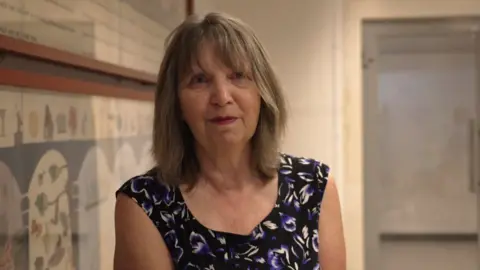
Her daughter Liz Maiklejohn, who helped out during the summer holidays aged 13, said the tapestry "had its share of potential catastrophes" in the last five decades.
After completion, the tapestry was shown at various events including the Bristol 600 celebrations on Clifton Down in 1973, which was hit by a severe storm.
The marquee was blown down in a gale and the art was dragged through mud. The washing afterwards made the panel shrink, requiring it to be manually stretched out.
"Three years later, the tapestry was taken to America and there was a bit of a problem with the plane flying it home," Maiklejohn recalled.
"One of the engines was actually on fire so it was diverted to New York.
"So what with fire and flood, the tapestry has its own rich history - let alone the history that it's portraying."
Follow BBC Bristol on Facebook, X and Instagram. Send your story ideas to us on email or via WhatsApp on 0800 313 4630.
