Retiring police chief targets 'armchair critics'

 Stuart Woodward
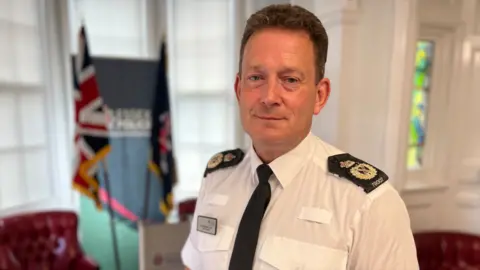
A departing chief constable has defended his officers against "armchair critics" as he prepares to retire from the force.
Ben-Julian Harrington has led Essex Police since 2018, having started his career with the Metropolitan Police in 1990.
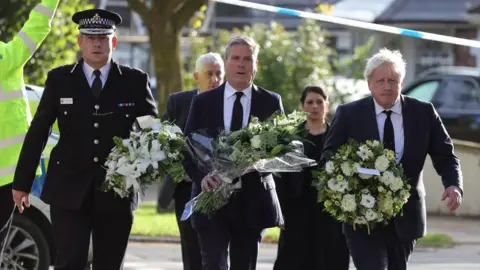
During his Essex tenure, he oversaw incidents such as the discovery of 39 bodies in a lorry in Grays, the murder of MP Sir David Amess, and large-scale protests at a hotel in Epping last summer.
In an exclusive interview with the BBC, Harrington discussed his plans beyond retirement - including a cycle ride across France - as well as his regrets and his message for new Prime Minister Andy Burnham.
Criticism
Harrington said he and his officers had seen a rise in "armchair critics who are criticising the police for decisions that are made with limited information, under pressure… complex decisions that are life and mission critical".
He said his officers got it right "99 times out of 100" and acted with good faith, and were held accountable if they get things wrong.
"I know personally where I've had my daughters read the comments that have been made about things I've said and done which are then played out in their school," he said.
"I've got thick skin, I'm divorced from some of these things, but for a young officer or staff member who's got a young family… that's a real impact."
Harrington said the Epping protests led to a rise in abuse on social media towards his female officers.
"When I see the misogynistic abuse, and the reference to near-on hate crimes around references to what they would like to do with them or 'I know where you live' or 'I'll help you love' - that's not about freedom of speech - that is about crime, it's about disorder."
He continued: "It's attacking the very officers that every single day are out there protecting the communities that they live in, that they serve in."
'Mistakes'
Essex Police was accused of "bussing in" counter-protesters during unrest outside the Bell Hotel in Epping last summer, after a migrant living there was charged with - and later jailed for - sex offences.
Several people have since been convicted of violent disorder following the clashes which broke out between protesters and the police.
"Did we make mistakes? Of course we did, because it was a complex pressurised situation," Harrington said, adding his officers tried to allow people to assemble and protest as "one of the enshrined rights in this country".
"We were clear about the facts - where the accusation was we bussed people in, the facts were, we did not."
"What I wasn't prepared to do was after the fact - from my armchair, so to speak - was to criticise operational commanders who, in the heat of the moment, had made a decision to put some people in a van to drive them away in order to stop them being assaulted."
He added: "That was a good decision - it was not for me to criticise."
'Regrets'
 Downing Street/EPA
"If you ever leave a job and think you've done all the things you wanted to… then you weren't working hard enough," Harrington said.
He said he was "really proud" of being able to put more officers on the front line despite being "one of the most poorly funded forces".
But he said he wished he could pay them more.
"I'm not going to roll any hand grenades in the door as I leave - I fully support the pay award that's been given - but I think if you want quality staff and officers and you want them to stay… you need to pay them well and recognise them for the job they do."
"My regrets are perhaps I haven't been loud enough in talking out [about that]," he continued.
Harrington reflected on the discovery of 39 dead Vietnamese migrants in a lorry in Grays in 2019, saying it had "a massive impact" on him and his officers.
He said the murder of Sir David was "an absolute tragedy", but he was proud the force had since done "what [Sir David] would want" by building relationships with communities and supporting young people
On a more personal level, Harrington has chaired the National Police Chiefs' Council's Operations Committee and was formerly the national lead for public order and public safety policing.
What next?
 Essex Police
Harrington said becoming chief constable had been "a pinnacle of my career", and after 36 years of policing he was feeling "a little bit apprehensive" about the future.
"I'm probably a little bit institutionalised… [but] it's the right time for me to move on, so I'm really excited… for whatever the next chapter is for me."
Harrington said he had no other job lined up, but would not rule anything out in the future.
The day after retiring, he plans to embark on a 1,118 mile (1,800km) cycle ride to visit historical castles.
"I've got a ferry booked going over to France with me, my bike and my tent," he said.
"I have become a bit of a history geek thanks to a podcast on Plantagenet history… so I'll be dotting my way across France visiting Plantagenet castles and history points."
Harrington said he would then meet up with his wife in the south of France "for a proper holiday", where he was looking forward to spending time "without all the responsibility, power and late-night phone calls".
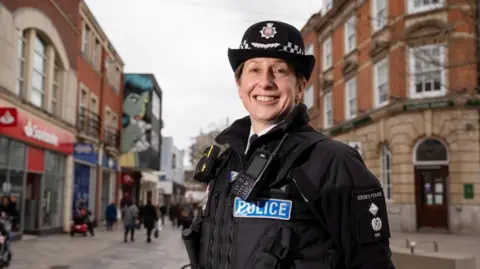
Deputy Chief Constable Rachel Nolan is due to take over from Harrington, after his retirement on 31 August.
She will become the first female to lead the force.
Do you have a story suggestion for Essex? Contact us below.
Follow Essex news on BBC Sounds, Facebook, Instagram and X.
