Wind farm firm calls for review of restrictions at nuclear blast monitor site

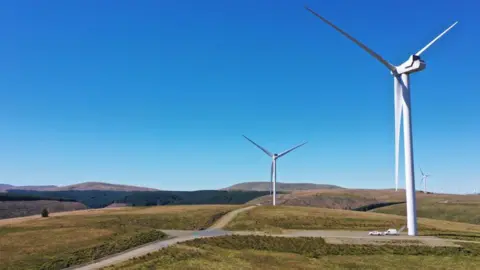 CWP Energy
A firm behind stalled plans for a major wind farm in southern Scotland has called for an review of restrictions near a nuclear blast monitoring site.
CWP Energy is challenging the refusal of its 60-turbine Scoop Hill plans, near Moffat, over concerns about its impact on the Eskdalemuir Seismic Array.
The company the restriction zone around the site, which was established in 1962 to detect nuclear explosion activity, was based on limited and out of date information.
The Scottish government said that safeguarding the array was a "shared priority" with the UK government.
Continuously operating and safeguarding it ensures that the UK can comply with its international obligations under the Comprehensive Nuclear Test Ban Treaty.
Consultation came to a close this week on plans for an updated approach to managing any potential interference on its operations from onshore wind farms in the area.
It has been seeking views on extending an exclusion zone around the array from 10km (six miles) to 15km (nine miles) and using a new way to measure the impact of developments proposed within 50km (31 miles).
The aim is to "better balance array safeguarding with the potential for increased onshore wind deployment within the broader 50km zone".
However, CWP said that the proposal was based on information which was more than 20 years old and derived from very limited data.
It said it risked blocking a huge number of developments across a swathe of southern Scotland and northern England.
A number of previous proposals have already been blocked because of concerns over their impact on the site.
CWP Managing director Rod Wood said it was holding back a "£60bn investment opportunity".
The company also argued that other countries did not have such restrictions near similar seismic stations.
"Protecting Eskdalemuir and unlocking Scotland's wind potential are not competing objectives," said Wood.
"We can do both, and we have shown how.
"What we cannot do is spend another 20 years defending a number worked out on the back of an envelope.
"An evidence-led approach here would unlock around £60bn of investment, 8,500 jobs and 6GW of clean power in exactly the part of the country that needs it most."
'Close collaboration'
The Scottish government said consultation which closed on 5 August had allowed experts, communities and the industry to "raise any technical concerns".
It said that would ensure the final approach to the issue remained "robust and fully-aligned with the need to protect this nationally-important asset".
"It is too early to determine the results of the consultation so it would not be appropriate to comment," it added.
The UK government's Department for Energy Security and Net Zero said in a statement: "Our consultation on Eskdalemuir follows years of close collaboration between the Ministry of Defence and the onshore wind industry.
"We are collating feedback from the industry on a range of options, and we will soon publish a response that delivers homegrown power and creates good jobs, while maintaining our national security."
