What is the Cooper's Hill cheese rolling tradition?

 Getty Images
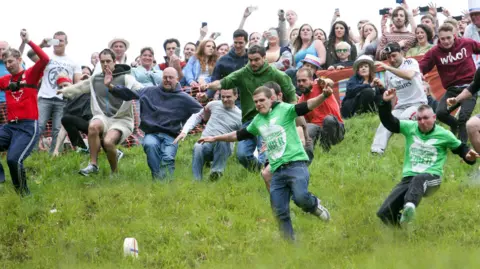
It has captured imaginations for centuries, but no one really knows why people chase a wheel of Double Gloucester down Cooper's Hill.
Each year in Gloucestershire, competitors hurl themselves down the steep slope in pursuit of the rolling cheese, a tradition thought to date back hundreds of years.
But where did it begin?
Could it have been started by the Phoenicians in 500 BC? The Romans before the 5th century? Or simply as summer games played on a very steep hill?
In truth, no one really knows but the theories are as colourful as the race itself.
Earliest evidence of cheese rolling
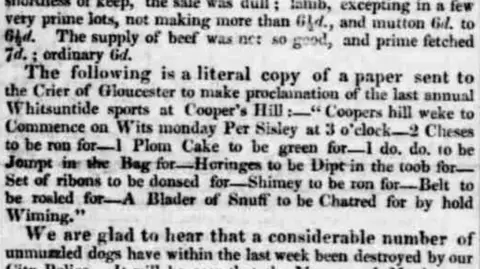
Despite suggestions it began 10 years earlier, the first written record of cheese rolling appears on 9 June 1836 in Berrow's Worcester Journal.
It describes the Cooper's Hill Wake, announced by the Gloucester Town Crier, which also appeared in the Gloucestershire Chronicle two days later.
2 cheses to be ron for.
1 Plom Cake to be green for.
1 do. do. to be jumpt in the bag for.
Horinges to be Dipt in the toob for.
Set of ribons to be donsed for.
Shimey to be ron for.
Belt to be rosled for.
A blader of snuff to be Chatred for by hold wimming
These events suggest a day of traditional festivities, including sack races, wrestling and maypole dancing, a race for a smock and for snuff and, naturally, the famed cheese roll at Whitsuntide.
 None
NonePagan ritual or Roman roots?
Historians have long debated the origins of the contest.
One theory suggests the event began as a pagan ritual marking the summer solstice, with a burning wheel of wood and straw rolled down the hill to symbolise renewal of life and ensure a good harvest. The cheese may have later replaced the wheel as a representation of the sun.
Another links it to grazing rights, with ceremonies held to assert access to common land, accompanied by traditional games and dancing around a maypole at the top of Cooper's Hill.
Jean Jefferies, who has written a history of the event, believes there may be a Roman connection.
She said: "There was dancing around the maypole, tug of war, children's races on the hill, running races and wrestling. There were all sorts of games and competitions.
"I like to think it was the Romans because, as I understand, they would roll things down a hill (as part of paganism).
"There's a Roman villa at the bottom of the hill in Witcombe."
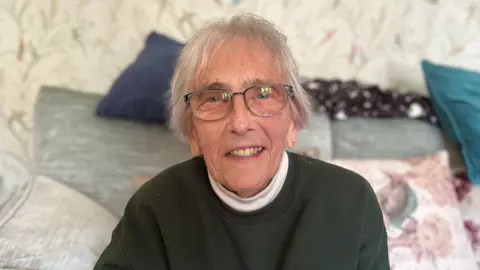
Jefferies, whose late husband used to organise the cheese rolling when they lived on Cooper's Hill, has written the only book on the history of the event, Cheese Rolling in Gloucestershire.
Despite extensive research and collecting stories handed down through generations, she found no definitive 'holy grail' evidence of why it started.
 Jean Jefferies
How the race gained global attention
Today, the cheese rolling is a global spectacle, attracting competitors - and social media influencers - from around the world.
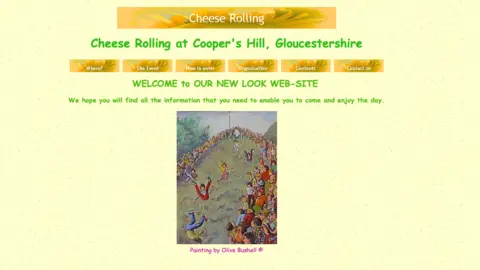
Jefferies also played a role in raising its profile, created the first dedicated website about the event in the early 2000s:
"It exploded," she said.
"But I didn't tell the neighbours it was me. Nobody knew I'd done it, that was the funny thing."
Historic accounts of danger and spectacle
Accounts from the 19th and 20th centuries highlight the risks involved in taking part in the event.
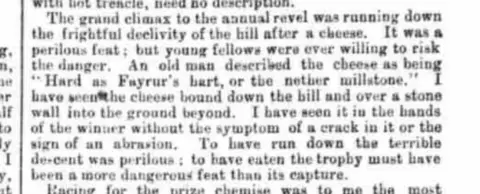
An 1890 description from H.Y.J. Taylor in the Gloucestershire Chronicle reads:
The grand climax to the annual revel was running down the frightful declivity of a hill after a cheese. It was a perilous feat; but young fellows were ever willing to risk the danger. An old man described the cheese as being "hard as Fayrur's (pharoh's) hart or the nether millstone."
In Kenneth Hare's 1949 book Gloucestershire there's a recalling of cheese rolls gone by:
The master of ceremonies stands by in smock-frock and beaver hat. An enormous crowd eye him intently, and await the signal. The rope which holds them back drops. His pistol rings out sharp and clear, a cheese goes bowling down the slopes, and a horde of rustic sportsmen precipitate themselves forwards and downwards after their singular quarry.
 None
None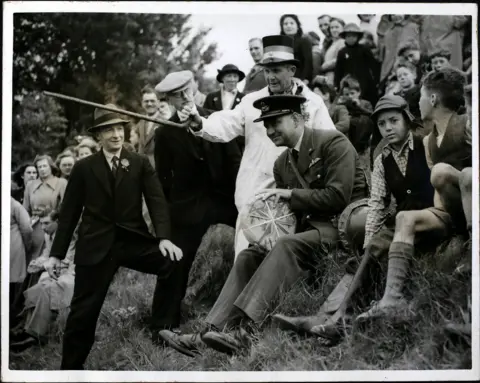 Getty Images
Has there been any serious injuries at the cheese rolling?
Despite its reputation, there is no confirmed evidence of any participant dying during the event.
One long-standing story tells of a man called Billy allegedly killed by a runaway cheese as he was walking up to watch the cheese rolling, though this remains unverified.
Hare recounts the tale with a humorous epitaph:
How came the village epitaph-maker to neglect this golden opportunity for his art?
Here Lies Billy if you please
Hit in the stomach with a cheese
Cheese is holsum fare they say
It turned Billy into clay
Cheese rolling during wartime
The tradition continued even during the first and second world wars, but without real cheese.
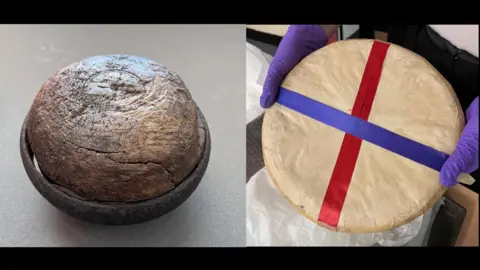
Amy Washington, from the Museum of Gloucester, explained: "During the war it wasn't the done thing to use real cheese when they had rationing so these wooden cheeses were used instead."
In World War One, solid wooden blocks were used, sometimes reinforced with iron. By World War Two, they were made to resemble real cheese more closely.
"It's got modern materials on it, masking tape and grease-proof paper with the traditional ribbons and looks more like a cheese.
"The rumour is that there's a real piece of cheese inside which kept the tradition going in wartime."
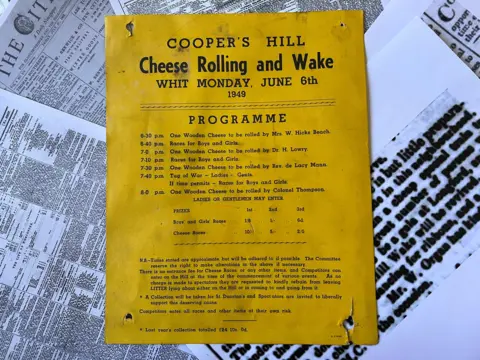
They were used right up until the end of rationing with a poster for the event in 1949 showing the wooden cheeses in play, with 10 shillings for the winner rather than the famous Double Gloucester.
 Jean Jefferies Collection
Why do people still take part?
There is still no clear answer to the origins of the tradition but its appeal endures.
So what drives competitors to risk injury chasing cheese downhill?
Every year, runners take on the "frightful declivity" of Cooper's Hill, despite the bruises and broken bones.
Jean Jefferies offers simple advice for those that dare.
"Don't!", she says. "It's so dangerous, but there haven't been that many injuries!"
Follow BBC Gloucestershire on Facebook, X and Instagram. Send your story ideas to us on email or via WhatsApp on 0800 313 4630.
