The sub-Arctic town pitching itself as Canada's gateway to Europe

 Eloise Alanna/BBC News
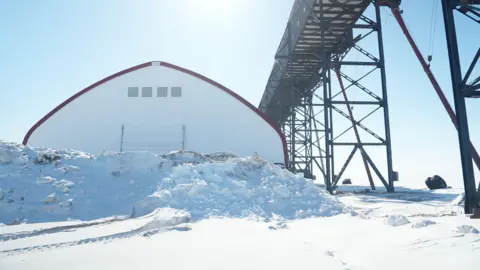
The Port of Churchill sits idle for most of the year, blanketed by snow and frozen by the bitter cold climate of Canada's sub-Arctic. It's only operational in the summer for four months, sometimes five.
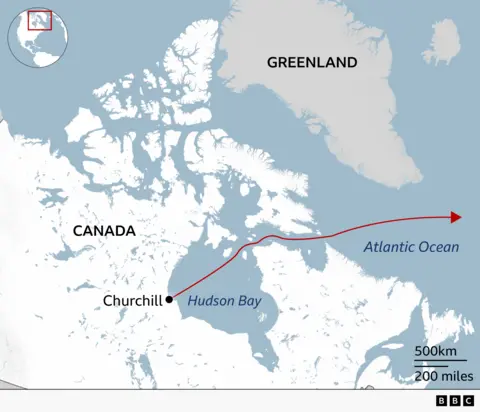
But where weather is a hindrance, it has geography on its side - the northern Manitoba port sits on the Hudson Bay, a vast body of water with a direct route through the Bay's strait into the Labrador Sea and the north Atlantic Ocean.
From there, cargo ships sail more quickly to Europe, and can reach Africa and South America, delivering goods ranging from food to critical minerals, and even – Canada's leaders hope – liquified natural gas (LNG).
For decades, ambitions of expanding the Port of Churchill have fallen short — derailed, locals argue, under years of poor management as experts openly questioned whether an Arctic port makes good economic sense. Canada is now hoping to change that, guided by the inevitability of climate change, the challenge of US tariffs, and Europe's energy shortage fuelled by ongoing global conflicts.
"Canada has an abundance of resources, and this port expansion will mean we can ship more to the world," Prime Minister Mark Carney said earlier this year.
The expansion of the Port of Churchill has been flagged as a key project by Carney that has the potential to transform Canada's economy and reduce its trade reliance on the US, working towards the prime minister's goal of doubling non-US exports in the next decade.
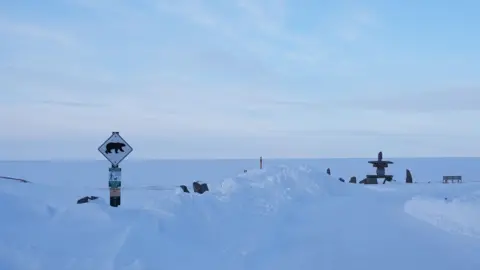
To outsiders, Churchill is known as the Polar Bear Capital of the World. Its economy has long relied on seasonal tourism, with visitors flocking to the town in the late summer and autumn to catch a glimpse of the northern lights and local wildlife like beluga whales, caribou and — as its moniker suggests — polar bears.
But it is also the site of Canada's only Arctic deep-water seaport, meaning it has the potential to accommodate ultra-large container vessels, oil tankers and LNG ships. With rail access to Churchill through southern Manitoba, the town has a direct travel path to resource-rich western Canada.
 Eloise Alanna/BBC News
The Port of Churchill opened nearly a century ago and was primarily used to export grain from the prairies. That ended in 2016, as shipments declined with producers opting for cheaper routes. It reopened in 2019, when it began shipping grain again as well as key supplies to other parts of northern Canada.
For Churchill, a remote town of approximately 1,000 residents, developing the port is seen as an opportunity to create hundreds of jobs and improve quality of life.
The port had fallen into disrepair under a Denver-based company that took ownership of it in 1997, said Mike Spence, the mayor of Churchill and co-chairman of the Arctic Gateway Group, a consortium of indigenous and community groups that now own the port.
Spence said the group wanted "to take control of our own destiny". The ownership transfer was finalised in 2018.
Since then, Ottawa has spent C$320m ($235m; £174m) on the port, including on its maintenance and restoration.
"The previous owner didn't invest in the port, in the rail line," Spence told the BBC, speaking inside a small restaurant attached to a hotel that he co-owns in Churchill — one of the few that stays open in the off-season winter months.
Work has since been done to modernise the railway and the port's infrastructure. In August 2024, the port delivered its first critical mineral shipment ever to Belgium.
It is now funding studies to see if it can be economically viable year-round, and if so, become a hub that would be capable of delivering resources to Europe. The port has also been pitched as a way for Canada to strengthen its Arctic sovereignty.
Manitoba Premier Wab Kinew said the goal is to start shipping out gas from the Port of Churchill by 2030 - a timeline dismissed by his political opponents as a "complete fabrication".
Alex Crawford, an assistant professor and researcher of Arctic climate systems at the University of Manitoba, is part of a team that was tapped by Arctic Gateway Group to study open water shipping in the region.
"Ice-free shipping year-round is not going to happen this century, even with a really aggressive warming scenario," he said.
He told the BBC that navigating Canada's Arctic waters is a complicated task because ice forms inconsistently along the Hudson Bay, making it difficult for ships to travel through for most of the year without an escort of costly icebreakers.
Icebreakers have been used by Russia in recent years to export natural gas and minerals year-round from Siberia to Asia through the Northern Sea Route. The vessels, which are nuclear-powered, have been dubbed "the world's largest and most powerful" by the US Naval Institute.
Canada's icebreaker fleet is much smaller by comparison, and plans to build new ships have been derailed over decades by bureaucracy and limited resources.
In recent years, Canada launched a plan to build a new fleet, including a class 2 icebreaker that can operate year-round and cut through ice as tall as 10ft. It is this type of advanced icebreaker that would make navigating through the frozen Hudson Bay possible, Crawford said.
There are also questions on whether a port expansion would jeopardise the local wildlife and with it, the valuable tourism industry.
Mayor Spence said that concern will be part of ongoing engagement with the local community.
"But again, let's remember that climate change is upon us," he noted. "What's the polar season going to look like in 10 years' time, or 20 years' time?"
He added that people in the region want employment. "The trick here is to find a balance."
Others are skeptical about just how much economic potential the Port of Churchill can unlock, especially if it is not operating year-round.
 Eloise Alanna/BBC News
"From a standard maritime shipping perspective, it does not make much sense unfortunately," said Jean-Paul Rodrigue, a professor of Maritime Business Administration at Texas A&M University in Galveston.
Rodrigue noted that navigating Arctic waters in and of itself is expensive because ships need to be especially equipped for the harsher conditions. He added that demand for LNG is typically constant, meaning the port would need to operate 12 months of the year.
Businesses, he said, will need to consider whether it's worth the extra costs to shorten travel by just a few days.
He noted that the Port of Churchill has long been "a symbol of Canadian Arctic maritime ambitions".
Those ambitions, he argued, have not been realised because the project has failed to deliver a clear business case in the past.
While the Port of Churchill's development has been flagged as a focus area for Prime Minister Carney's economic growth plans, it is not on the shortlist of projects due to receive more immediate federal government support, signalling its expansion is not yet a sure thing.
But Rodrigue is not entirely pessimistic. He said the port could serve a niche, particularly for stockpiling and delivering strategic minerals mined in western Canada.
Canada now finds itself at an "inflection point", he said, which could transform the way businesses and the public view the port.
The port has already attracted some international support. Its operators signed an agreement earlier this year with the Port of Antwerp-Bruges in Belgium to collaborate on design, business development and future trade.
Spence, the mayor of Churchill, said the interest from Europe is a sign of the major geopolitical shifts that have been spurred by President Donald Trump's return to the White House.
The last year, Spence said, has also woken up Canada to start looking at the rest of the world.
