Why the Tartan Army in the US can't buy haggis during World Cup

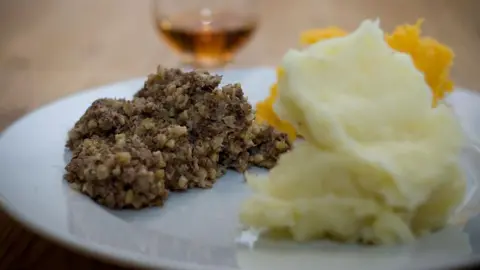 Getty Images
They'll be coming down the road for the World Cup - but there is one national delicacy the Tartan Army won't be able to find on arrival in the United States.
Haggis has been banned there since the early 1970s due to the fact it contains sheep's lungs - which is banned from being used in food products sold there.
Alternatives on offer leave lungs out of the recipe and replace it by adding in more heart or extra liver.
However Scottish butchers are using this summer's football extravaganza as a chance to argue for putting haggis back on the menu.
What is the justification for banning haggis?
On 17 June 1971 the US's Code of Federal Regulations published a document that stated: "Livestock lungs shall not be saved for use as human food."
This was based on a study published in December 1969 by the United States Department of Agriculture (Usda) that inspected "several hundred random samples" of beef lungs.
Of those, 93.5% were found by inspectors to have "various abnormal conditions". These included fluids from other parts of the body, such as stomach acid.
The Usda wrote it was not practical to examine all parts of all lungs used in food and therefore implemented a blanket ban, with all lungs classed as unfit for humans to eat.
The 57-year-old study remains the key evidence used to justify the US ban on lungs in food to this day.
As haggis involves sheep's lungs in the recipe, it has been blocked - whether the product is made in Perthshire or Pennsylvania.
The findings have been disputed, with some pointing to how the likes of Scotland, Peru and Mexico consume food with lungs in it but have never suffered a massive outbreak of illness.
Many European countries - including the UK - inspect lungs as part of food standards policy, before declaring it suitable to eat.
 Simon Howie
Award-winning Perthshire butcher Simon Howie told BBC Scotland News the regulations on haggis were "an irritation" for both his company and millions of people living in the US who are either ex-pats or have connections to Scotland.
He believes the World Cup, where a huge number of Scots are travelling to the US to watch the nation compete against Haiti, Morocco and Brazil, offers a chance to raise the issue, saying the dish is "synonymous" with Scotland.
"It has always felt a bit of a nonsense," he says.
"It's one of those quirks that has never been tackled since the early 1970s as it is a relatively low-selling product.
"With the World Cup there has never been a better chance to shout about it and try to get the product back on the shelves there. I know there are alternatives but I don't think they taste the same."
Haggis without sheep's lungs
Anne Robinson has run the Scottish Gourmet USA shop since 2005, selling the likes of potato scones, pies and shortbread.
For haggis, she and her husband Andrew Hamilton, a chef from Inverness, have had to improvise.
"The lung product is critical to the texture," she says.
"It keeps it crumbly as a dish, rather than clumping together. So my husband and a French pate maker we worked with spent several Sundays trying to come up with an alternative.
"Eventually we had a recipe that is very close to what is served in Scotland, using beef liver that serves the same function as the lung."
However she would welcome any changes that let haggis be imported.
"There is a market for it, and not just for Burns night. When I started the business in 2005 selling haggis was not on my radar, but phone calls started coming in quickly, asking 'where's the haggis'.
"I would love to bring in haggis from Scotland."
MacSween's butchers have also developed an alternative that sells well in Canada, but the company's James MacSween told BBC Scotland News a deal had not been struck yet to import the product to the US.
 PA Media
In April Donald Trump announced he would be removing tariffs and restrictions on whisky imports, letting Scotland work with the state of Kentucky on whisky and bourbon.
The decision resulted in a political row over who should take the most credit for the result, but Howie believes it shows diplomacy can result in deals.
He hopes something similar could see traditional haggis start to be imported to the US.
The butcher has helped launch a tongue-in-cheek campaign called No Haggis No Party, aimed at getting attention on the ban.
While there is silliness with the campaign - including Make Haggis Legal Again baseball caps being sold - Howie believes looking at the legislation would be beneficial.
He said: "There needs to be a will on the other side to take a look at this and say 'what are the issues here'.
"You saw how good a job was done with the tariffs on whisky, in a low-key way, and we would like to think something along those lines could happen."
'No proof study is out of date'
However the Usda are showing little signs of lifting the ban.
In papers released last month the Food Safety and Inspection Service responded to a 2023 petition regarding lifting restrictions on livestock lungs.
It noted the petition had support from various scientists and academics, who said the 1971 ruling was out of date, while the fact no outbreaks of illness had broken out in other nations, like Scotland, could be considered a rebuttal of the research.
However the inspection service stated it did not consider this to be true, saying it was "not sufficient to support that they [lungs] are fit for human consumption in the United States".
It added: "The 1969 study has also not been proven to be out of date because there are no more recent studies or data specifically proving that lungs are safe to eat."
Denying the petition without prejudice, it concluded: "While the ban on lung consumption may deprive certain Americans of access to traditional or cultural foods, FSIS has concluded that, due to the lack of evidence to refute the aforementioned 1969 USDA study, and the lack of sufficient data or studies proving that lung consumption is safe, the risk of consuming lungs outweighs the benefits."
Getting haggis back on the menu in the US seems like a goal unlikely to be scored anytime soon.
