Train passengers warned of hot weather disruption

 Network Rail
Train passengers are being warned to expect disruption next month because of engineering work as a result of the hot weather.
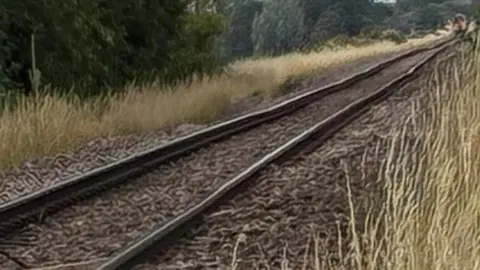
Network Rail said the peat and clay that sits under long stretches of the railway in East Anglia had dried out and shrunk, causing the track to drop in places and become uneven.
Speed restrictions late at night and an amended timetable will need to be put in place "until the ground conditions have recovered".
Routes affected from 3 August include Great Northern services in Cambridgeshire and Norfolk, Greater Anglia services in Essex and also c2c trains in Essex.
 Network Rail
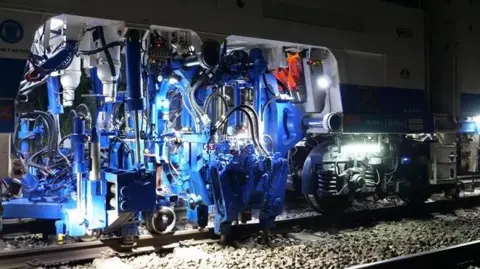
Network Rail said its engineers would be working to "reduce the effects of dried-out soil by using machines called tampers to lift the track, push stone ballast underneath and create a solid foundation so that trains can run smoothly".
New ballast would be put down to help raise the level of the track.
A spokesman said while engineers were already working to improve track conditions using tampers, they needed additional time overnight to treat more track.
The affected routes are expected to be:
- Great Northern services between Ely in Cambridgeshire and King's Lynn in Norfolk. Speed restrictions will affect the timetables. There is more information on the rail operator's website
- Greater Anglia: London Liverpool Street – Southend Victoria and Wickford – Southminster routes, with changes to some services from 22:45 onwards including buses replacing some trains. On Thursdays only, after 23:30, some services on the London to Colchester route will have journey times extended by up to six minutes
- c2c: Some changes to late night services (which run between London Fenchurch Street and Shoeburyness in Essex)
Network Rail said that last year, engineers treated about 62 miles (100km) of track on Anglia using tampers to help tackle the effects of dried-out soil.
"Ahead of this summer season, teams have already dropped thousands of tonnes of ballast to help keep the track as smooth as possible, with 49,000 tonnes expected to be dropped during 2026 in total," a spokesperson said.
Do you have a story suggestion for Cambridgeshire? Contact us below.
Follow Cambridgeshire news on BBC Sounds, Facebook, Instagram and X.
