Mental health leaders explain monitoring system snub

 BBC
BBCA healthcare trust has defended its decision to abandon a controversial digital monitoring system for mental health patients.
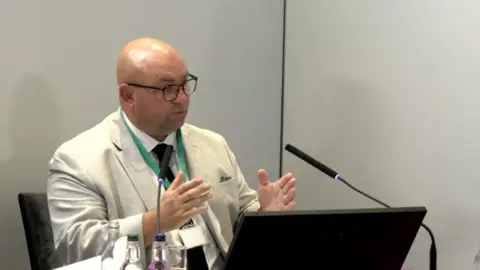
Leicestershire Partnership Trust (LPT) gave evidence on Tuesday during the Lampard Inquiry in London, which is examining the deaths of more than 2,000 people under the care of Essex mental health services between 2000 and 2023.
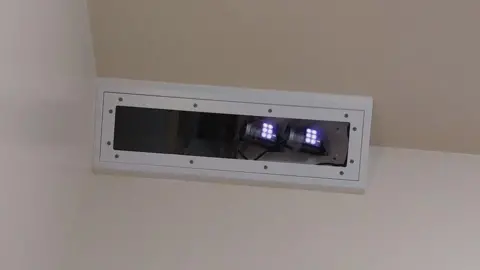
The Leicestershire trust piloted a system which uses infrared sensors and cameras in patients' bedrooms, but decided not to use it.
Oxevision is used by a number of mental health trusts across England, including neighbouring Derbyshire Healthcare NHS Foundation Trust where bosses are looking to expand its use.
Grave concerns about the system have been raised previously in the inquiry with campaigners claiming it had been overly relied upon by staff at Essex Partnership University NHS Foundation Trust.
Campaign group Stop Oxevision has said it had concerns around patient's dignity, privacy and consent processes which vary across the country, but the creators of the system have said it is an important safety aid.
The Information Commissioner's Office (ICO) recently confirmed it was investigating Oxehealth, which developed Oxevision, and said "as this is a live investigation, we are unable to comment further".
'Low number opting-in'
In Leicestershire, it was piloted from December 2022 to February 2023 then again from November 2024 to January 2025.
The first pilot adopted an opt-out model and the second pilot was opt-in - following advice from NHS England - and this consent was re-visited weekly.
Andres Freire-Patino, deputy director of mental health services at LPT, who began working at the trust in 2023, told the inquiry that one of the aims of the pilot was to test whether Oxevision could support patients getting a better night sleep.
Oxevision can digitally track pulse rates and breathing rates, so this does not need to be done in-person and disturb patients throughout the night.
Freire-Patino said: "Sleep is incredibly important in terms of people's recovery from mental health."
However, the inquiry heard one patient - a pregnant woman - slept in an interview room as she refused to stay in a bedroom with Oxevision, even with it off.
Freire-Patino said there were a number of reasons why they decided not to use the technology, but one was only 42% of patients consented to its use during the second pilot.
The inquiry heard while sleep hygiene improved for certain individuals at the Leicestershire trust, there was no reduction in the use of one-to-one observations, no evidence of released staff time, and no measurable reduction in incidents or length of stay.
 Lampard Inquiry / YouTube
Rose Powell, from Stop Oxevision, said the camera records 24/7 in people's bedrooms.
"We don't ever think that there is a time when anyone should have to face that kind of surveillance in their bedroom, especially people who were trying to recover from mental illness.
"We also don't think the technology improves safety.
"We know that often we have this argument pitted against us between safety and patient rights, but we know that it's our right to be psychologically safe in a mental health hospital and being recorded constantly doesn't provide us with that.
"We've heard from patients who felt neglected, who felt abandoned on wards because this technology has been used in place of staff coming to see them to make sure they're OK."
'Helps recovery'
Derbyshire Healthcare NHS Foundation Trust uses contactless patient monitoring in nine of its 11 inpatient units, and plans are in place to use it in all 11 units by 2027.
The trust said monitoring takes place in bedrooms and seclusion areas, to help ensure that patients are safe and well.
"It helps patients with their recovery as it can reduce in-person observations and avoid the need to disturb or wake them when they are resting or taking time away from the activities on the ward.
"The monitoring consists predominantly of infrared monitoring of heart rate, breathing rate, location and movement. A discussion takes place about our use of contactless patient monitoring when individuals are admitted and at regular intervals during their stay. The system is used in an individualised way, based on each patient's condition and needs."
An NHS England spokesperson said it has been clear with NHS providers that "any vision-based monitoring technology must support a human rights based approach to care and only be used in line within legal requirements and ensuring patient and family consent is in place".
An Oxehealth spokesperson said technology has a "vital role to play in supporting safer inpatient mental health care, an area without any medical device technology until Oxevision".
"The impact of the technology has been significant, and the facts speak for themselves: in one trust alone the system has helped staff in responding to 1,453 safety incidents over a four-year period.
"As a spokesperson for the trust said, the use of Oxevision has assisted the trust to 'make more timely interventions when required and therefore assisted in preserving life.'"
Listen to BBC Radio Leicester on Sounds and follow BBC Leicester on Facebook, on X, or on Instagram. Send your story ideas to eastmidsnews@bbc.co.uk or via WhatsApp on 0808 100 2210.
