Decision due on 600 new flats in Reading town centre

 Gensler
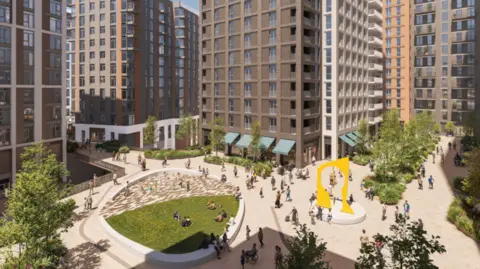
A decision is due to be made on plans to build nearly 600 flats in Reading town centre.
The proposals are the third phase of the Station Hill development, one of the biggest projects in the town.
A decision will be made about detailed plans for Phase 3A of the development, which would see 598 flats built within two new apartment blocks, by Reading Borough Council's planning committee later.
The Station Hill development project has so far included restaurants, an office building, and 600 further flats.
Phase 1 saw Friars Walk shopping centre replaced by apartments and the Siren Craft bar, with Phase 2 seeing One Station Hill built on the site of the Garrard Street multi-storey car park.
The new flats will be split into 34 studios, 330 one-beds, 214 two-beds and 22 three-bed flats.
'High quality of architechture'
Xafinity House, a defunct multi-storey office building, would need to be demolished to make way for the apartments.
The plans are supported by Steve Vigar, the council's planning team leader.
Speaking to the Local Democracy Reporting Service, he said: "The design of buildings would offer a high quality of architecture, which would have a positive effect on the townscape at close quarters and from other viewpoints in the town."
Outline plans for the project were approved in July 2021, subject to detailed plans being approved at a later stage.
Changes made since include the scrapping of a single L-shaped building design in favour of separate blocks.
The development will provide 75 affordable rental flats, split into three three-bed, 27 two-bed and 45 one-bed flats, amounting to 12.5% affordable housing provision, less than the council's policy of 30%.
The development project is car-free, except for four disabled spaces, with 337 cycle spaces provided.
