Ducklings saved after hatching on roof terrace

 Kai Carrington
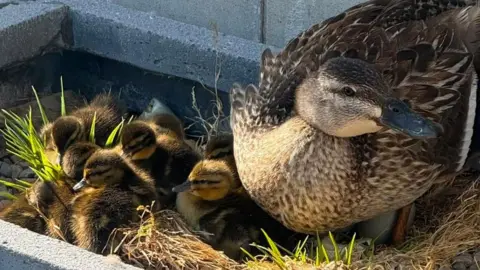
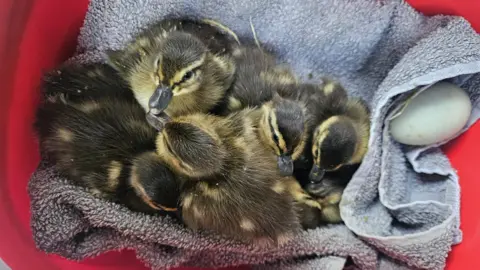
A duck and her nine ducklings have been rescued from a roof terrace after wildlife experts feared they would jump to their deaths.
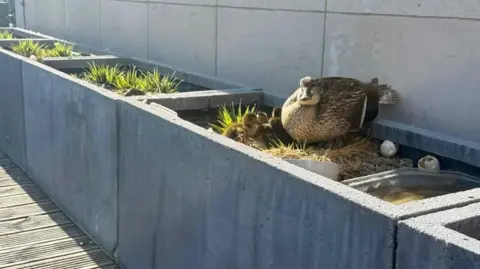
They were spotted by a Tradepark member of staff after the ducklings had hatched in a plant pot on the second-floor terrace of the K2 building on Bond Street on Tuesday morning.
Peter Gray, a volunteer with Hull Wildlife Protectors, said while ducks can go to "unusual" areas to lay their eggs, they don't always choose "the safest place".
After arriving at about 18:30 BST the same day to rescue them from the terrace, Gray said: "We quickly saw they were nesting in a plant pot in a patio building near the top of the building. It was quite high up."
 Kai Carrington
Gray said the biggest concern the wildlife group had was that the ducklings would not survive if they tried to jump off the building.
He explained: "When the mother needs to move them, she can fly to the ground and call to them but the ducklings at that point can't actually fly.
"They would sort of throw themselves off the building.
"They can generally float as they are so light but, because they're landing on hard ground, they will get injured."
He said the mother duck may have been left wandering around the city centre trying to find water, which would require crossing busy roads.
 Hull Wildlife Protectors
Donna Wilson, sales director at Tradepark Ltd, noticed the ducklings on Tuesday morning before calling the wildlife group.
She said she was "shocked" that the mother had chosen to lay her eggs there.
Gray said: "Luckily, the mother duck was semi-used to people so she wasn't too nervous.
"Once we'd got the mother secured, we could put her into a basket and gather up the ducklings."
They were taken to Ren's Wildlife Hospital in Keyingham, one of the rehabilitation centres that the group works with.
'Take action'
Pamela Maunsell, founder and trustee of Ren's Wildlife Hospital, said the ducklings and mum were "doing really well" and would be released into the wild when they were ready to fly.
She said: "The wildlife group did a good job getting them down.
"People need to take action if they find animals in distress and seek advice if you're unsure of what to do."
Gray said it was a "common occurrence" for the wildlife group to rescue ducklings in the city from April to the end of July.
He said: "When the weather is so dry and hot, wildlife may be struggling for food so you may see them in unusual areas and coming a bit closer.
"They're struggling for food and water. Putting water out for birds can be a lifesaver at this time of year."
Listen to highlights fromHull and East Yorkshire on BBC Sounds, watch the latest episode of Look North.
Download the BBC News app from the App Storefor iPhone and iPad orGoogle Play for Android devices
