How one of India's most successful female politicians is losing her party

 NurPhoto via Getty Images
Political parties usually survive defeat. What they often struggle to survive is the sudden loss of power.
That is the predicament facing the Trinamool Congress (TMC) party in West Bengal, a state of more than 100 million people in eastern India.
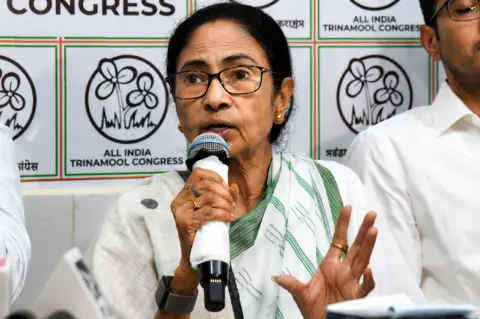
Barely a month after being voted out of office, the party is facing a rebellion by most of its legislators, a potential split among its MPs and growing doubts about the authority of its founder, Mamata Banerjee.
Banerjee is no ordinary regional leader. In 2011 the firebrand politician achieved what many thought impossible, ending 34 uninterrupted years of Communist rule in West Bengal and dismantling one of the world's longest-serving elected left-wing governments. Time magazine later named her among the world's 100 most influential people.
She would go on to govern for 15 years, turning the TMC into India's most successful regional party and herself into one of the country's most formidable opposition politicians.
 Hindustan Times via Getty Images
Which is what makes the events of the past month so startling.
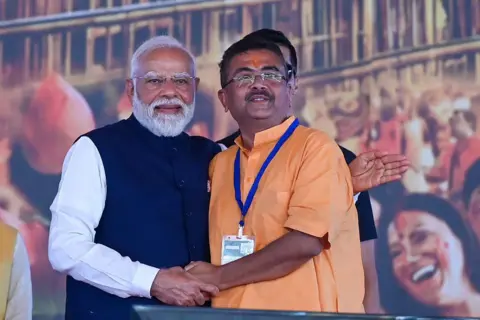
Last month Narendra Modi's Bharatiya Janata Party (BJP) swept to power in West Bengal, ending the TMC's 15-year rule amid a potent mix of anti-incumbency, religious polarisation and controversy surrounding the electoral rolls.
Yet Banerjee's party was hardly annihilated. It still won 26 million votes, only about three million fewer than the BJP, and retained roughly 40% of the popular vote. It remains a substantial political force, with 80 legislators in the state assembly and 28 members of parliament.
By any conventional measure, it should be regrouping after defeat. Instead, it appears to be coming apart.
The real shock came inside the legislature. Within weeks of the election, roughly three-quarters of the TMC's legislators revolted against both Banerjee and her nephew, Abhishek Banerjee, widely seen as her heir.
The rebels seized control of the party's legislative wing, installed their own opposition leader and accused the leadership of forging signatures on legislative documents.
What initially appeared to be a state-level mutiny has now spread to Delhi. A reported 20 of the TMC's 28 MPs have now written to the speaker of parliament seeking to break away from the party's parliamentary group and align themselves with the BJP-led ruling alliance. If confirmed, it would elevate the crisis from a legislative revolt to an existential challenge to the party's leadership and unity.
The parliamentary revolt is only the most visible symptom of a wider breakdown.In Falta, a constituency the TMC had won with 56% of the vote in 2021, the party failed even to keep a candidate in the fray for a repoll.
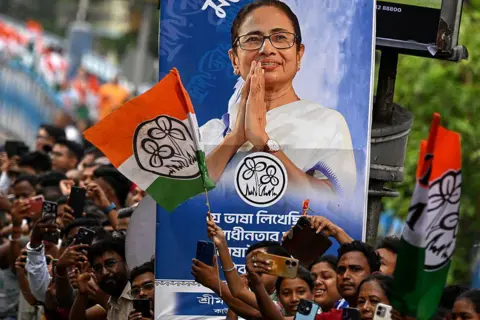
Then came perhaps the starkest symbol of its decline: a public meeting earlier in June that drew only a few hundred people, a far cry from the vast crowds that once testified to Banerjee's political dominance.
Power has ebbed away with startling speed. Almost every day, TMC leaders are arrested on corruption charges and paraded, party offices are deserted, organisational networks are being dismantled and figures who once commanded fear and influence are being publicly attacked in their own strongholds.
"What has happened is quite unprecedented," says Dwaipayan Bhattacharyya, a political scientist.
The speed of the TMC's unravelling points to a deeper weakness. Unlike the communist movement it overthrew in 2011, the party never built a robust ideological structure capable of surviving the loss of power.
Its unifying force was a combination of Banerjee's charismatic personal appeal and the patronage that comes with power. As Bhattacharyya puts it, the party rested on two pillars: "Mamata's brand value and governmental resources."
"To maintain control across Bengal, Banerjee relied less on party institutions than on powerful local leaders who were given considerable autonomy in their own fiefdoms," says Bhattacharyya.
The arrangement worked while the party remained in power.
Local strongmen competed fiercely for influence, often producing intense intra-party rivalries and violence. But power also brought access to patronage, protection and, critics allege, opportunities for enrichment.
Now both pillars that held the system together - state power and Banerjee's aura of invincibility - have weakened.
"The TMC has lost the government, and Banerjee's personal election defeat in Kolkata has tarnished a political brand. As a result, many local power brokers are finding themselves vulnerable to rivals, investigations and public anger, creating strong incentives to defect or switch allegiance," says Bhattacharyya.
This is where the BJP enters the story.
Rahul Verma, a fellow at the Delhi-based Centre for Policy Research, argues that the rise of a nationally dominant BJP has transformed the incentives facing regional politicians.
 AFP via Getty Images
"Earlier, defections tended to involve individual leaders breaking away. Today entire factions can rebel because the BJP provides an alternative centre of power, resources and political protection. The pattern resembles recent splits in parties such as Shiv Sena [a powerful regional party in western India] where a succession struggle and the concentration of power within one family triggered a large-scale rebellion," says Verma.
Verma sees the TMC's troubles as part of a broader transformation in Indian politics. Regional parties, he argues, have become increasingly centralised and family-centric.
"Ambitious lieutenants may accept a founder's authority, but often balk when leadership is passed to a family heir. The split in Shiv Sena, after Uddhav Thackeray elevated his son Aditya, illustrated the problem, he says.
Earlier succession battles tended to remain within political families or involved dissidents who lacked the resources to mount a serious challenge.
The BJP's presence has changed that equation.
"Combined with generational transitions and patronage-driven party structures, it creates a potent mix: once a party loses office, local leaders who joined for power and influence often see little reason to stay," says Verma.
For now, 71-year-old Banerjee remains defiant.
She has described the BJP's victory as "illegal" and "immoral", and alleged that around 100 seats were "looted".
She dismisses the rebellion as naked opportunism. "For so long, some people enjoyed power, and now that we have lost, they immediately seem to have reached an understanding with another party," she said last week.
Yet she insists the party can recover. "We will rebuild the party anew. TMC is not for its leaders; it is for its workers."
Can the TMC emerge from what increasingly looks like an existential crisis?
It is too early to tell. The rebellion could fizzle out and the rebels led by a minor legislator - a former communist who defected to TMC - could break further and return to Banerjee. But if the MPs now signalling support for a split hold their nerve, the challenge could prove more consequential than early sceptics assume.
Yet writing off Banerjee would be premature.
"She can still come back," says Bhattacharyya. "If there is one face in Bengal that still attracts attention and one voice that people cannot simply dismiss, it is hers."
But any revival, he argues, will require more than charisma. It will demand a willingness to renew the party and make difficult decisions about its leadership. So far, that has not been Banerjee's strongest suit.
Throughout her career, Banerjee has defied political odds. Yet the task before her is unlike any she has faced before. Overthrowing a government is one thing. Rebuilding a party after its own leaders have abandoned it may be quite another.
