How school pupils 'beat the experts' in measuring Chernobyl fallout

 Reuters
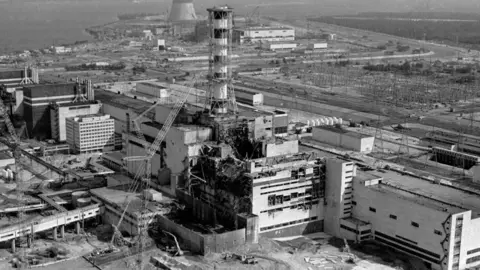
It was 40 years ago when a Chernobyl reactor suffered an explosion, sending a radioactive plume across Europe. Four decades on from the world's worst nuclear accident, we speak to former teachers and pupils at a school which claims to have beaten the experts in accurately measuring the radiation reaching UK shores.
"The first thing I did was phone my mother and said, 'please run a bath so you've got a supply of uncontaminated water'", recalls Tom Bootyman.
"Don't be so daft," she swiftly replied.
Upon hearing about the news 1,300 miles away at the nuclear power plant in the then-Soviet-controlled Ukraine, the former science teacher at Ackworth School took no chances and set up a radiation monitoring kit in a classroom laboratory.
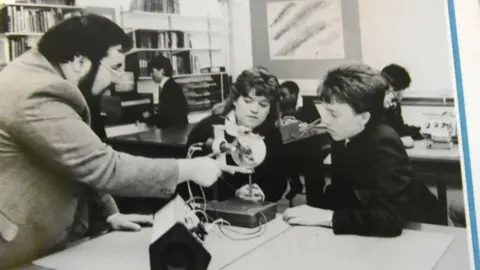
After the quick call to his mum, Bootyman, a 28-year-old deputy head of physics at the school in West Yorkshire, shifted his teaching to an impromptu nuclear radiation lesson using apparatus on the lab's shelves.
"I first heard about the meltdown on BBC News and thought, oh crikey, that's not good," he says.
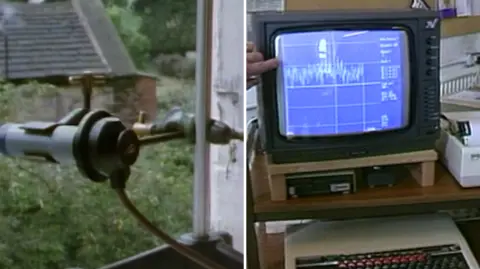
The young teacher attached a Geiger counter - a device used for measuring radioactivity - to a classroom window.
"I left it running overnight, came back and discovered there was nothing unusual at all," he says.
The plume reached UK shores on 2 May 1986, coinciding with a weather front of heavy rain.
 Ackworth School
"We kept looking at the Geiger counter every day and then later hooked it up to a new piece of kit which meant we could actually record it," he says.
"On the Saturday, five days after the news report, it rained and we noticed the count rate had gone up by about 15%."
Coincidentally, Bootyman, now 67, was reading Russian newspapers at the time to help improve his grasp of the language and saw the first Soviet mention of the story "tucked away on the inside pages".
The physics teacher says the first reading had not been enough to cause anybody locally any danger, but it was causing major issues in rural communities.
As a result of the explosion, radioactive particles became locked in upland peat and accumulated in grazing sheep.
Nearly 10,000 UK farms were eventually affected in total, with restrictions covering sheep movements not ending for some in Wales and Cumbria until 2012.
"A sheep can eat an acre of grass," he says.
"They were concentrating the radioactivity inside their bodies and they had to be removed from the food chain."
According to the UN, the event affected more than 3.5 million people in total and contaminated nearly 19,300 sq miles (50,000 sq km) of land.
In the UK, the National Radiological Protection Board (NRPB) was an independent authority tasked with monitoring radiation levels at the time.
However, Bootyman recalls: "It was the weekend and nobody from the NRPB was around.
"I think one person from the NRPB might have been doing something, but they'd taken their equipment inside because it was raining."
 Tom Bootyman
"I believed at the time we were the only people in the country who actually measured the fact that radiation had turned up in the UK," Bootyman says.
"I've since found out some other schools did too, but because we were a boarding school we were there on the weekend and we were able to measure the radiation on a Saturday."
Rachel Belk was a15-year-old pupil at Ackworth School at the time and was one of Bootyman's pupils.
"The whole school was very proud of Tom," she remembers.
"Especially the A-level students who spent more time involved in the study."
Belk, who now works at the school, says: "It was the Cold War era, so we all really appreciated the full significance of anything to do with the USSR and nuclear power."
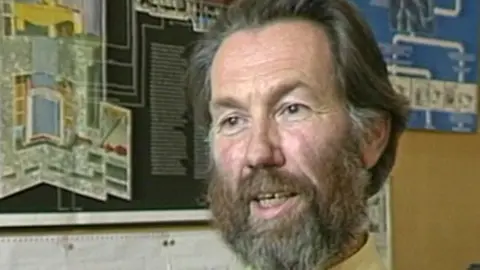
Bootyman says the experiment, which became a subject of special study for his physics students, also provided good lesson material for pupils in later years.
"I've taught successive pupil generations about our measuring with a VHS video of a TV programme that featured us, the BBC's Take Nobody's Word For It," he says.
"We played it so many times and used it for teaching until one day, finally, it degraded."
Allow Facebook content?
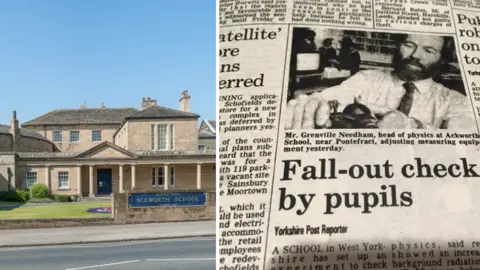
Speaking to the New Scientist magazine in 1986, Grenville Needham, the school's head of department, talked about the media interest the school's testing provoked.
"We stole a march on everyone around us when we monitored the local level of radiation in the atmosphere during the crisis," he said at the time.
"After four days of what seemed to be valid results, the press, radio and television descended on our school, fascinated that an ordinary secondary school could be collecting the sort of data they thought was to be had only from such grand bodies as the NRPB."
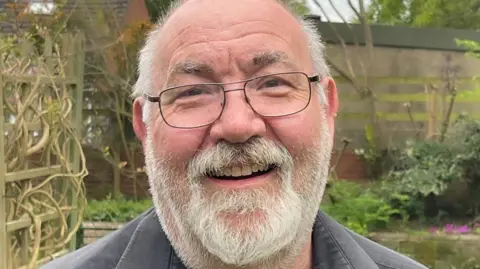 Tom Bootyman
Bootyman described the attention on the school at the time as "absolute pandemonium".
"My boss Grenville was giving media people 15-minute slots in the laboratory for him to talk to while I was marshalling the queue in the corridor outside," he says.
Needham, who died in 1999, shared his surprise with the BBC in 1986 about how ahead of the game the school was.
"We still find it rather difficult to believe we were the only people around here who were monitoring and who have a record of the level of radiation," he said.
"It was a very important demonstration about the way we can use school equipment, particularly in the case of an emergency, and its there to check in a straightforward, simple way, something even the experts may get wrong."
Listen to highlights from West Yorkshire on BBC Sounds, catch up with the latest episode of Look North.
