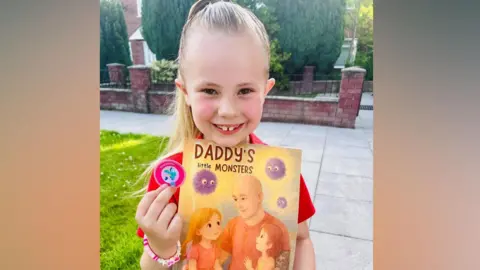
Schoolgirl, 6, writes book about dad's terminal cancer diagnosis

 Family handout
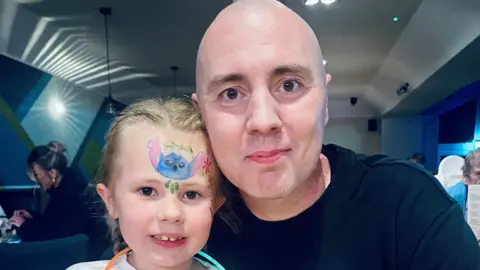
When Chris Capstick was diagnosed with cancer three years ago, his family made the decision not to use the word c-word in the house.
Instead the disease was known as "daddy's little monsters" for the benefit of his two youngest children.
But in November, Chris, from Bromborough in Wirral, was given the heartbreaking diagnosis at the age of 40 that the cancer was terminal.
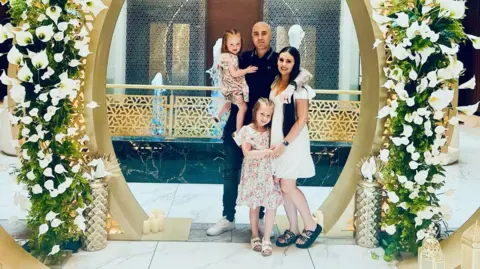
His wife Lauren said she knew she had to help her children understand what was to come, while not terrifying them about the reality of terminal cancer.
"It was really, really hard," said the 30-year-old, who works as an arts coordinator for young people but has taken time away to support her husband.
"Hearing the word terminal…you've kind of got to get yourself ready in a way and prepare yourself. I suppose you start like a grieving process.
"Having a six-year-old and a two-year-old, we didn't really know how to navigate it."
 Family handout
This is when the idea of writing a rhyming storybook with their eldest daughter Isabella, who is now aged six, was born.
"We thought what a great thing to do little cartoon monsters in a way that aren't scary," said Lauren.
"The book's very subtle. Isabella doesn't even know the word - we haven't told her that word."
Isabella wanted to write the book from her own perspective with lots of colourful illustrations on each page.
"We actually kept it from Chris," said Lauren.
"We didn't tell him about it and we gave it to him on Father's Day. He was speechless. He didn't know what to say.
"He didn't know whether to read it there and then because obviously the front cover said 'Daddy's little monsters' he knows that is what she knows [about the cancer].
"He just told her how proud he was and we're both so proud of her."
The book project has helped to keep the conversation flowing about how Isabella was feeling.
"It has actually stopped her from closing off emotionally, so she's very, very open with her feelings and questions towards the diagnosis," said Lauren.
While the book was initially to help their own family, it is now available to buy on Amazon after a family friend suggested that it could also help others facing similar circumstances.
"We just weren't expecting it to blow up, to be honest," she said.
"It's been up for a week and she has sold 138 copies."
 Family handout
About one in 29 children and young people aged five to 16 will face a bereavement at some point in their childhood of a parent or sibling, according to the Childhood Bereavement Network.
That is roughly one per class.
For those diagnosed with cancer, the impact of their diagnosis on families is often one of their biggest worries.
'Ask me anything'
June Davis, lead nursing and allied health professional adviser at Macmillan Cancer Support, said there was no right or wrong way to discuss a cancer diagnosis with children.
"People often feel that talking to children will make them worry but it is important to give them the chance to talk openly about their fears and worries," she said.
"Parents could also consider using simple language and keeping the information relevant to what is happening now rather than what may happen in the future.
"It's always a good idea to give children the option of asking questions and talking about how they feel."
She said for younger children, it can be helpful to use simple explanations and familiar terms.
"Don't feel you need to cover everything at once but do try to keep the conversation on-going by perhaps saying – 'you can always ask me anything, even if you ask it again'," she said.
"This can help surface any worries they may have such as, for example, cancer being something that they might catch.
"Reassure them where you can, that their routines will continue."
Listen to the best of BBC Radio Merseyside on Sounds and follow BBC Merseyside on Facebook, X, and Instagram. You can also send story ideas via Whatsapp to 0808 100 2230.
