Police chief considers joining legal action over PC Harper killers' early release

 PA Media
The chief constable of Thames Valley Police says he will consider joining legal action to block the release of two of PC Andrew Harper's killers.
Chief Constable Jason Hogg told the BBC he was in talks with the Police Federation of England and Wales over the matter, adding public opinion on their potential release was "overwhelming".
PC Harper, who served with Thames Valley, was killed in 2019 when he was dragged by a car down a country road as three teenagers fled the scene of a quad bike theft in Berkshire.
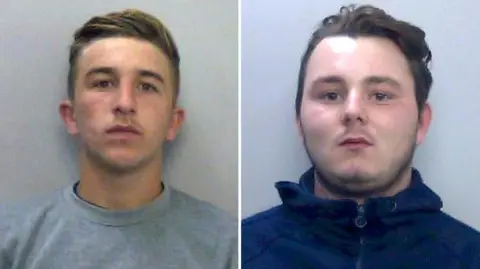
The two passengers in the car, Jessie Cole and Albert Bowers, were sentenced in 2020 to 13 years for manslaughter and could apply for early release after serving half of their sentences.
 PA Media
The driver of the vehicle, Henry Long, received a 16-year sentence and is not eligible for early release.
Speaking on the Today programme, Thames Valley Police chief Jason Hogg urged the government to reconsider its position.
Only prisoners convicted of murder, rape, grooming, and serious child sex offences will be excluded from the scheme in England and Wales - while those convicted of manslaughter remain eligible.
"I fully understand the challenges around the crisis in the prison system," he said.
"But the decision made and where that line has been drawn, I do not believe that people responsible for taking the life of another citizen in our country should be released early."
He said: "I was informed yesterday that the Police Federation are considering legal action, I am in discussions with the Police Federation with regards to this matter".
Asked whether this meant he would join them, he said: "I think we need to get some legal advice in relation to this. This is something I certainly would consider."
Following PC Harper's death and a campaign by his widow Lissie, Parliament passed "Harper's Law", which gives mandatory life sentences to the killers of emergency services workers. It also doubles the maximum penalty from 12 months to two years for those who assault police or other emergency workers.
But the new rules - introduced in 2022 - did not apply retrospectively to the sentencing of PC Harper's killers, and so do not prevent them from being released early.
Hogg said: "The law isn't retrospective and we all understand that, but the fact that they are released early simply seems perverse."
Aileen O'Connor, branch chairman of Thames Valley Police Federation told BBC Breakfast her organisation was exploring whether legal action was an option.
"If it is an avenue we can explore then I'll get behind that 110%," she said.
As for what shape a potential legal challenge might take, she said: "Ultimately that's for the specialists, the barristers and those in that legal sector to make that decision whether there is a challenge there.
"If there is a challenge then we will look to take that challenge."
Sentencing minister Jake Richards told the BBC it would be wrong to pick out individual cases and block two of PC Harper's killers from early release.
Although the government had reviewed what sentences would be excluded from the early release scheme, he confirmed "manslaughter is not one of those offences".
On Wednesday the Ministry of Justice released a new list of exclusions that will be exempt from the early release scheme.
It said rapists, as well as criminals sentenced for child sex offences and grooming and conspiracy offences for these crimes, will no longer be eligible to leave prison early.
Murderers and terrorists were already not eligible for the early release scheme.
Richards said: "It would be wrong to pick out individual cases within different offending cohorts. That wouldn't be right. It wouldn't be lawful either. So it is correct that those two individuals will be subject to the new regime from October".
Any legal challenge would have to be heard in the High Court, where ministerial decisions are reviewed.
Judges would have to be convinced that the government's choice of who gets out and who remains inside was either totally unlawful because they did not have the power to decide - or so irrational that it failed a legal test for reasonable decision-making.
Crucially, judges do not rule against a minister just because they do not like the choice they have made - there has to be a clear legal flaw in how they went about it.
Met Police commissioner Mark Rowley said the PC Harper case has had "a chilling effect on the confidence of police officers when they see a justice system that's not prepared to support their bravery".
On Tuesday Justice Secretary Alex Norris said the government wanted to go further but warned that a prison capacity crisis would be likely if fewer prisoners were allowed early release.
Norris apologised to families who would be affected by the early release scheme and stressed that the government wanted to go further "but we cannot".
"We have to make this decision, we've been able to make some changes to it, but we have to have the rest of the sentencing act changes otherwise we run out of prison places in November and that can't happen," he said.
The justice secretary said 5,000 extra releases will take place in 10 batches from October.
Approximately 1,000 prisoners will now not be released early following the revision to the scheme, he clarified.
The government also announced an extra £10m will go to front-line victim support services, including a new national helpline.
Additional reporting by home and legal correspondent Dominic Casciani
