It's time for the Eurovision grand final - here's what you need to know

 EPA
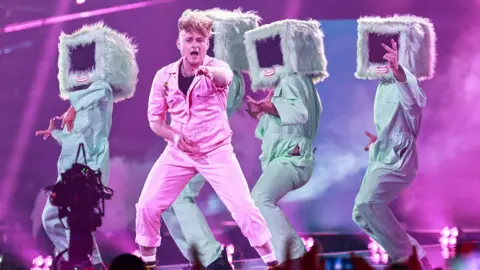
EPAThe grand final of the 70th Eurovision Song Contest takes place in Vienna on Saturday evening.
Acts from 25 countries will compete, with bookmakers suggesting Finland, Greece and Australia are among the favourites.
The UK is represented by high energy electro-pop musician Sam Battle, performing under the name Look Mum No Computer.
A number of countries are boycotting the contest over Israel's participation.
What is the Eurovision Song Contest?
The Eurovision Song Contest is an annual televised competition organised by the European Broadcasting Union (EBU).
Songs must be original and no more than three minutes long. They cannot have been released or publicly performed before 1 September 2025.
Lead vocals must be live, with no lip-syncing or auto-tuning allowed and a maximum of six singers and dancers on stage.
Most but not all Eurovision participants are European countries.
Israel can compete because its national broadcaster Kan is a member of the EBU.
Australia takes part every year after being invited to join the contest's 60th anniversary celebrations in 2015.
However, the rules state that Australia cannot host Eurovision should it win.
When is the 2026 Eurovision Song Contest grand final and who is competing?
 Reuters
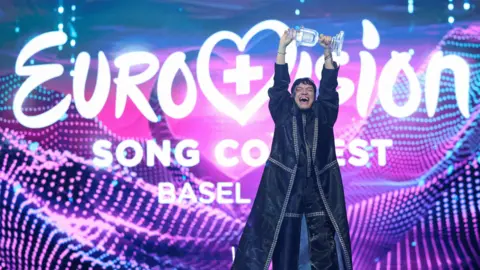
The grand final will be held in the Wiener Stadthalle in Vienna on Saturday 16 May. TV presenter Victoria Swarovski and actor Michael Ostrowski will host.
Singer La Voix will deliver the results of the UK's national jury live from Salford.
Semi-finals were held in the days beforehand.On Tuesday, the qualifying acts were Belgium, Croatia, Finland, Greece, Israel, Lithuania, Moldova, Poland, Serbia and Sweden.They were joined on Thursday by Albania, Australia, Bulgaria, Cyprus, Czechia, Denmark, Malta, Romania, Ukraine and Norway.
There are also five acts who automatically qualified for the final: 2025 winner Austria plus the UK, Italy, France and Germany, who all provide extra financial support to Eurovision.
How do I watch Eurovision 2026?
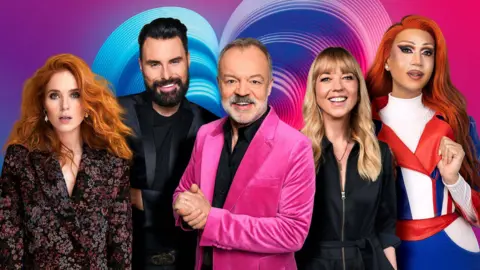
The Eurovision grand final is on BBC One and BBC iPlayer from 20:00 BST on Saturday 16 May.
Graham Norton will oversee proceedings.
Audio description will be available on BBC iPlayer and BBC One. Live British Sign Language (BSL) interpretation will be available on the Red Button and iPlayer, while subtitles will be available on BBC One and signed coverage on iPlayer.
Who is the UK Eurovision entry Look Mum No Computer?
Look Mum No Computer is solo artist, songwriter and YouTuber Sam Battle.
He will perform the song Eins, Zwei, Drei.
He previously performed as frontman of indie rock band Zibra, which appeared at Glastonbury 2015 as part of BBC Introducing.
"I find it completely bonkers to be jumping on this wonderful and wild journey," he said.
"I have always been a massive Eurovision fan, and I love the magical joy it brings to millions of people every year, so getting to join that legacy and fly the flag for the UK is an absolute honour that I am taking very seriously."
Sam is also described as "an inventor of unique musical machines".
The singer-songwriter has his own museum in Ramsgate called This Museum is (Not) Obsolete. It includes a vintage Game Boy which he has programmed to play a 100-year-old church organ.
Why is Israel's participation controversial?
Tensions have grown over Israel's participation in Eurovision in recent years because of the war in Gaza.
Spain, Ireland, the Netherlands, Iceland and Slovenia decided not to participate in the 2026 contest - the biggest boycott in Eurovision's 70-year history.
Israel's Eurovision 2026 contestant Noam Bettan told the BBC he was surprised by protests that disrupted his semi-final performance.
Several audience members - including one with "Free Palestine" written across his chest - were removed after chants of "stop the genocide" were heard during the song.
During the 2025 final in Switzerland, two people attempted to storm the stage and throw paint over Israel's contestant, Yuval Raphael. They were stopped by crew members and later arrested.
A number of countries also raised concerns after Raphael came top of the public vote in 2025 - finishing second overall after jury votes were taken into consideration.
Reports suggested that an Israeli government agency had paid for adverts and used state social media accounts to encourage people to vote for its entry.
Eurovision - which describes itself as non-political - has consistently resisted calls for Israel to be excluded. But it has changed the voting rules for the 2026 contest to limit the influence of governments on the results.
Director Martin Green told the BBC he agreed that "some of the promotion by some of the broadcasters [in the past] was a little disproportionate".
He said that organisers are watching this year's voting patterns contest "very, very carefully," but defended the integrity of the current system.
Israel previously said the decision to let it take part was a "victory" over critics who had tried to silence it and spread hatred.
How does Eurovision voting work?
 Getty Images
In the final, every participating country is awarded two sets of scores: one from a jury of music experts and one from fans.
For the 2026 contest, fans have a maximum of 10 votes - down from 20 - which they can cast by phone, SMS or via the official Eurovision app. They can vote for as many different acts as they like, but cannot back their home country.
Each country awards 12 points to its most popular song while the second choice gets 10, and the rest are scored from eight to one.
Votes from viewers in non-participating countries are combined into a single bloc known as the "rest of the world" vote.
Jury votes will be added to the public vote to decide which countries qualify for the final. Previously, jury votes were only used in the grand final itself.
The contest organisers also said that better technical monitoring would help "detect and prevent fraudulent or coordinated voting activity, and strengthen monitoring of suspicious patterns".
