'Our support dog has been life-changing'

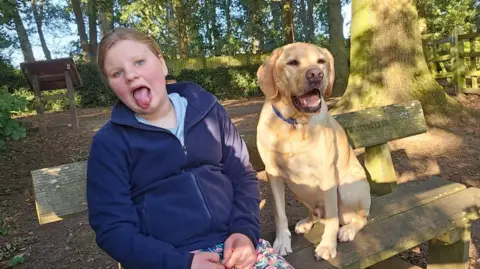 Family handout
Adding a labrador into family life can occasionally cause chaos, but for Laura and Miles Charlton the role of Rodney has been crucial.
Rodney has been helping their daughter Betsy, who has autism and global development delay, to live more safely and independently for the past four years.
With Betsy now 13 but still needing help every day, her parents, who live in Radcliffe-on-Trent, Nottinghamshire, said Rodney "has just changed our lives".
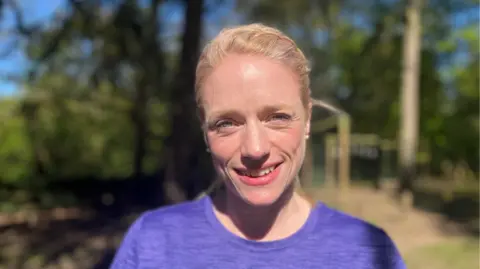
Laura is also running the London Marathon on Sunday in aid of Support Dogs, the charity that trained and provided Rodney, and has already reached her target of raising £2,500.
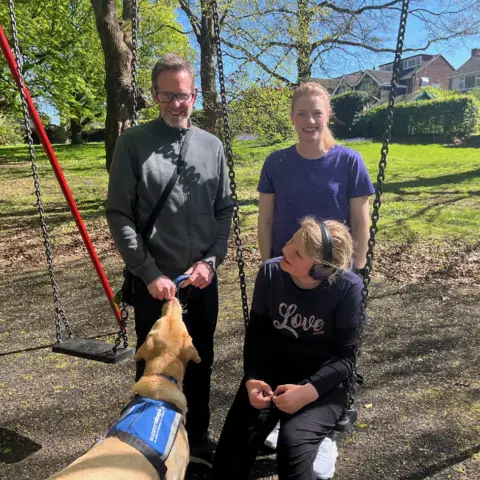
Betsy was diagnosed with autism at a young age and is classed as non-verbal, making communicating her feelings more difficult.
Like some autistic children, she has no sense of danger and often runs off without warning, potentially putting herself at risk, but with Rodney at her side she has been able to live more independently.
Charlton said the labrador's "phenomenal" support meant her daughter was able to enjoy things previously unavailable to her.
"Rodney has opened doors for Betsy to allow her to integrate and experience things and feel comfortable in environments she generally wouldn't have felt comfortable in," the 45-year-old said.
"It's really life-changing. I wouldn't want to think of life without Rodney, especially now Betsy is a teenager."
Miles Charlton said Rodney has become "one of the family", but still manages to have fun when not donning his support dog jacket and carrying out his official duties.
"When he hasn't got his jacket on he's a bit of a crazy dog - he's a massive goof, he'll just run and do 'zoomies', which is just running round and round the garden," he said.
"As soon as he's got his jacket on though he's so calm, so placid, and he's ready for working."
Danny Anderson, head of fundraising at Support Dogs, said it usually took about two-and-a-half years to fully train an animal, who then would work for an average of eight years before enjoying retirement.
"The impact they make during that career is absolutely incredible - these are more than just dogs, they are highly-skilled medical devices," he said.
"Each dog is different, and each child is different, but the impact is absolutely huge."
Listen to BBC Radio Nottingham on Sounds and follow BBC Nottingham on Facebook, on X, or on Instagram. Send your story ideas to eastmidsnews@bbc.co.uk or via WhatsApp on 0808 100 2210.
