How rare is it to see dolphins in our rivers?

 Vivian Stratton
A common dolphin attracted crowds after it was spotted tangled in netting in the River Orwell.
Rescuers disentangled it and hoped it would find its way back to sea. Sadly, this was not to be the case, and it later died.
Its cause of death will be determined by scientists in the coming days.
But why was the dolphin in the river in Ipswich, and how unusual is it for them to appear in freshwater urban environments?
What happened?
 BDMLR
BDMLRThe common dolphin was spotted in the water near Ipswich Railway Station - some 11 miles (17.7km) from the mouth of the River Orwell - on Wednesday afternoon.
Crowds gathered to catch a glimpse, but there was also concern that it was in the river at all, and appeared to have rope caught on its body.
The British Divers Marine Life Rescue (BDMLR), Suffolk Fire and Rescue Service and a marine vet were called, and the dolphin was disentangled a little further upriver, near the Sir Bobby Robson Bridge.
It had sustained minor wounds, but as it was able to breathe, swim strongly and was actively avoiding vessels, it was allowed to go on its way.
BMDR warned people to keep their distance because the mammal was in a "critical period of recovery" and did not need additional stress and distraction.
On Thursday, the dolphin was found dead by the BDMLR team, which said that despite being free, the animal "did not take the opportunity to leave with the tide".
Why do dolphins do this?
 Woolverstone Marina and Lodge Park
Dolphins are an offshore species found all over the UK but often come close to shore to feed, according to The Wildlife Trusts.
On Wednesday, the mammal had been seen swimming in circles and travelling some distance upriver in Ipswich. BDMLR said that behaviour was occasionally seen in some species of dolphin and harbour porpoises following food sources, so it was not always a cause for concern.
A spokesman for the charity Whale and Dolphin Conservation (WDC) said before the dolphin at Ipswich died, it may have got lost or may have been chasing an abundance of prey.
"As can often be the case, this individual may be sick," he added.
"If this is a common dolphin, then he or she will prefer to chase and feed on mackerel or herring, but they also like to be in groups, so it is a bit concerning that this individual is alone."
How common is it?
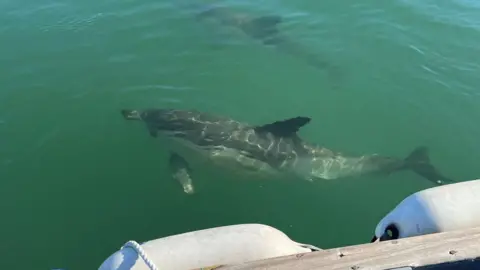 Woolverstone Marina and Lodge Park
WDC said it was not unusual for a dolphin or porpoise to swim upriver in the UK, but it was still an unusual sight.
Last year, a pod of dolphins was spotted in the River Orwell at a marina in Woolverstone, which is much further downriver and, crucially, the dolphins were seen frolicking in a group and thought to be following food sources. Common dolphins are used to depths of 200m (656ft), so the risk of stranding was a concern at the time.
In March, a dolphin also managed to make it to the depths of the Cambridgeshire Fens. Even a direct swim via the River Great Ouse in King's Lynn, Norfolk, would have involved a distance of some 28 miles (45km) through unfamiliar territory, including two major sluices. It had been monitored but disappeared and was found dead beside the New Bedford River at Mepal, near Ely.
At the time, Dan Jarvis, director of welfare and conservation at BDMLR, said it was "exceptional" to see a dolphin in that part of the county.
Other instances include when two dolphins swam 45 miles (72km) inland, to near Huntingdon. They both died. And in July, the Cetacean Strandings Investigation Programme said a dolphin had travelled the furthest west up the River Thames for a common dolphin. It was found dead at Richmond upon Thames.
What happens now?
 Suffolk Fire and Rescue Service
Initially, it was hoped that the Ipswich dolphin's story would have a happy ending.
However, the dolphin's body was later recovered from the river, and the BDMLR said it was found to be a male common dolphin measuring 2.2m (7.2ft).
Its body was placed into storage for the Cetacean Strandings Investigation Programme, which hoped a post-mortem examination would provide valuable scientific information about the animal's condition and cause of death.
Do you have a story suggestion for Suffolk? Contact us below.
Follow Suffolk news on BBC Sounds, Facebook, Instagram and X.
