Pickleball and protests: Trump visit stirs up world's largest retirement community
Some call the Villages - the largest retirement community in the world - "Disney without rollercoasters".
But descriptions of the Villages from residents themselves are even more effusive.
"It's like being at a resort on a full-time basis," says North Carolina transplant Betty Brock, 79. "I tell all my friends that don't live here, if you get bored in the Villages, it's not the Villages, it's you."
"The bottom line is, it's kind of like utopia," says 62-year-old Terri Emery, speaking against the backdrop of live music blaring from one of the Villages' five squares.
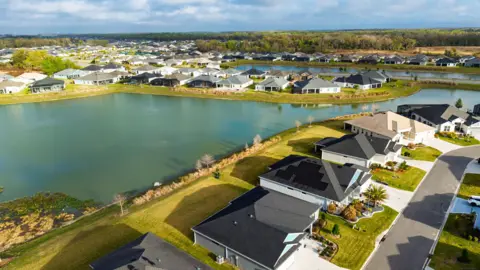
Spanning 30,000 acres, three counties and four zip codes, the Villages is a meticulously-landscaped master-planned community known for sunshine, socialising and an endless supply of recreational fun for those over the age of 55.
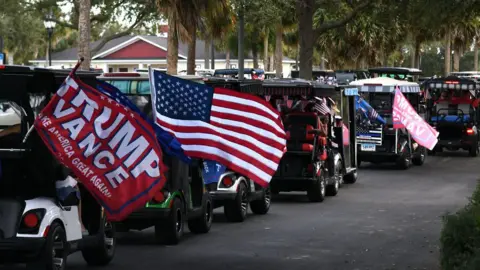
Behind Emery, fellow Villagers are dancing to covers of Livin' La Vida Loca and Man! I Feel Like A Woman. Nearby is a neatly parked row of colourful, personalised golf carts - the preferred mode of transport in this sprawling pensioners' paradise.
"You move here to be young; you don't move here to die and become old," says Emery, who's just finished dinner at a steakhouse down the street.
But even utopia has its no-go zones, apparently.

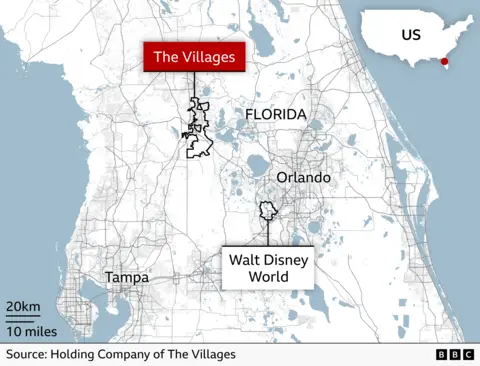
Since US President Donald Trump returned to office last year, politics have become an increasingly thorny issue in the Villages. The president is due to give a speech at a local rally on Friday, as part of his wider efforts to champion his economic policies with voters ahead of the midterm elections.
The speech has created a buzz in the community for very different reasons. Trump supporters are thrilled and honoured the president is visiting. Democrats - along with other Trump critics - are planning protests. But one thing they all agree on, at this point, is that it's better not to talk about it to each other.
"Everybody does still try to get along," says Maddy Bacher, 63, a Democrat originally from Connecticut. "You want to at least be able to say good morning and how are you and how's the dog.
"But… I find you don't socialise as much, and it's kind of difficult, because everything you do move to talk about might have a political consequence."
Politics, says North Carolina transplant Brock, does come up, but "not as much as you think, because you don't ever know where that line is".
 Getty Images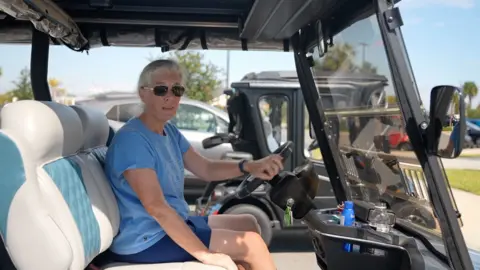
The community, which was founded in the 1970s, has been a reliable Republican stronghold, voting for Trump in all three of his electoral bids. While its retiree population remains heavily conservative, a whopping No Kings protest against Trump last month turned heads - with nearly 7,000 people participating across two Villages locations, according to local reports.
"Nothing turns out Democrats like Trump," says Democratic Club president Bill Knudson, who moved with his wife to the Villages four years ago. Knudson was "kinda stunned" at how many people appeared at a new members meeting held weeks after the president took office again.
"They had to go out of their way to find us," he adds.
While throngs of Trump supporters in the Villages were scrambling to get tickets to the speech on Friday, members of the Democratic Club were making signs and planning their protest.
The vast majority of Villagers use golf carts to get around, but the community is so expansive that it would take Knudson about an hour in his cart "going 20 miles an hour" to get to Trump's location. Everyone is grumbling about what the effect will be on traffic, and that - along with safety concerns - is keeping some people home on both sides of the political divide.
Those challenges won't deter Democrat Dorothy Duncan, though. The retired lawyer joined the No Kings demonstration, and she is choosing from a number of her protest signs for Friday's Trump appearance.
"There are certain issues you cannot be silent on," she says.
Still, Duncan is sitting outside Starbucks with a handful of other friends, including a staunch supporter of the president.
"What really attracted most people is his no filter," says Pittsburgh native Tom Samson, 81, the retired owner of a pest control business. "He doesn't have a filter and says whatever's on his mind, and he's not a politician."
The discourse is civil and the banter is friendly on this humid, overcast morning before Trump's visit, but such across-the-aisle political discussions are few and far between, residents say.
When Bob Carberry moved to the community 14 years ago, it was almost "apolitical," he says. But Trump's entry into politics changed all that, according to Carberry and nearly every resident who agreed to speak.
"The emotional level of politics is something that's emerged probably more so in the last five years with Trump," Carberry says.
Maddy Bacher recalls how one woman left her clay club – the Villages boasts more than 3,000 clubs for every pastime one could think of, from female fly fishers to parrot enthusiasts to alumni of different colleges – because of opposing opinions on the Covid booster.
That's part of the reason Bacher began a weekly pickleball game frequented only by fellow Democratic voters. Her husband, meanwhile, started a Democratic club golf group because "some people felt uncomfortable" with the right-leaning politics they encountered on the green.
For his supporters, Trump's arrival on Friday has become the hottest event in the calendar.
"He's a man that does do what he says he's going to do, and he may not be diplomatic, and he may not be charming, may not be politically correct, but he's doing what every president before him has promised to do when they're out there campaigning but have never done," says Sharlene, who declined to give her surname.
She's devastated that she'll have to work during the speech, but Republicans were organising watch parties - and discussing possible golf-cart parades - for those unable to attend. Phil Montalvo, 79, started a new Villages Republican club three years ago in addition to an already established one - cutting down commute times for conservatives living at different ends of the community.
"Everybody's jazzed," the retired lawyer says of Trump's visit. The president has garnered legions of fans in the Villages, Montalvo says, particularly for his "America First" message.
"We like America to be first, and that seems to be the glue that holds everybody together," he says. "And Trump, he's the orchestra leader on that, and everybody looks up to him for that reason – and strength."
While he acknowledges Democrats' increasing visibility in the community, he's not too worried about any liberal political sway.
 Getty Images
He uses Sumter County - one of the three in which the Villages sits - as an example to illustrate why. There are 23,000 registered Democrats, he says, in comparison with 77,000 registered Republicans.
"We're not sitting on our laurels, but we're not intimidated by that at all," he says of displays such as the No Kings protest. "It's great that they express themselves. We think they have the wrong message, but that's their prerogative."
Other die-hard Trump supporters are less magnanimous.
"It's absolutely disgusting," Emery says. "I think they're communists. The only king is the Lord. Trump is not a king. He's our president, and if you like him or not, he's still your president at the end of the day."
At dinner the other night, Emery and her dining companion struck up a conversation with another Trump supporter who'd become embroiled in a dispute with a neighbour. The neighbour took down the resident's Trump flag - prompting the indignant homeowner to call police.
 Getty Images
It's just another example of rising tensions that began in 2016, when Trump was first elected.
"We'd have a block party and things like that, and then… some of the people started putting up Trump flags," Democratic golfer Thomas Bacher says. "And that just caused a big rift. We didn't have block parties anymore. People wouldn't talk to each other anymore."
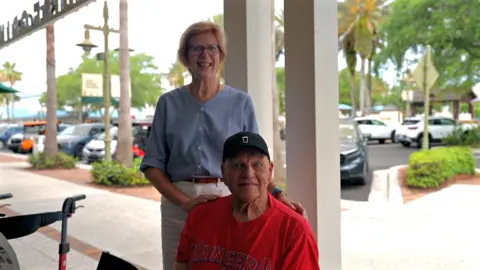
Roy Irwin, 82, moved to the Villages in 2012 - and quickly met fellow Villager Susan Prince at church. They've now been together 14 years.
When socialising locally, Irwin says, "I try to talk gently with everybody, no matter what their belief - respect their opinion." The Villages, he says, is "just like anywhere else - there's people [feeling] very strongly on both sides.
"It's really a microcosm of the country," Irwin notes.
Not everyone, however, has firmly chosen sides. Edward Hannan, 77, acknowledges the importance of the president's visit but won't be going, mostly to avoid the expected hours-long wait and TSA-like screening.
"I disagree with him on many things, but there are certain things that I like," says Hannan, a lawyer. "He has an organisational skill that, frankly, has not been evidenced in many of our American presidents. But, offsetting that, he is very, very aggressive.
"You should not denigrate people who disagree with you; you should reason with them."
He laments the absence of such discourse in the Villages; people either don't talk politics, he says, or only discuss it with those they know well or are certain to share their views.
"So that's a negative, because getting diverse ideas in a small group is difficult," he says.
Hannan calls himself "not fixated ideologically." When asked whether that makes him an anomaly in the Villages, he barely waits for the end of the question before resolutely blurting out his answer.
"Yes."
Video by Meiying Wu
